Do You Need a Thermostat for a Bearded Dragon Enclosure
A thermostat gets recommended the moment you bring up a basking bulb, but no one quite explains why or which type to buy. The short answer is yes, a bearded dragon thermostat belongs on every enclosure running a controllable heat source.
It is the only thing standing between a hot summer afternoon and a 130°F basking surface. The longer answer depends on which bulb you are running and where the probe sits.
This is not a bit of luxury kit. It is a safety device that pays for itself the first time your room temperature swings ten degrees and your dragon does not end up with a belly burn.
What a Bearded Dragon Thermostat Actually Does
A thermostat sits between your wall socket and your heat source. It reads the temperature at a probe you place inside the enclosure, and it adjusts how much power reaches the bulb to hold your target basking spot temperature steady.
Without one, the bulb runs at full power every second it is switched on. The basking surface climbs until something else stops it, which usually means the room getting warm or the bulb eventually failing.
With one, the bulb dims or pulses to maintain your set temperature regardless of what the room is doing. That is the entire job.
When You Actually Need One
Three situations make a thermostat non-negotiable rather than optional.
You are running a halogen or reptile basking bulb that produces heat the room cannot safely cap. Without control, a 75W halogen can push a surface to 120°F on a hot day and 95°F on a cold one. That swing is the problem.
You run night-time heat through a ceramic heat emitter because your room drops below 60°F in winter. A CHE at full power overnight in a small vivarium can climb to dangerous levels before morning.
You are a new keeper still learning to read temperatures and behaviour. The safety margin a thermostat provides is worth more to a beginner than to a keeper who has been watching probe readings for five years.
When a Thermostat Might Not Be Essential
A few experienced keepers skip the bearded dragon thermostat on mercury vapour bulbs, because MVBs cannot be dimmed without breaking them. They manage heat by bulb wattage and mounting height instead.
This works, but it demands daily monitoring and a cool room with stable ambient temperature. For most households, the failsafe of a controlled bulb beats the alternative every time.
The Three Thermostat Types Explained
Reptile thermostats fall into three categories, and matching the right one to your bulb matters more than brand or price.
| Type | Best For | Do Not Use With |
|---|---|---|
| Dimming | Halogen basking bulbs, reptile basking bulbs, deep heat projectors | Nothing, but overkill for a CHE |
| Pulse proportional | Ceramic heat emitters, radiant heat panels | Any light-emitting bulb (causes flashing) |
| On/off | Heat mats only (not suitable for beardies) | Halogens, CHEs, any reptile setup for a dragon |
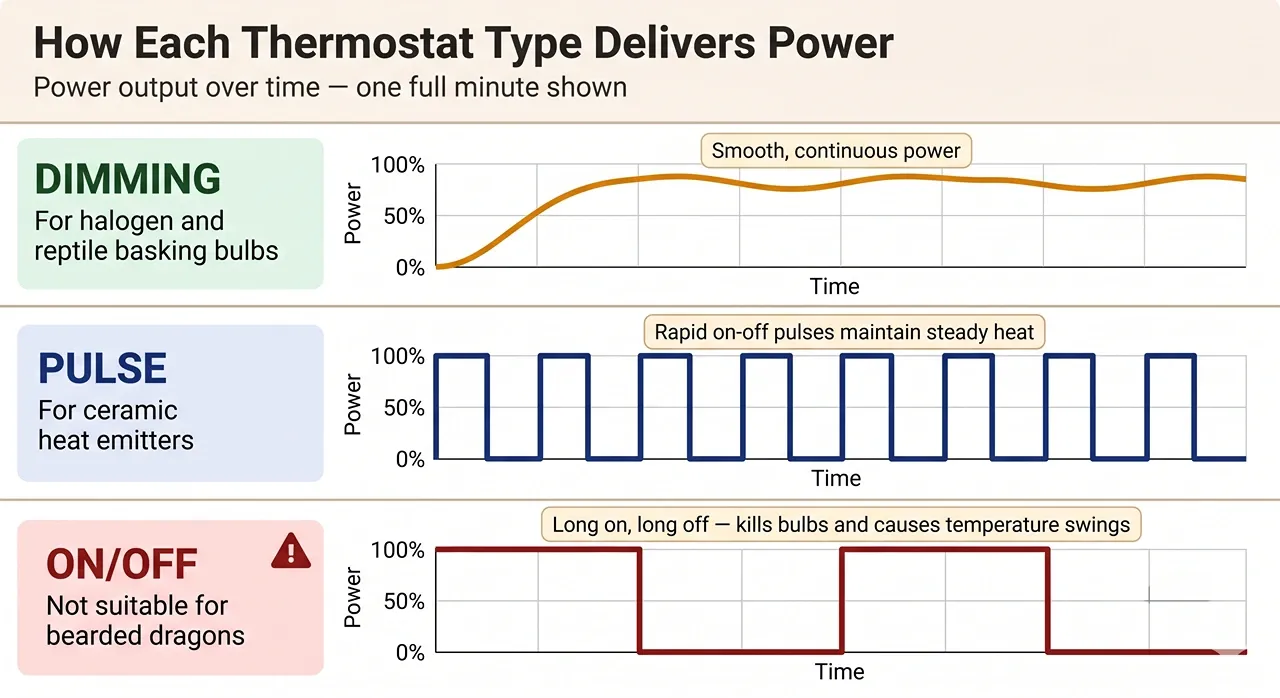
The difference between these three types comes down to how they deliver power to the bulb. A dimming stat smooths output continuously. A pulse stat bursts power on and off rapidly. A cheap on/off stat just slams the full supply in and out at long intervals. The graph below shows what each pattern actually looks like in real use.
Dimming Thermostats and Basking Bulbs
A dimming stat reduces the voltage reaching the bulb, which lowers the temperature smoothly. The bulb stays on constantly but adjusts brightness to hold your target.
This is the right tool for a halogen flood or a standard reptile basking bulb. It is also fine for a deep heat projector.
There is one catch most guides skip. If your bulb is too powerful for the enclosure, the thermostat will hold the temperature correct but the bulb will run dim. A dim basking spot is a weak basking spot visually, which matters because dragons use brightness as a cue to bask.
Pulse Thermostats and Ceramic Heaters
A pulse proportional bearded dragon thermostat sends short bursts of power rather than adjusting voltage. The bulb is either fully on or fully off, cycling quickly enough to hold a stable temperature.
This works brilliantly on ceramic heat emitters because CHEs do not emit light and do not care about flickering. Put a halogen on a pulse stat and you get a strobe light.
Pulse stats are the standard for night-time heat. Most modern units have separate day and night setpoints, so one stat on a CHE covers both day-end failsafe and overnight warmth.
Why On/Off Thermostats Fail Here
On/off or “mat” thermostats switch the heat source fully on or fully off at set thresholds. Cheap versions are sold for heat mats and are unsuitable for any bearded dragon setup.
Using one on a halogen will shorten the bulb’s life dramatically. The thermal shock of repeatedly slamming a filament on and off kills bulbs in weeks rather than months.
Probe Placement Most Keepers Get Wrong
This is where half the bearded dragon thermostat problems in the hobby actually come from. The probe tells the thermostat what to regulate, so its position defines your entire setup.
A probe sitting directly on the basking surface under the bulb reads radiant heat. That is what your dragon’s back is absorbing. This is the correct placement for a dimming thermostat controlling a basking bulb.
A probe hung in the air away from the bulb reads ambient enclosure temperature. That is useful for a CHE providing background warmth, but it will never accurately reflect the basking surface.
Probe Placement for a Dimming Stat
Mount the probe at basking surface height, directly beneath the bulb, on the basking platform itself. Not floating in the air. Not on the wall of the enclosure.
The probe should sit where the dragon’s back would be when basking, because that is the temperature you actually want to control.
Probe Placement for a Pulse Stat
Mount the probe in the cool zone or mid-enclosure, positioned to read ambient air temperature rather than radiant heat. A CHE warms the air, and you are regulating ambient warmth overnight.
Set the target to your night-time minimum (65–70°F for adults). The CHE only kicks in if the room drops below that threshold. You can read more about correct nighttime temperatures in the full bearded dragon heat at night breakdown.
Why You Still Need a Thermometer
A thermostat tells itself what the temperature is at the probe. That is one reading, at one location, and both components can fail.
A digital thermometer with a separate probe placed elsewhere in the enclosure catches the thermostat when it drifts. A digital infrared temperature gun lets you verify the basking surface directly, which is the gold standard.
Keepers who rely on the thermostat readout alone are one probe failure away from finding out their dragon has been basking at 85°F for two weeks. The full setup for verifying readings is covered in the guide on measuring bearded dragon temperature accurately.
Setting the Right Target Temperature
The thermostat is only as good as the number you type into it.
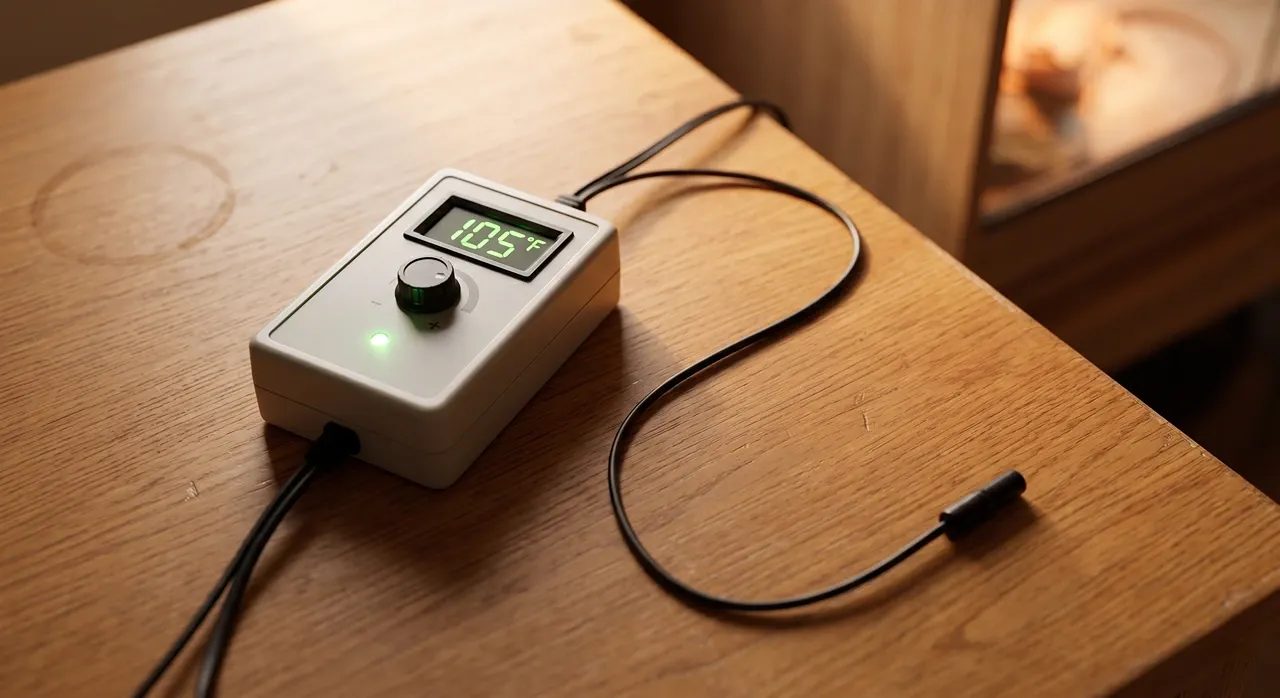
For a dimming stat with the probe on the basking surface, set it to 105°F for adults or 108°F for juveniles and babies. Verify the surface reading with an infrared gun before trusting the number.
For a pulse stat on a CHE with the probe reading ambient, set it to 65–70°F for night-time heat on an adult. Dragons tolerate cold nights better than most owners believe, and your daytime basking numbers do not change regardless of which bearded dragon thermostat you choose.
Common Thermostat Mistakes to Avoid
A few bearded dragon thermostat errors come up on reptile forums repeatedly, and each one is preventable.
- Running a basking bulb on a pulse thermostat, which causes the bulb to flash on and off
- Placing the probe near the cool end while trying to control the basking spot
- Buying a thermostat rated lower than the bulb wattage, which trips safety cutouts
- Assuming the thermostat readout is always correct without a backup thermometer
- Setting the target without first measuring what the surface actually reaches at that setting
- Leaving a thermostat running for years without checking probe accuracy
The last one catches experienced keepers as much as beginners. Probes drift over time. An annual sanity check with an infrared gun is cheap insurance.
What Wattage Thermostat Do You Need
Every bearded dragon thermostat comes rated for maximum wattage, usually 100W, 300W, or 600W. Match it to your bulb with headroom to spare.
A 75W halogen fits comfortably on a 100W-rated dimming stat. A 150W CHE needs at least a 300W pulse stat. Never run a bulb at more than 80% of the thermostat’s stated maximum.
If you run multiple heat sources from one thermostat, which some units support, the combined wattage must stay inside the rating.
Do Mercury Vapour Bulbs Need a Thermostat
No, and they cannot use one. Mercury vapour bulbs shatter or fail fast if dimmed or cycled, which is why they are always plugged directly into a timer.
Control temperature on an MVB by changing the mounting distance or stepping down to a lower wattage. This is one reason many experienced keepers have moved to halogen and separate UVB tubes, because the halogen can be thermostatted and the UVB runs independently on a timer.
Bearded Dragon Thermostat Recommendations
Brand tier matters more than price on thermostats. A cheap unit that fails closed leaves your bulb running at full power indefinitely.
Mid-tier dimming stats from Microclimate, Habistat, and Herpstat have decades of hobby track record. Budget units from major reptile brands work fine for backup or secondary roles but should not be the only thing between a bulb and a burnt dragon.
Avoid unbranded units sold with bargain setup kits. The failure modes on those are unpredictable, and probe accuracy is often poor out of the box.
Frequently Asked Questions
Can you thermostat a mercury vapour bulb?
No, mercury vapour bulbs cannot be thermostatted because dimming or cycling damages the arc tube. Control temperature with bulb wattage and mounting height instead, and verify with a digital thermometer.
What temperature should I set the thermostat to?
For a dimming stat with the probe on the basking surface, set 105°F for adults or 108°F for juveniles. For a pulse stat on a CHE reading ambient, set 65–70°F for night-time heat on an adult.
Where do you place the thermostat probe?
For a dimming stat controlling a basking bulb, mount the probe on the basking surface directly beneath the bulb at the dragon’s back height. For a pulse stat on a CHE, mount the probe in the cool zone to read ambient air.
Can I run two bulbs on one thermostat?
Yes, if the combined wattage stays under 80% of the thermostat’s rated maximum and both bulbs are the correct type for that thermostat. Two halogens on one dimming stat is common and works well.
Do I need a thermostat on UVB?
No, UVB tubes run on a timer, not a thermostat. UVB output is not temperature-controlled and thermostatting a UVB tube would damage both the stat and the bulb.
Your Thermostat Setup Checklist
- Identify your heat source. Halogen or reptile bulb needs a dimming stat, CHE needs a pulse stat.
- Buy a thermostat rated for at least 25% more wattage than your bulb draws.
- Mount the probe on the basking surface for a dimming stat, or mid-enclosure for a pulse stat on a CHE.
- Set the target temperature appropriate to the probe location. Surface readings and ambient readings take different numbers.
- Verify the actual basking surface with an infrared temperature gun before trusting the thermostat readout.
- Install a secondary digital thermometer with an independent probe as a failure backstop.
- Check probe accuracy once a year by comparing the readout to a known-good thermometer in the same spot.
Written by
Sarah ArdleySarah has kept bearded dragons for over ten years. She founded Beardie Husbandry after discovering that most mainstream care advice — including what she followed with her first dragon — was doing more harm than good. Every article on this site is grounded in veterinary research and real keeper experience.