How to Measure Bearded Dragon Temperature And Humidity
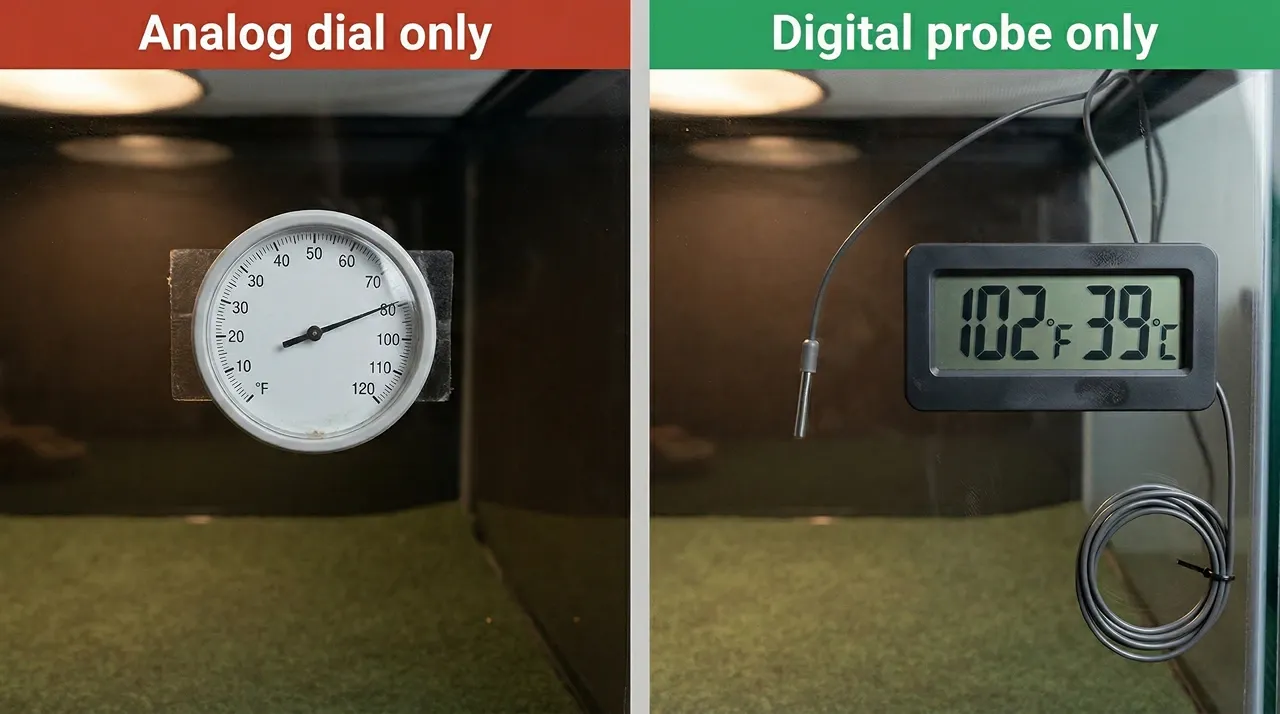
The analog dial thermometer stuck to most starter enclosures is the single most common cause of temperature problems in bearded dragon setups. Owners trying to measure bearded dragon temperature with these gauges are often reading figures that are 10, 20, or in some high-wattage setups, up to 40 degrees off from what’s actually happening inside the tank.
That’s not a rounding error. A dragon basking on a surface that your dial reads as 105°F could be sitting on something closer to 130°F. Getting this right takes the correct tools, placed in the right locations, reading the right things.
Why Analog Gauges Are Wrong
The bimetallic coil inside a dial thermometer responds to heat, but it lacks the precision needed for reptile husbandry where a five-degree error at the basking end has real consequences. The dial reads whatever temperature the air directly around the gauge face happens to be, which is rarely the temperature your dragon actually experiences.
At low-wattage setups, analog gauges have been tested with errors of 5 to 7 degrees. At higher wattage, documented reptile hobbyist testing has recorded errors approaching 40 degrees Fahrenheit. That’s the gap between a basking spot your dragon can safely use and one that burns belly skin.
Stick-on thermometer strips are worse still. They measure the temperature of the enclosure glass itself, not the air or any surface inside the tank. Glass conducts and radiates heat differently from the enclosure interior, so the strip reading reflects the panel, not your dragon’s environment.
The Three Tools Every Setup Needs
No single instrument gives you a complete picture of conditions inside the enclosure. You need three, each doing a job the others can’t replicate.
An IR Temp Gun for Basking Surfaces
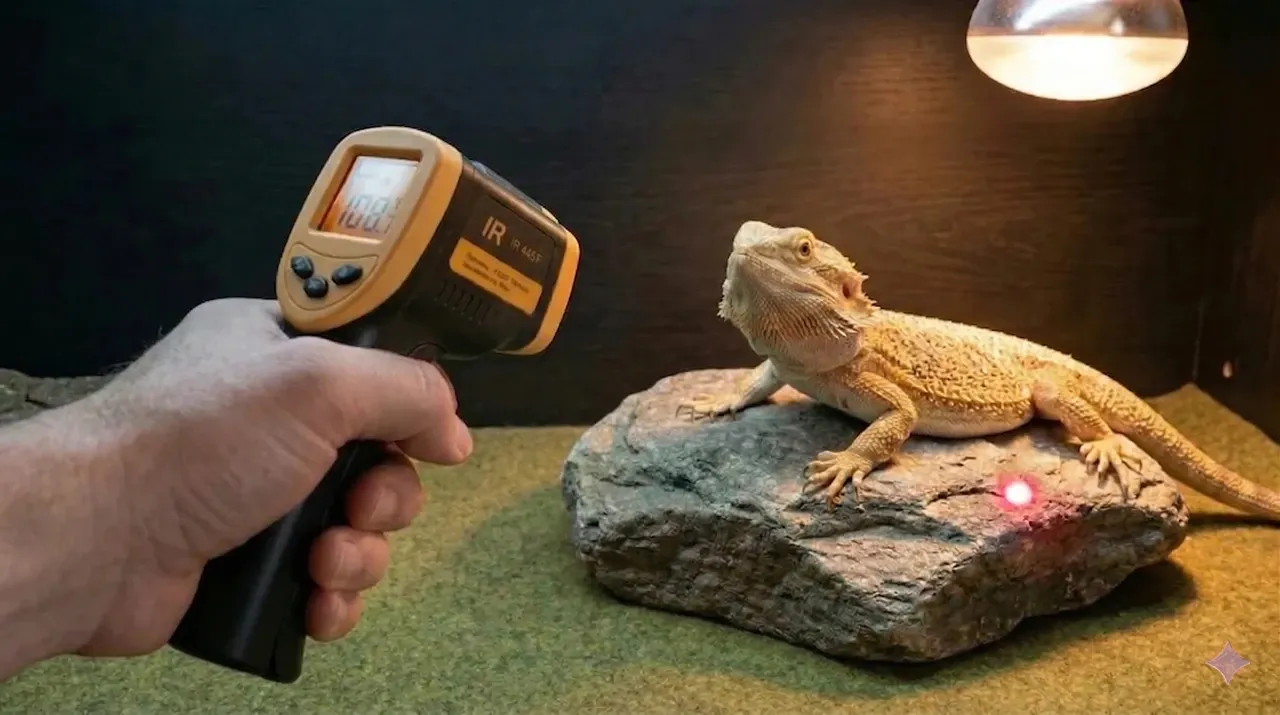
An infrared thermometer reads surface temperature the moment you point and press. It measures the infrared energy radiating from any solid object, which makes it the right tool for checking the rock, tile, or branch your dragon physically sits on during basking.
The firm limitation: an IR gun cannot measure air temperature. Pointing one at open air returns a meaningless number. Use it on surfaces only.
You don’t need a reptile-branded model. A kitchen or HVAC infrared thermometer from a hardware store reads just as accurately and usually costs half the price of pet-branded equivalents. Any unit covering a range up to at least 480°F (250°C) handles every zone in a bearded dragon enclosure without issue.
A Digital Probe Thermometer for Air Temperature
A probe thermometer with a thin wired sensor measures ambient air at the exact location you position it. This is how you read the thermal gradient across the enclosure, confirming the cool side is genuinely cool and the air in the basking zone is at the right temperature for your dragon to breathe and circulate.
For a bearded dragon setup, two simultaneous air readings are the standard: one at the basking end and one at the cool end. A dual-probe unit handles this in one device; two single-probe thermometers work just as well. A min/max memory function is worth having, since it shows you the highest and lowest temperatures recorded while you weren’t watching.
Probe thermometers are also how you verify that your heating equipment is performing as expected. The thermostat display shows the temperature at its own sensor position, which may not match the air temperature at the locations that matter for your dragon. A thermostat and thermostat sensor paired with a separate probe thermometer is a much more reliable combination than relying on the thermostat’s own readout alone.
A Digital Probe Hygrometer for Humidity
A hygrometer measures water vapour in the air. For a bearded dragon enclosure, you want a digital unit with a probe you can position independently of the display, so the sensor sits where the reading is representative while the display remains visible outside the tank. Analog hygrometers drift the same way analog thermometers do.
Combo units measuring both temperature and humidity from a single probe are a practical option and save space on the glass. Check that the unit has a probe rather than a fixed face sensor, otherwise you can’t place it where each reading is most accurate.
Surface Temperature Is Not Air Temperature
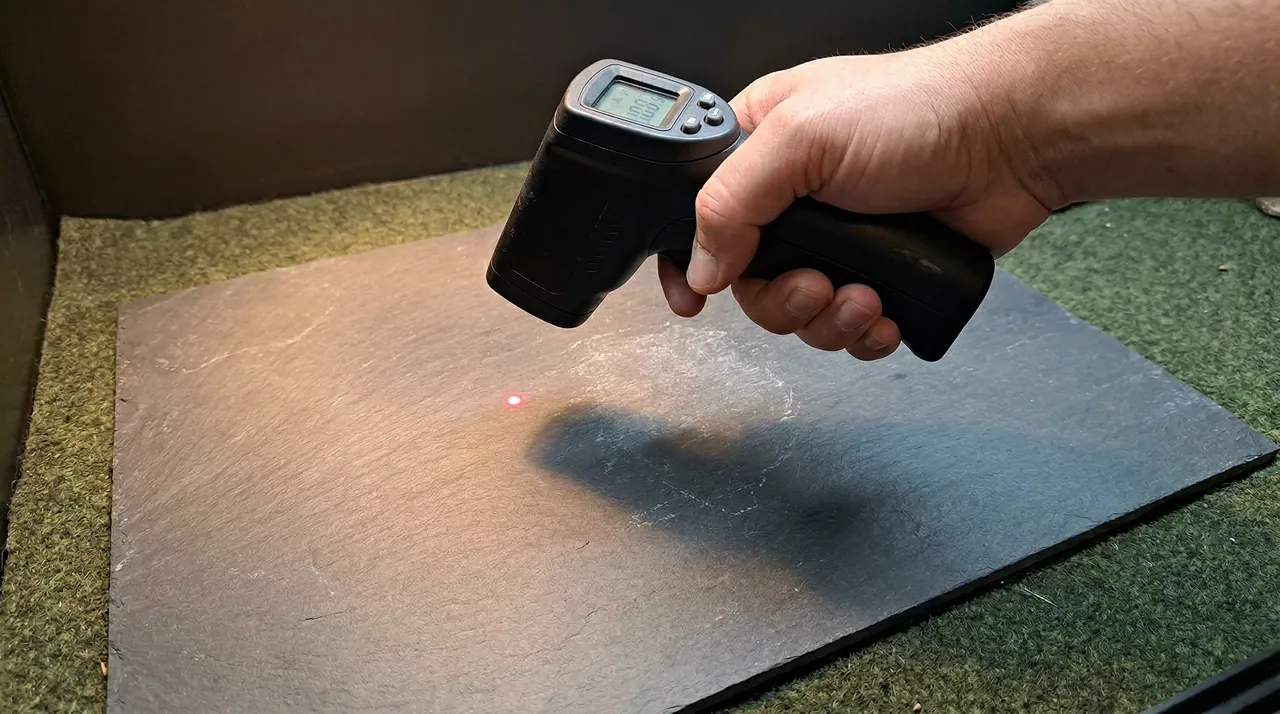
This is the distinction that most care guides gloss over, and it’s the most important concept in bearded dragon temperature measurement. Your dragon regulates its core body temperature mainly by pressing its belly against warm surfaces, not by breathing warm air. The surface contact point is the primary heat transfer mechanism.
Bearded dragons are ectotherms, relying entirely on external heat sources to reach the body temperatures needed for digestion, immune function, and normal behaviour. VCA Animal Hospitals notes that these animals maintain internal temperature entirely through selective movement between warmer and cooler areas, with the basking surface serving as the primary warming method.
What this means in practice: the basking surface temperature your dragon physically contacts is the reading most directly affecting its health at any given moment. The air temperature above and around that spot is a separate measurement, equally necessary but different in what it tells you.
An IR gun gives you the surface reading. A probe thermometer gives you the air reading. Running one without the other leaves a gap in your data that you can’t compensate for by guessing.
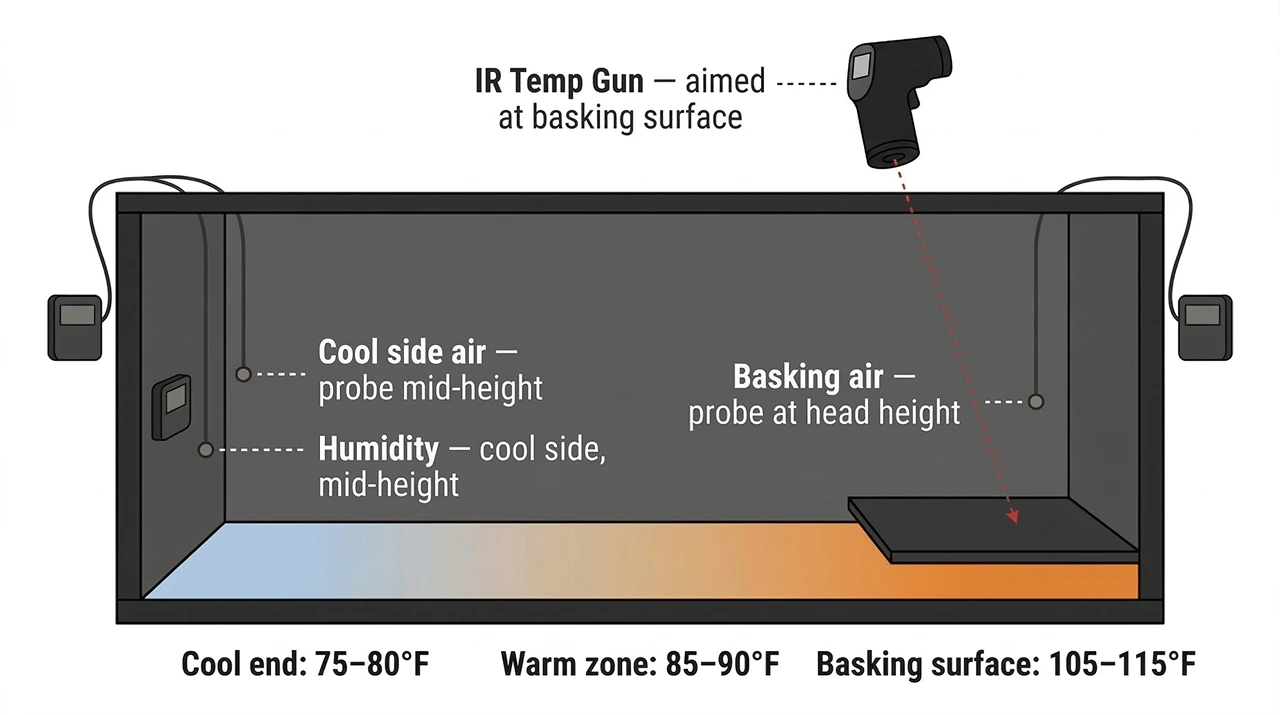
Where to Place Each Tool
Each tool does a specific job at a specific location. Using the IR gun to check air temperature or placing the hygrometer probe at the basking end produces numbers that look plausible but mean nothing for your dragon’s actual conditions. Position matters as much as the tool itself.
| Measurement | Tool | Placement |
|---|---|---|
| Basking surface | IR temp gun | Aim directly at the surface your dragon rests on, from above. Point at the centre of the basking spot, not the edge. |
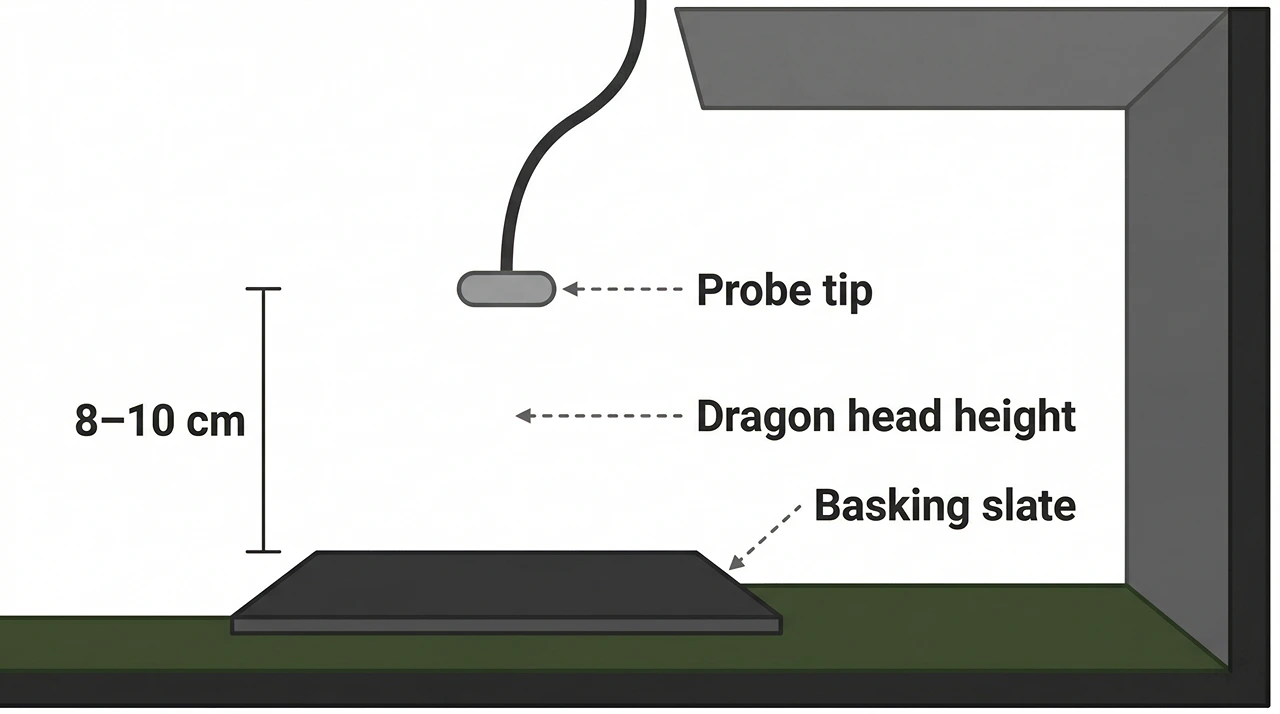
| Basking zone air | Probe thermometer | Position the probe approximately 3 to 4 inches above the basking platform, at the height your dragon holds its head while basking. |
| Cool side air | Probe thermometer | Opposite end of the enclosure, mid-height, clear of the glass wall. |
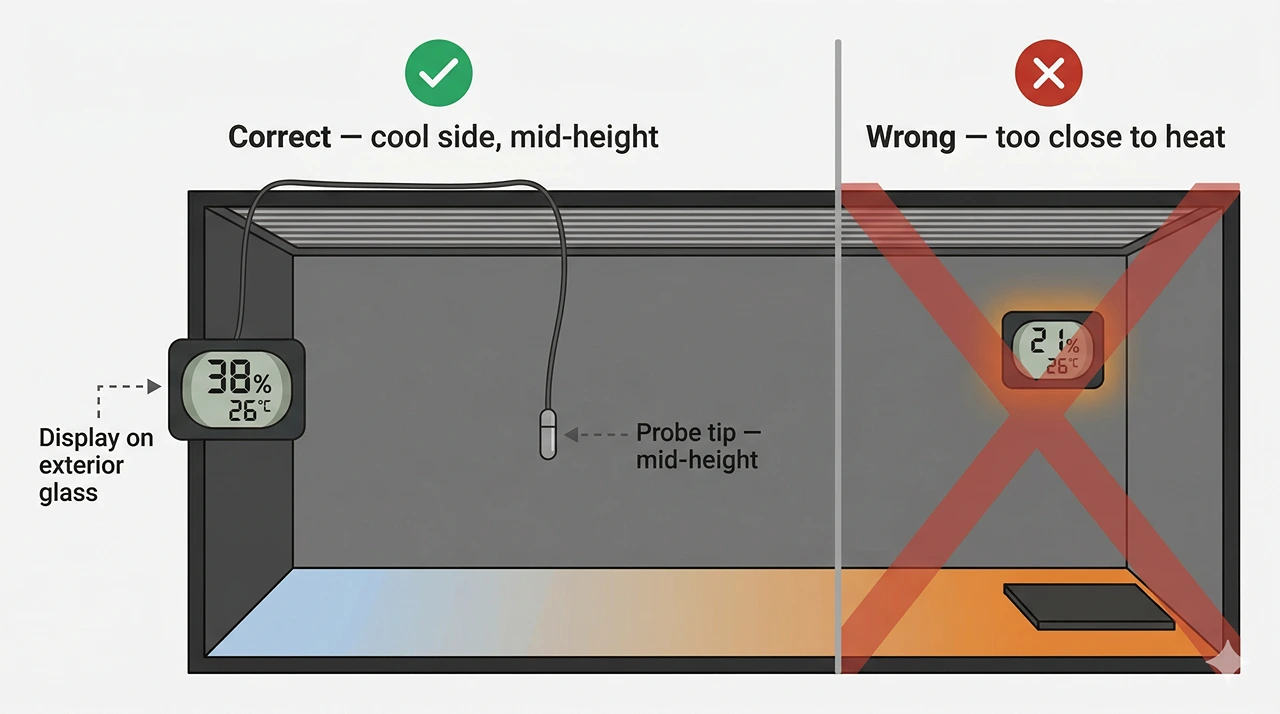
| Humidity | Probe hygrometer | Cool side, mid-height. The hot side reads artificially low because heat reduces relative humidity. |
Keep probes clear of the glass where possible. Glass conducts heat from outside the enclosure, and a probe touching the panel may read the glass temperature rather than the air inside the tank, skewing your gradient data.
Temperature Targets by Zone
| Zone | Adult | Juvenile | Baby (0 to 6 months) |
|---|---|---|---|
| Basking surface | 105–115°F (40–46°C) | 105–115°F (40–46°C) | 110–115°F (43–46°C) |
| Basking zone air | 95–105°F (35–40°C) | 100–105°F (38–40°C) | 100–110°F (38–43°C) |
| Warm side air | 85–90°F (29–32°C) | 85–90°F (29–32°C) | 85–90°F (29–32°C) |
| Cool side air | 75–80°F (24–27°C) | 75–80°F (24–27°C) | 75–80°F (24–27°C) |
| Nighttime | 65–75°F (18–24°C) | 65–75°F (18–24°C) | 70–75°F (21–24°C) |
Babies operate at the higher end of every range and have less tolerance for cool-side temperatures dropping below 75°F, where digestion slows noticeably. Temperature accuracy matters most during this period, and the full care requirements for hatchlings cover the broader husbandry context behind those tighter thresholds.
How to Measure Humidity Correctly
Measuring humidity in a bearded dragon enclosure is more nuanced than it looks. The target is 30–40% during the day, but that number is meaningless if the hygrometer probe is positioned poorly.
Placing the probe near the basking lamp returns a reading lower than the actual humidity elsewhere in the enclosure. Heat reduces relative humidity, so the air directly under a high-wattage basking bulb reads as drier than it is at the other end of the tank, even when the absolute moisture content in the air is identical.
The cool side, mid-height placement gives the most representative reading of the overall enclosure humidity. If you have a second probe, placing one on each end gives you the full picture of what your dragon experiences across the gradient.
Humidity consistently above 50% for extended periods creates conditions that can contribute to respiratory infections, particularly when ventilation is poor. High readings usually point to one of three sources: a water dish sitting too close to the heat source, inadequate enclosure ventilation, or room humidity affecting the tank through a poorly vented screen top.
Why Humidity Spikes After Lights Off
When your basking and UVB lamps turn off at night, the enclosure cools down and relative humidity rises. Cooler air holds proportionally more moisture as a percentage, so the same amount of water vapour registers as higher humidity at a lower temperature. This is expected and normal.
An enclosure reading 35% at peak basking time might climb to 50–55% by midnight. That’s not a problem. If you’re seeing sustained nighttime readings above 60%, check for moisture sources, particularly substrate retaining water from a recent bath or a water dish that doesn’t evaporate freely during the day.
Measuring Bearded Dragon Temperature at Night
Nighttime temperature is something many keepers don’t track closely enough. An enclosure cooling below 65°F at night isn’t immediately dangerous for a healthy adult dragon, but sustained cold nights slow metabolism, disrupt digestion, and can push a dragon into early brumation behaviour when no true seasonal cycle is happening.
To measure nighttime temperatures accurately, use your probe thermometer with min/max memory. Set it before lights off and check the minimum reading the next morning. If your unit doesn’t have that function, check the cool end reading once during the night until you have confidence in your nighttime baseline.
The IR gun is not useful for nighttime air temperature checks. The probe thermometer is. If nighttime lows consistently fall below 65°F, a ceramic heat emitter on a separate thermostat handles the overnight period without producing any light that would disrupt your dragon’s dark cycle.
Cross-Checking Your Readings
The tools you use to measure bearded dragon temperature are only as reliable as their last calibration check. No thermometer or hygrometer is guaranteed accurate out of the box, and a unit that was reading correctly six months ago may have drifted since.
To check a probe thermometer, position two probes side by side at the same location for ten minutes and compare the results. They should agree within one to two degrees. A gap larger than that means at least one unit needs replacing before you trust either reading.
For the IR gun, point it at a glass of ice water, which should read 32°F (0°C). A consistent reading several degrees off in either direction indicates calibration drift. Most budget IR guns cannot be recalibrated, so a persistent error means replacing the unit rather than adjusting your expectations.
Skipping this step is how keepers end up maintaining what they believe is a correct temperature gradient while their dragon won’t bask, loses appetite, and shows the classic signs of an improperly calibrated setup without any obvious explanation for why.
Frequently Asked Questions
Is One Thermometer Ever Enough
Not for a bearded dragon enclosure. A single probe gives you one data point at one location. You need at minimum a reading at the basking end and a reading at the cool end to confirm your gradient is correct. A dragon in an enclosure where both ends read 110°F is in danger, and a single probe placed at either end wouldn’t tell you that.
Does an IR Gun Work Through Glass
No. Glass reflects infrared energy rather than transmitting it, so a temp gun pointed at the outside of your enclosure glass returns the glass surface temperature, not the interior. Always measure from inside the enclosure, or through an open top vent.
Thermostat and Probe Give Different Readings
The thermostat is only reading temperature at its own sensor position, which may be in open air rather than at the basking surface. The probe thermometer at its location gives you a separate, equally valid reading. Neither is wrong; they’re measuring different points. Position the thermostat sensor where you want it to regulate, and use your probe thermometer to independently verify conditions at the locations that actually matter for your dragon.
How Often Should I Check Temperatures
Check basking surface temperature with the IR gun at least once daily during the first few weeks of a new setup, and any time you change a bulb or adjust positioning. After that, a daily glance at your probe displays combined with a weekly IR spot-check is generally enough to catch the gradual heat output decline that happens as a basking bulb ages.
Are Combo Temperature and Humidity Units Reliable
Digital combo units with a probe are reliable for general monitoring. The limitation of cheaper combos is that a single probe handles both readings from one position, so you’re either optimally placed for temperature or humidity, rarely both. A dedicated hygrometer probe on the cool side and a separate temperature probe at basking air height gives you better data from both measurements.
Getting Your Measurement System Set Up
Before the enclosure runs its first full photoperiod, set up all three tools and allow four hours to stabilise with lights on. Then take your first complete set of baseline readings:
- Basking surface temperature with the IR gun, aimed at the centre of the basking spot
- Basking zone air temperature with a probe at your dragon’s head height above the platform
- Cool side air temperature with the second probe at mid-height on the opposite end
- Humidity with the hygrometer probe on the cool side
If the basking surface is too low, adjust lamp wattage or raise the basking platform before introducing your dragon. Bringing the platform two to three inches closer to the lamp can shift surface temperature by 10 to 15 degrees without changing the bulb at all. The full process of dialling in the correct output is covered in the bearded dragon lighting setup guide, which covers lamp type selection and placement distance in detail.
Write down your baseline readings. When your dragon is eating well, basking regularly, and shedding normally, you have a confirmed working setup. If behaviour changes later, those documented numbers tell you whether the enclosure has drifted from the conditions your dragon was thriving in.
Replace any basking bulb that’s more than six months old, even if it still appears bright. Basking bulbs lose heat output well before they burn out. Re-measuring bearded dragon temperature after every bulb change is a habit that prevents gradual temperature drops from going unnoticed over weeks, when the only sign something is wrong is a dragon that’s become less active for reasons that aren’t immediately obvious.
Written by
Sarah ArdleySarah has kept bearded dragons for over ten years. She founded Beardie Husbandry after discovering that most mainstream care advice — including what she followed with her first dragon — was doing more harm than good. Every article on this site is grounded in veterinary research and real keeper experience.