Bearded Dragon Feeding Schedule by Age
The bearded dragon feeding schedule that works for a three-month-old will cause real health problems in a two-year-old. The diet shifts as your dragon grows, but the specific numbers are where things get unclear fast. Every stage from hatchling to adult is covered below, with the reasoning behind each shift so you can adjust when your dragon develops faster or slower than expected.
Why the Bearded Dragon Feeding Schedule Changes With Age
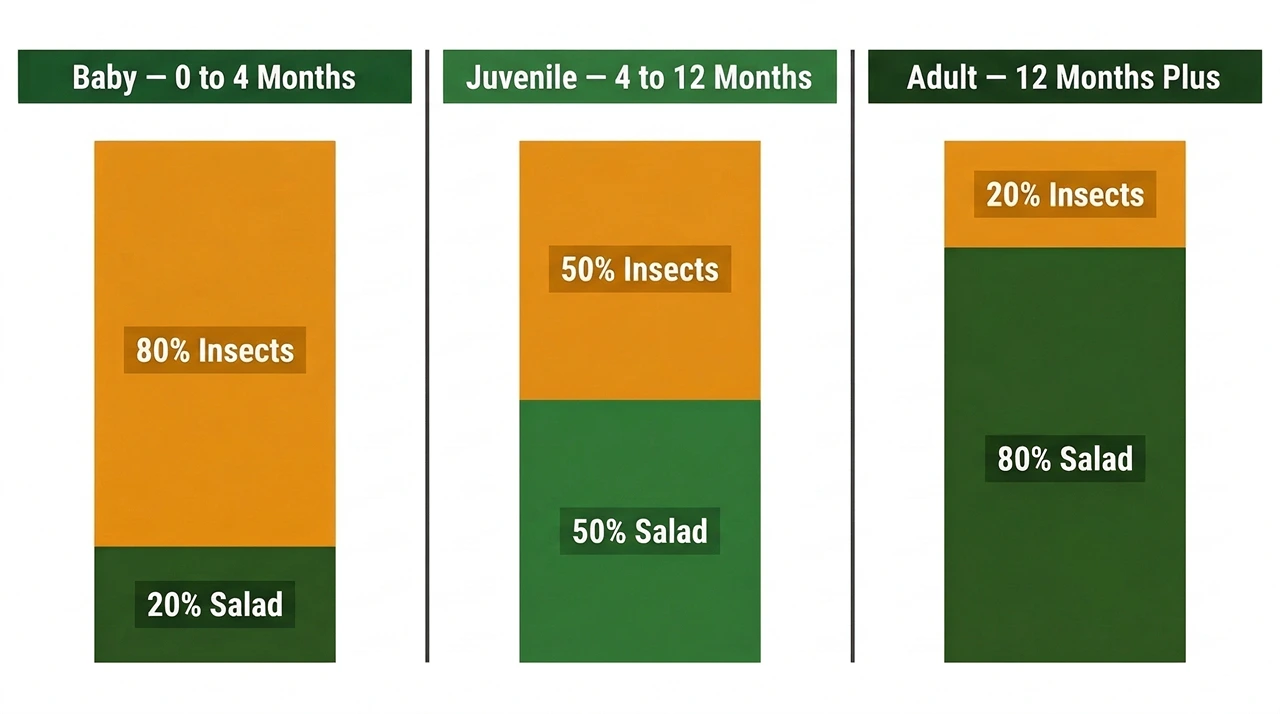
A baby dragon is burning through protein to build bone and muscle at a rate that will never happen again in its life. Between hatching and four months, a healthy hatchling can double its body length. That growth demands a high-insect diet offered multiple times per day. Greens are available but largely ignored at this stage, and that is normal.
Once that growth rate slows, the metabolism drops with it. An adult dragon living in a 4×2 enclosure with no need to sprint after prey has completely different energy requirements than a hatchling. Continuing to feed an adult like a juvenile is the primary cause of fatty liver disease in captive dragons.
The problem is not the occasional overfed meal but sustained months at the wrong ratio, long past the point where a high-insect diet served any purpose.
Feeding a Hatchling Under Four Months
Three feeding sessions per day is the standard for the first four months. Each session runs ten to fifteen minutes. Offer appropriately sized insects and remove whatever is left when the window closes. A healthy hatchling under two months old can eat thirty to fifty small insects across those three sessions. Dragons between two and four months typically eat slightly less per session as they start showing more interest in salad.
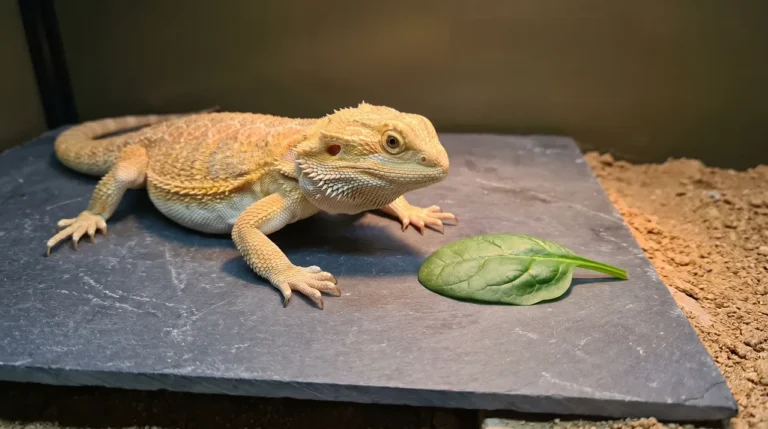
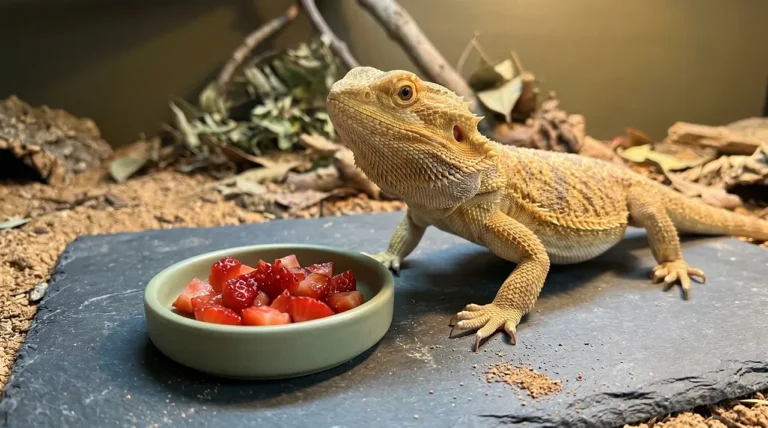
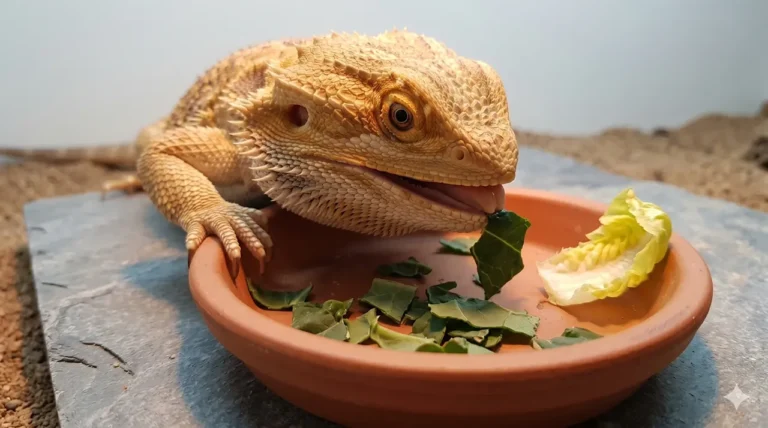
The salad bowl should be in the enclosure every day from day one, even if the hatchling ignores it completely. Early exposure to greens shapes food preferences later. Dragons that never see salad in their first few months are far more likely to refuse it as adults, creating a problem that takes weeks to fix.
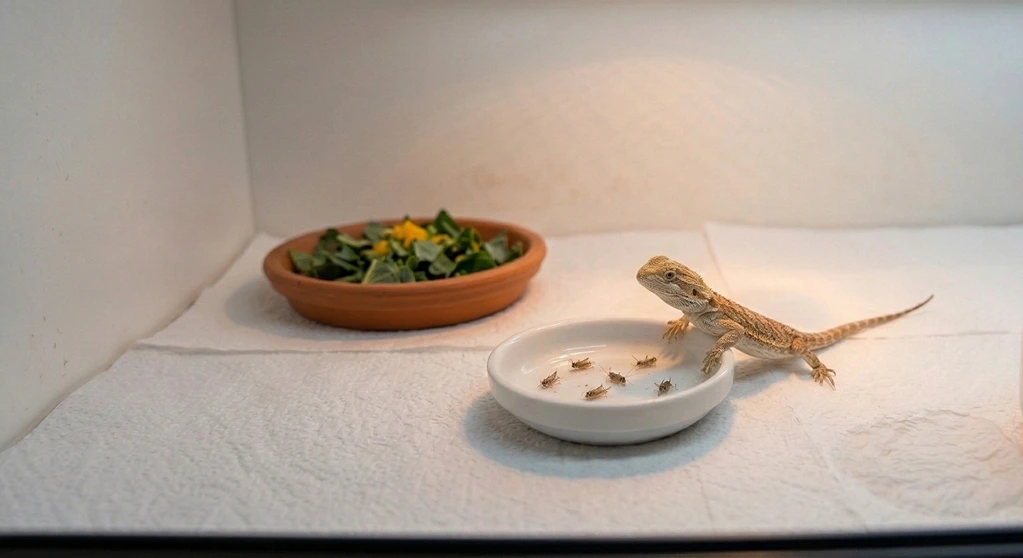
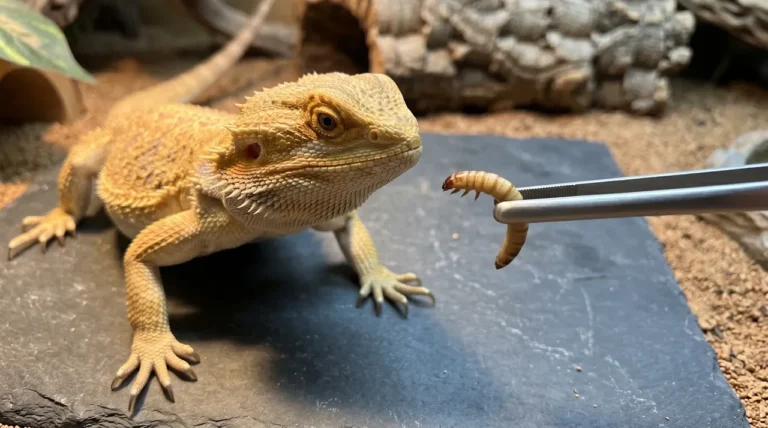
Hatchlings under three months should eat nothing but small crickets or black soldier fly larvae. Both are soft-bodied and small enough to move safely through a young gut. Dubias are fine from around two to three months once the dragon is large enough. Mealworms at this stage carry a genuine impaction risk and should not be offered until at least twelve months old.
What Changes Between Four and Twelve Months
This is the window most keepers find confusing because nothing changes abruptly. Between four and twelve months you are gradually stepping down insect frequency while stepping up salad. At four months, most dragons still want insects twice daily. By eight months, once daily is typically enough. By eleven or twelve months, you should be transitioning to the adult schedule of two to three times per week.
The number of insects per session also drops during this window. A four-month dragon eating twenty dubias per session is normal. An eight-month dragon eating the same amount at the same frequency is being overfed. Use the ten-minute window rule throughout the juvenile period and adjust based on what your dragon is actually eating rather than a fixed number.
Some dragons at seven to nine months start voluntarily eating less protein and showing more interest in greens. That is the transition working correctly. A drop in appetite for bugs at this age is not a health warning. If weight is stable and they are eating their salad, they are adjusting on their own schedule.
The Full Bearded Dragon Feeding Schedule by Age
The schedule below assumes a properly heated enclosure with a basking surface in the correct range and working UVB. Numbers will need adjustment if your setup is borderline on either count, because a cool dragon eats less and a dragon under weak UVB needs more dietary calcium support.
| Age | Insect Frequency | Insects Per Session | Salad | Calcium Dusting |
|---|---|---|---|---|
| 0 to 2 months | 3x daily | 10 to 20 per session (10 to 15 min window) | Daily, available but optional | Every feed |
| 2 to 4 months | 3x daily | 10 to 20 per session (10 to 15 min window) | Daily, encourage but do not force | Every feed |
| 4 to 6 months | 2x daily | 15 to 20 per session | Daily, offer before insects | Every feed |
| 6 to 9 months | Once daily | 15 to 20 per session | Daily, offer before insects | 5x per week |
| 9 to 12 months | Once daily reducing to every other day | 10 to 15 per session | Daily, primary food source now | 5x per week |
| 12 months and over | 2 to 3x per week | 8 to 15 per session | Daily, non-negotiable | 3 to 4x per week |
The calcium dusting column reflects a schedule using plain calcium without D3 as the primary supplement. If your UVB setup is correct with a T5 HO tube at the right distance, your dragon is synthesising D3 naturally and only needs dietary D3 once or twice a month at most. The full reasoning behind this is in the supplement schedule, but the short version is that D3 overdose is a real risk. The VCA feeding guidelines for bearded dragons also note that discussions with a reptile-savvy vet are advisable for dragons with any existing health history before adjusting supplement frequency.
What the Adult Feeding Schedule Actually Looks Like
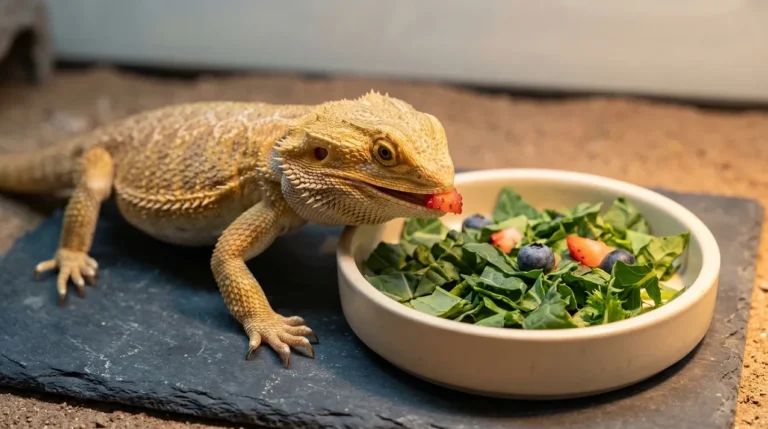
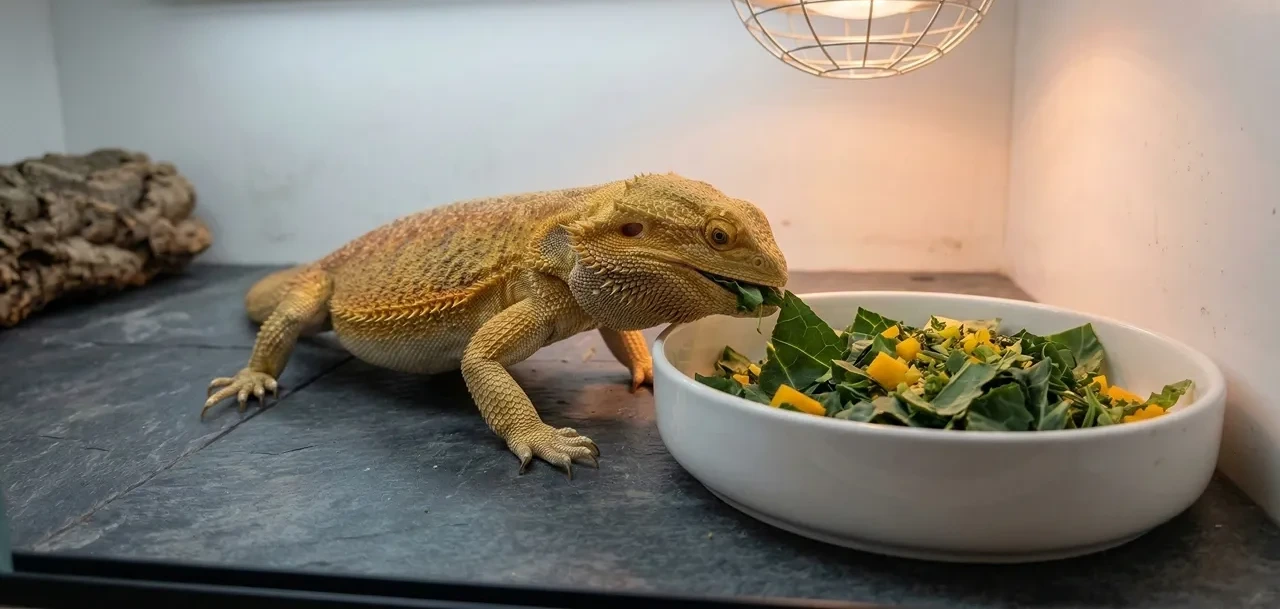
Two to three insect sessions per week with fresh salad every morning is the adult rhythm. On insect days, eight to fifteen appropriately sized dubias or crickets is a normal meal for a healthy adult. On non-insect days, salad is the entire diet. Many keepers settle into a pattern of insects on Monday, Wednesday, and Friday with salad daily. That structure works well because it is easy to remember and prevents the gradual drift back toward daily insect feeding that happens when you are not tracking it.
The salad should go in first thing in the morning before the basking light has fully warmed the dragon. A slightly hungry, slightly cool dragon is more likely to investigate the bowl. Once the basking spot hits temperature and the dragon is active and warm, insects become far more interesting than greens and the feeding window for salad largely closes.
Make sure feeder insects are properly gut loaded before any feeding session. An unloaded cricket from a pet store has almost no calcium content regardless of how much powder you dust on it, because the Ca:P ratio inside the insect body is working against you. Crickets need 24 hours to load while dubias need 48 to 72, so pulling the batch the morning of a feeding session is one of the most common gut loading mistakes keepers make.
What to Do If Your Dragon Is the Wrong Size for Their Age
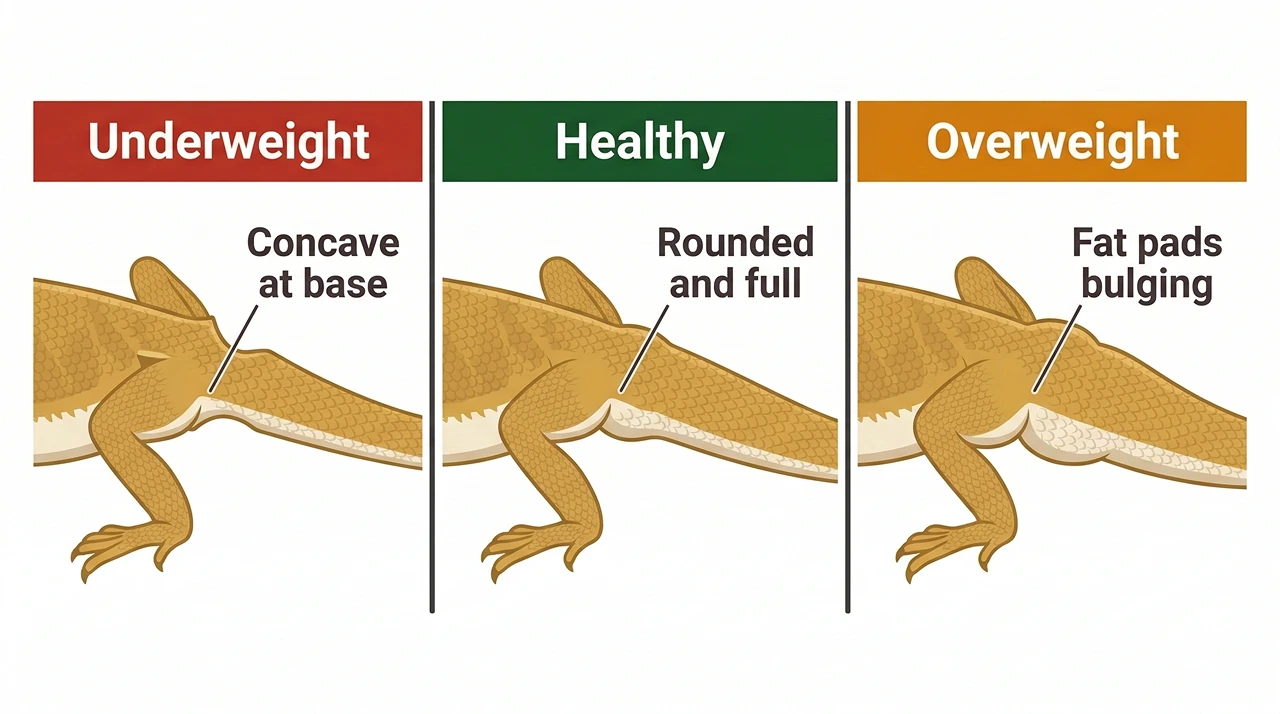
A dragon that is twelve months old but the size of a typical eight-month-old, often the result of early underfeeding or health issues, should not automatically move to the adult feeding schedule just because they hit twelve months chronologically. Track size and body condition rather than age alone. A thin, undersized twelve-month-old still needs daily insect feeding until their weight catches up to a healthy range for their length.
The reverse also happens. Some dragons, particularly those raised on dubias from early on, hit adult size at eight or nine months. Once a dragon reaches full adult length and is carrying healthy weight, continuing daily insect feeding will start causing weight gain regardless of age. Body condition is the more reliable trigger for switching to the adult schedule than the calendar.
When Your Dragon Stops Eating on Schedule
Food refusal almost always has a predictable cause tied to age, season, or enclosure temperature. The table below covers the most common scenarios in order of how often they actually come up.
| Situation | Most Likely Cause | What to Do |
|---|---|---|
| Adult refusing salad, accepting insects | Bug addiction, dragon has been trained to wait for insects | Withhold insects for three to five days. Offer salad only. A healthy adult will not starve itself. |
| Dragon refusing all food, October to January | Brumation, seasonal slowdown triggered by light reduction | Monitor weight weekly. Stable weight is fine. Rapid loss warrants a vet visit. |
| Juvenile refusing insects at 7 to 9 months | Natural protein appetite drop, diet transition starting | Move to once daily feeding, increase salad. If weight is stable, this is normal. |
| Dragon refusing food while in shed | Shedding suppresses appetite at any age | Offer food but do not force. Appetite returns within a day or two after the shed completes. Check for retained shed on toes and tail tip. |
| Dragon refusing all food, actively restless | Breeding season behaviour, February to April especially | Check temperature first. If enclosure is correct, this is likely hormonal. Offer food daily but do not force. |
| Dragon refusing food at any age, lethargic | Temperature problem or illness | Verify basking surface hits 100 to 110°F. If temperatures are correct and refusal continues beyond five to seven days, vet visit warranted. |
Temperature is the first thing to check before everything else. A dragon whose basking surface has dropped below 95°F cannot digest food efficiently, and stopping eating is the body’s response. A failed thermostat, a blown basking bulb, or a cool spell dropping ambient room temperature can all push the enclosure below the threshold the dragon needs. Verify the actual surface temperature with a temperature gun before assuming the problem is behavioural.
If your dragon is entering brumation for the first time, the appetite drop can be dramatic and alarming. Some dragons stop eating almost entirely for six to eight weeks. The key distinction between brumation and illness is weight loss. Weigh your dragon weekly on kitchen scales. A brumating dragon losing more than five to ten percent of its body weight over a month needs a vet check. The NC State Veterinary Hospital feeding guidance specifically flags lethargy combined with food refusal beyond one to two days as a reason to contact an exotic vet rather than waiting to see if it passes.
Giving In on Salad Days Teaches the Wrong Lesson
Offering insects when an adult dragon refuses salad is the most counterproductive move you can make. Dragons are not stupid. If refusing salad reliably produces insects within twenty minutes, they will keep refusing salad. You are not being cruel by holding the insect session on non-insect days. A well-fed adult dragon is not at any risk from three to five days of salad-only feeding, and that is typically all the time it takes for a stubborn dragon to start eating the bowl in front of them.
Frequently Asked Questions
How many crickets should a bearded dragon eat a day
It depends on age. A hatchling under four months can eat thirty to fifty small crickets across three daily sessions. A juvenile at six to nine months eats fifteen to twenty per single daily session. An adult eats ten to fifteen crickets two to three times per week, not per day.
At what age do you switch to adult feeding
The transition happens gradually between nine and twelve months, not on a single date. Most dragons are on a full adult schedule by twelve months, but a small or underweight twelve-month-old should stay on more frequent insect feeding until their body condition catches up. Use size and weight as your guide, not the calendar alone.
Can you feed a bearded dragon every day as an adult
Daily insect feeding in an adult causes gradual weight gain and eventually fatty liver disease. The adult schedule is two to three insect sessions per week with salad every day. Daily feeding of fresh greens is correct and encouraged. Daily insect feeding is what causes problems.
Why does my juvenile keep refusing salad
This almost always happens when insects are offered before or instead of salad at feeding time. Offer salad first thing in the morning before insects, and do not remove it when you bring in the bugs. Over time, most juveniles start eating salad alongside insects once they associate the bowl with food.
Do I need to gut load insects every time
Yes, for every feeding session at every age. An unloaded cricket from a bulk supplier has an inverse calcium-to-phosphorus ratio that actively works against calcium absorption regardless of how much you dust. Loading takes 24 hours for crickets and 48 to 72 hours for dubias. Pull your feeding batch the day before, not the morning of.
What to Do Each Week by Age
- ✅ Under four months: Three sessions daily, ten to fifteen minutes each, small soft-bodied insects only. Salad in the enclosure every day even if ignored.
- ✅ Four to six months: Reduce to two sessions daily. Start offering salad before insects at each session. Dubias are fine from this point if not already using them.
- ✅ Six to nine months: Once daily insect feeding. Salad every morning, insects in the afternoon. A natural appetite drop at this stage means the transition is working.
- ✅ Nine to twelve months: Step down toward every other day insects while salad becomes the primary daily food. By twelve months, most dragons are ready for the full adult schedule.
- ✅ Twelve months and over: Insects two to three times per week, eight to fifteen per session. Salad every single morning without exception.
- ✅ Use body condition, not just age. Check the tail base monthly. Rounded is healthy, angular or concave means more insects, fat pads bulging means fewer.
- ✅ Gut load every insect batch before any feeding session. Pull crickets the day before, dubias two to three days before.
- ✅ If food refusal starts, check basking surface temperature before anything else. Below 95°F will suppress appetite at any age before any behavioural cause does.
6 pages, schedule table, body condition chart, food refusal troubleshooting
Written by
Sarah ArdleySarah has kept bearded dragons for over ten years. She founded Beardie Husbandry after discovering that most mainstream care advice — including what she followed with her first dragon — was doing more harm than good. Every article on this site is grounded in veterinary research and real keeper experience.