Bearded Dragon Obesity: How to Safely Diet Your Reptile
A chunky beardie looks comfortable. Soft jowls, a thick tail base, a belly that spreads a little when they sprawl on the basking platform. For years the reptile community quietly accepted that shape as normal, even affectionate. The necropsy data tells a different story.
Hepatic lipidosis, commonly known as fatty liver disease, is one of the leading causes of death found at post-mortem in pet bearded dragons. Peer-reviewed prevalence studies report moderate to severe hepatic fat changes in 27% of dragons examined.
Bearded dragon obesity is not a cosmetic issue. It is a slow, silent organ failure that most keepers only recognise after their dragon stops eating in their fifth or sixth year. The good news is that the condition is almost entirely reversible in earlier stages if the approach is structured and patient. Reversing it is rarely aggressive. It is mostly about patience and a structured plan.
Why Beardies Get Fat So Easily
Reptiles process fat differently to mammals. In a dog or a human, most fat storage and metabolism happens in adipose tissue scattered throughout the body. In a bearded dragon, lipid metabolism is concentrated in the coelomic fat pads and primarily in the liver itself.
That anatomy makes the liver the first organ to show the damage when calories exceed demand. There is no safe buffer of body fat that protects the liver. Excess energy goes straight to the place most likely to fail.
The second factor is metabolism. An adult bearded dragon requires roughly one-tenth the daily calories of a mammal its size. The pleading stare at feeding time is not hunger in any mammalian sense. It is opportunism wired into a desert species that evolved around feast-and-famine food availability.
The third factor is husbandry. A dragon in a cramped 40-gallon tank with a cool basking spot cannot burn what little it takes in. Digestion slows below proper basking temperatures in the 100 to 108°F range, and the dragon stores rather than uses. Cold dragons get fat faster than warm ones on identical diets.
How to Tell a Dragon Is Truly Obese
Weight alone means almost nothing for a bearded dragon. A long, lean 22-inch female at 520 grams is perfectly healthy. A short, squat 18-inch male at 520 grams is dangerously overweight. Length, bone structure, and gender matter more than the number on the scale.
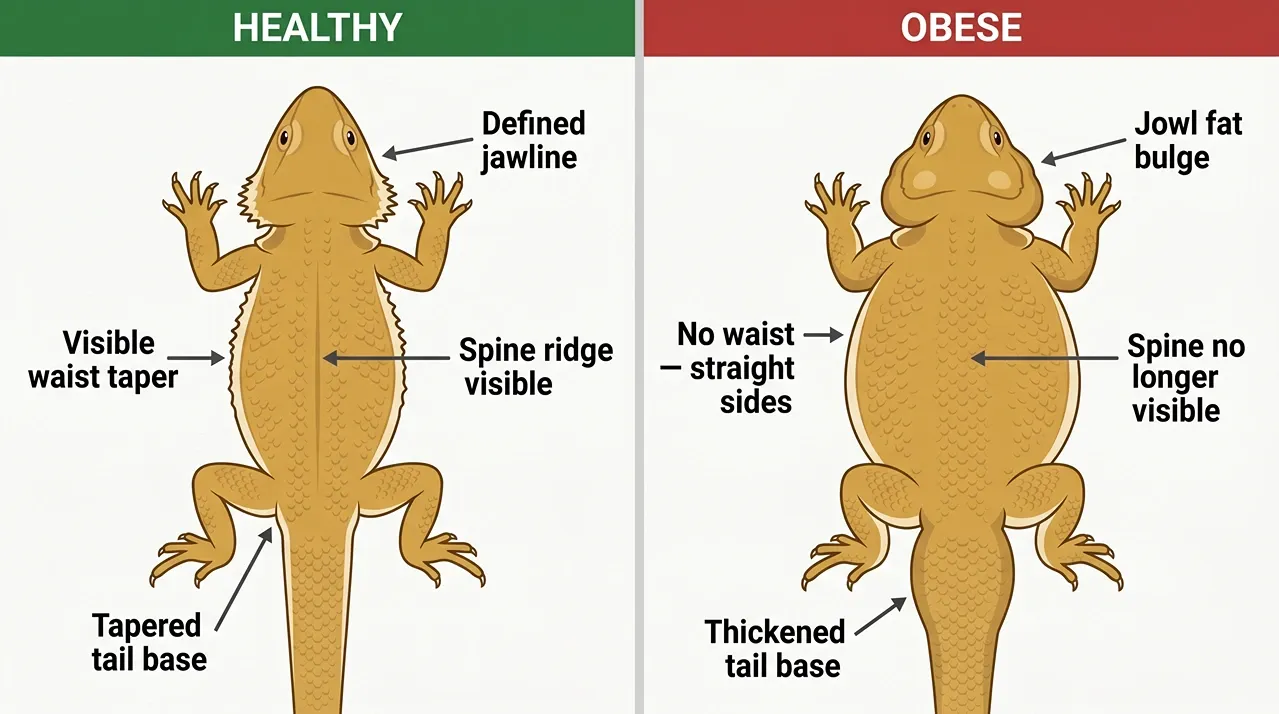
Run your thumb gently along the spine from the base of the skull to the hip bones. On a healthy dragon the vertebrae should be palpable through a thin layer of muscle and skin, not protruding, not buried. If you press firmly and cannot feel any spine at all, there is too much fat covering it.
Now look at the dragon from directly above. The body should taper in slightly between the front and back legs, then taper more sharply from the hips into the tail base. An obese dragon shows no waist at all. The body reads as an oval sausage from head to tail base, with the belly often spreading wider than the ribs when the dragon lies flat.
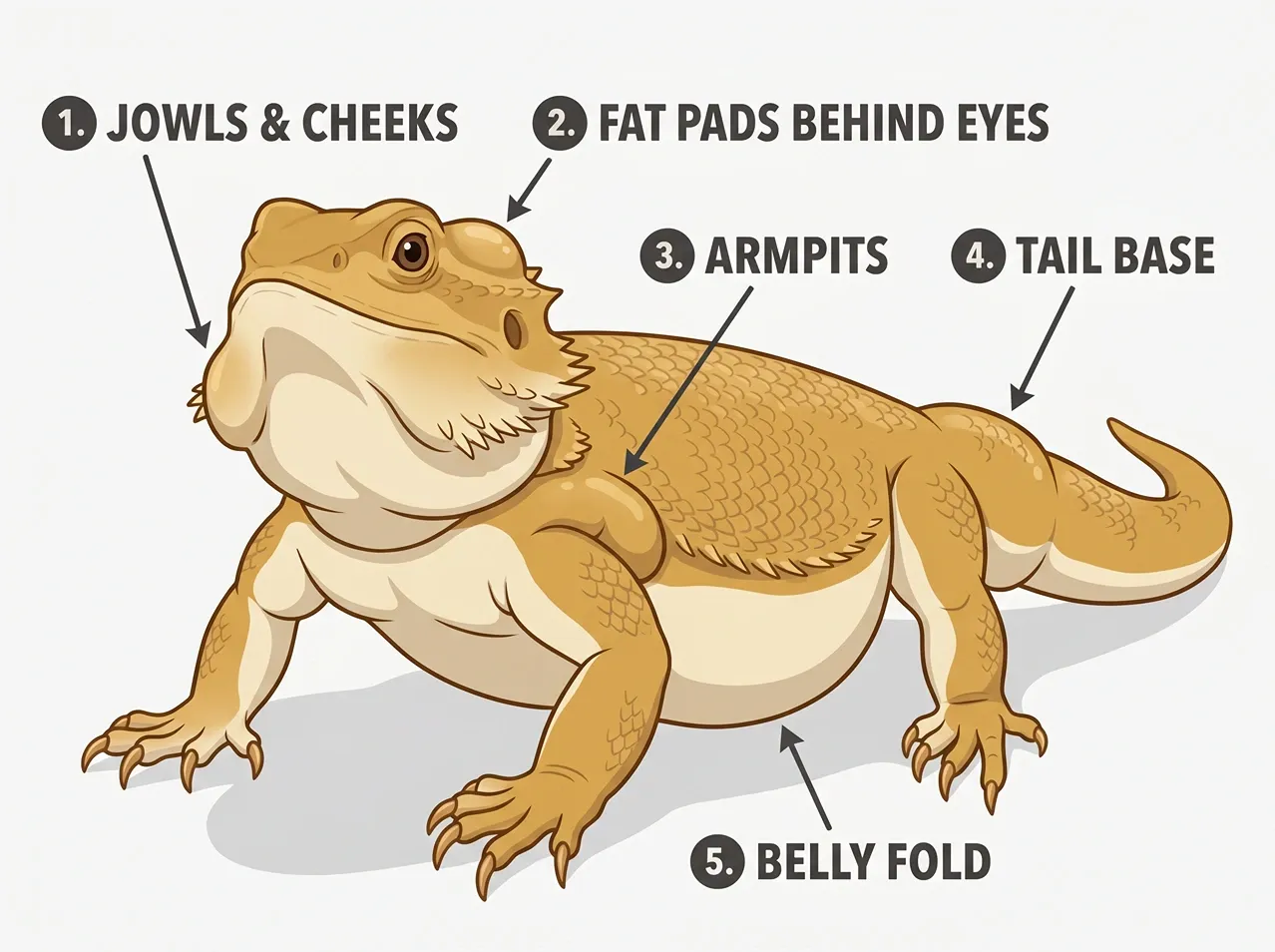
The Five Key Fat Deposits
These are the spots that get heavy first and give away a fat dragon before the belly does:
- Jowls and cheeks. Should be flat or gently rounded, never bulging out below the jawline when the mouth is closed.
- Fat pads behind the eyes. A squishy, exaggerated dome rather than a shallow curve.
- Armpits. Small folds of fat appearing where the front leg meets the body.
- Tail base. The first inch of tail behind the vent should taper, not bulge outward wider than the hips.
- Belly skin when handled. Should feel firm and flat, not soft or pendulous.
Obesity vs. Other Causes of Weight Gain
Before putting your dragon on any kind of diet, rule out the three common conditions that mimic obesity. A thin dragon on a weight loss plan can deteriorate fast.
| What You See | Likely Cause | What to Do |
|---|---|---|
| Wide belly, normal tail base, normal jowls | Possible gravidity or impaction | Vet exam before any diet change |
| Sudden belly swelling over days, lethargy | Ascites, organ failure, or severe impaction | Emergency vet visit, not a diet |
| Gradual weight gain over months, fat in all five spots | True bearded dragon obesity | Structured diet and husbandry adjustment |
| Thick body but visible spine and hips | Healthy muscle and fat balance | No action needed |
| Belly wide from above, restless, digging | Female with eggs | See gravid female guide |
A female who has never been with a male can still produce infertile eggs, and the clutch can add 30 to 80 grams over a few weeks. Mistaking that for obesity and cutting food can cause egg binding in an already stressed animal. Check for behavioural signs like restlessness and digging before assuming the weight gain is dietary.
The Real Causes of Obesity in Pet Dragons
Almost every case traces back to a combination of four husbandry mistakes, not a single overfeeding event.
Feeding Adult Portions to Juveniles
Keepers who raised their dragon on daily insects through the first year often keep feeding at that frequency into adulthood. A healthy two-year-old needs insects two or three times a week at most, with daily greens as the dietary foundation.
Protein needs drop dramatically after eighteen months, and the age-based feeding schedule reflects that shift with far fewer weekly insect meals for adults than juveniles.
High-Fat Feeders as Staples
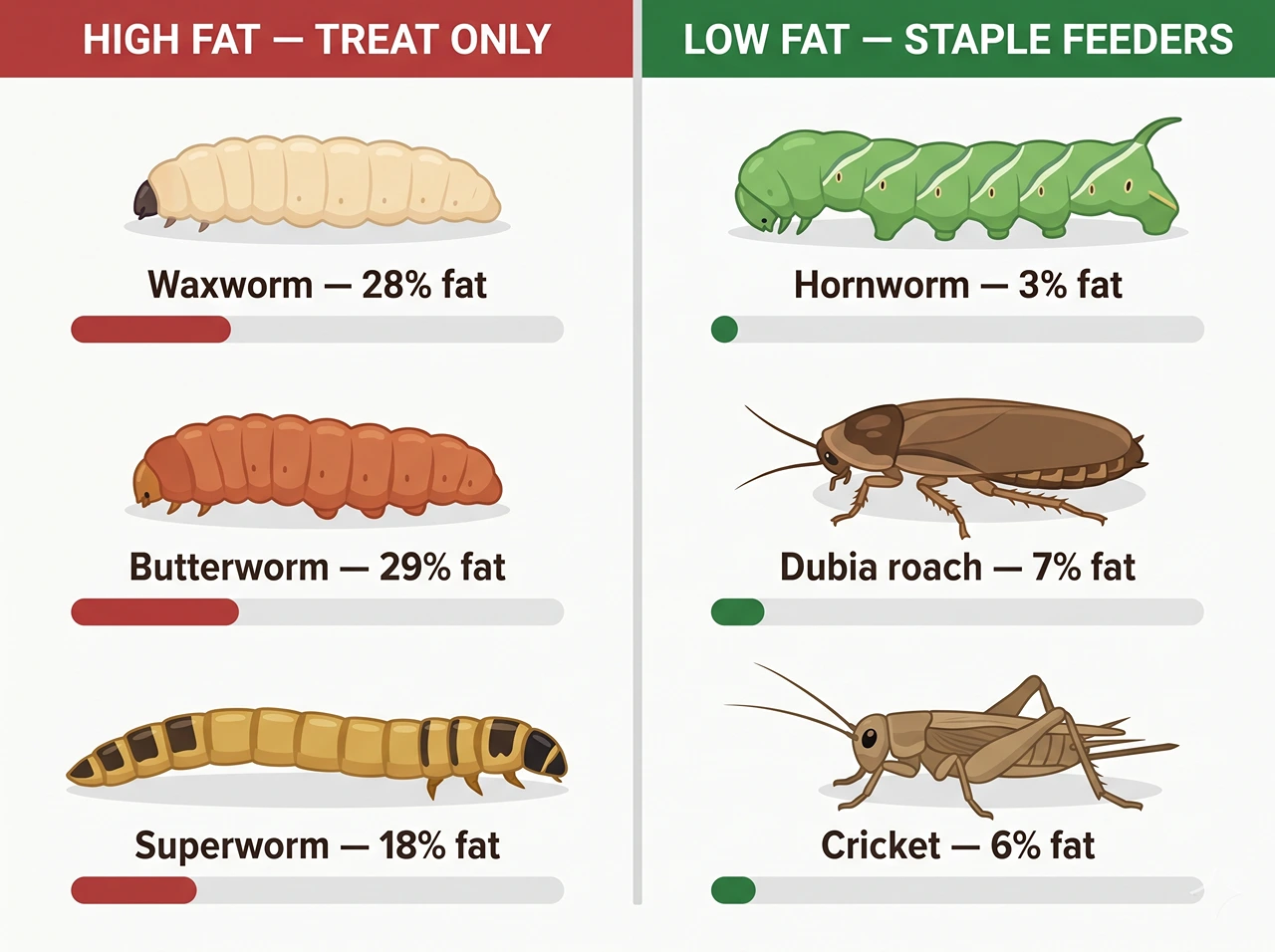
Superworms, waxworms, butterworms, and hornworms all contain far more fat than dubia roaches or crickets. Offered occasionally they are fine. Offered weekly or daily they become the primary driver of liver fat accumulation. Treat worms are treats. Treat worms fed as staples are the fastest route to hepatic lipidosis in an otherwise healthy animal.
Mealworms and Other Low-Value Feeders
Worth a separate flag because so many keepers still rely on them. The hard chitin shell, high fat-to-protein ratio, and limited nutritional value make them a poor daily choice. Whether mealworms belong in the diet at all depends heavily on the dragon’s age and current body condition.
Poor Cage Enrichment
A bare tank with a basking rock and a food bowl produces a sedentary dragon. Branches at varied heights, climbing platforms, hides at different temperature zones, and out-of-tank time all prompt movement. Movement is the denominator in every calorie equation. Dragons with well-designed enclosures and daily enrichment stay lean on diets that would make cage-bound dragons obese.
How to Safely Diet a Fat Dragon
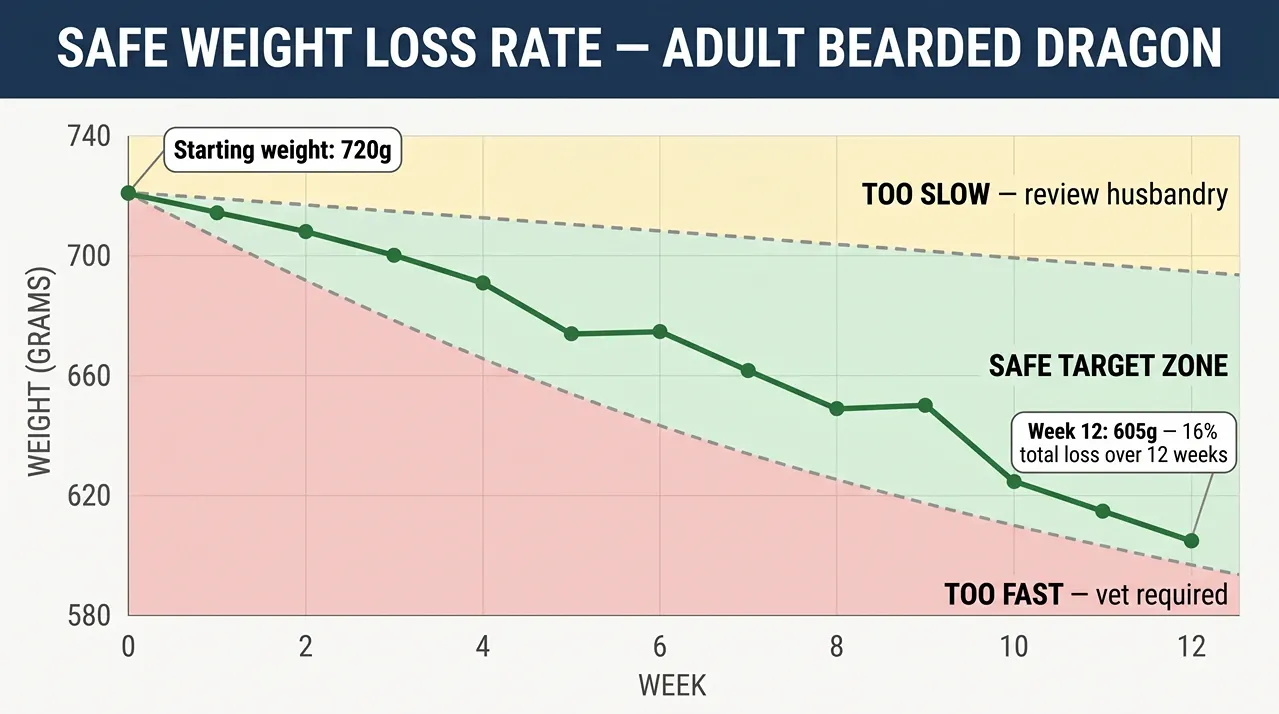
A bearded dragon did not get fat in a week and should not lose the weight in a week. Rapid weight loss exceeding 10% of body weight in seven days is a veterinary emergency, not a goal.
The sustainable target is 1 to 2% of body weight per week, which for a 600-gram dragon means 6 to 12 grams. Slow loss protects the liver. Crash dieting damages it further by mobilising fat stores faster than the organ can process them.
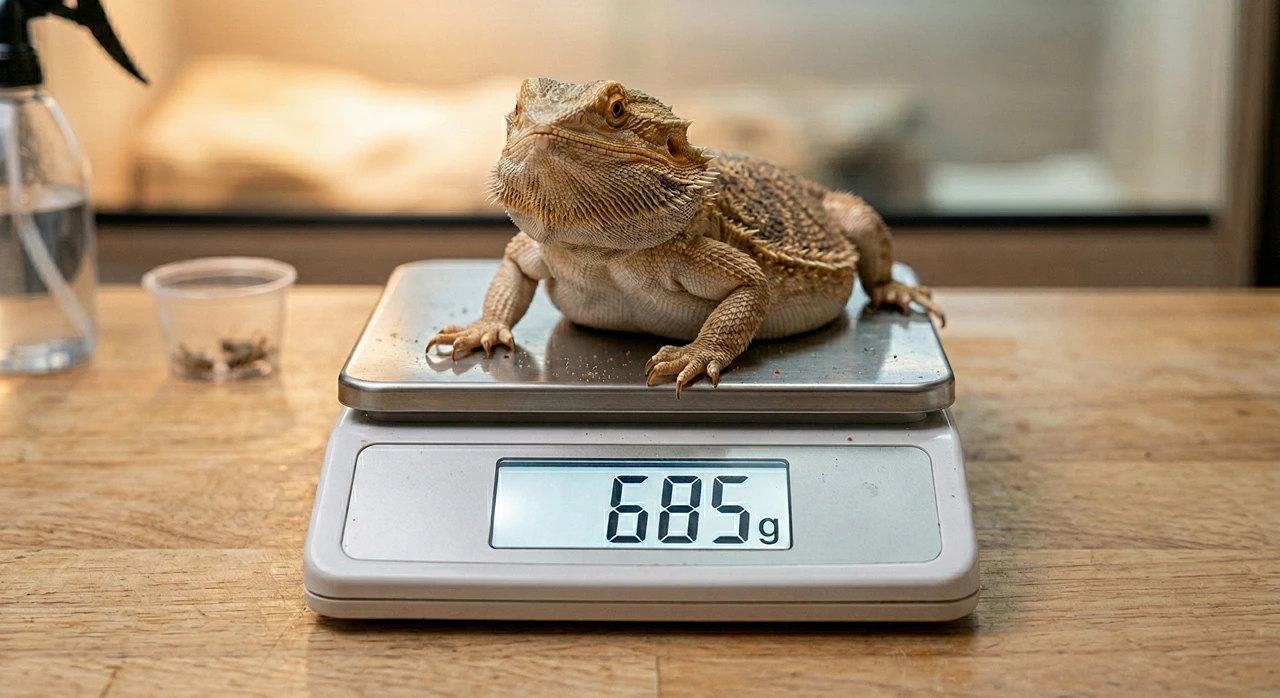
Weigh your dragon once a week, same day, same time, on a digital kitchen scale that reads to 1 gram. Record the number. Do not weigh daily. Daily weight fluctuates with hydration, gut contents, and recent basking, and the noise will drive you to change things that do not need changing.
Week One and Two, Switch the Feeders
Do not reduce food volume yet. Replace every high-fat insect with a lower-fat equivalent. Drop superworms, waxworms, butterworms, and hornworms entirely. Replace with dubia roaches or plain crickets at the same quantity your dragon is currently eating. This single change often produces visible fat pad reduction within three weeks, without the dragon feeling hungry.
If your dragon only eats fatty worms and refuses crickets or roaches, that refusal is itself a husbandry signal. A dragon fed treats for months will protest the switch for several days. Hold the line. A healthy adult can safely skip insects for a week while adjusting to the new menu.
Week Three Onwards, Cut Protein Frequency
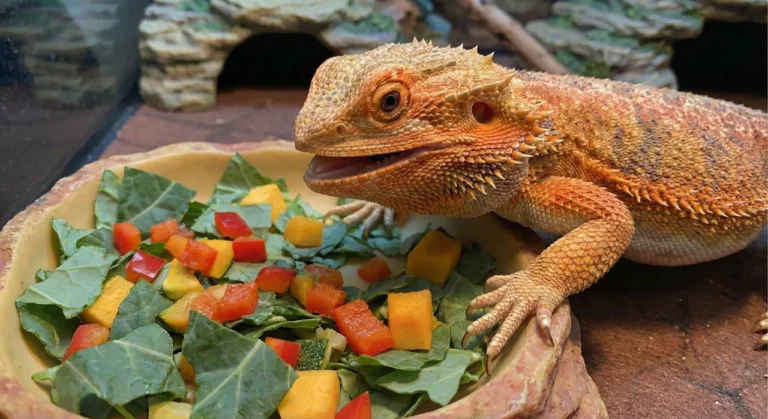
For an adult over eighteen months, reduce insect feedings to two or three times a week. On non-insect days, offer a generous plate of dark leafy greens, chopped squash, and occasional bell pepper. An adult who refuses greens is simply not hungry enough. Most dragons on all-bug diets will start eating greens within a week of reduced protein once they learn hunger returns.
Quantity per insect meal for a dieting adult sits around ten to fifteen appropriately sized dubia roaches or crickets. Avoid free-feeding from a bowl. Hand-feed or tong-feed so you can count.
Week Four Onwards, Review and Adjust
By week four you should see a measurable weight drop and a softening of the fat pad dome behind the eyes. If weight has not moved at all, review your basking surface temperature with an infrared thermometer. A dragon basking at 90°F metabolises far less than one at 105°F, and cold basking is the most common reason a diet stalls.
Exercise That Actually Works
Bearded dragons do not exercise the way a dog exercises. They do not run laps. What they do is move when the environment rewards movement, and stay still when it does not.
Daily supervised floor time outside the tank for 20 to 40 minutes gives most adult dragons more activity than a week inside an average enclosure. Let them walk, climb, or explore a dragon-proofed room. A warm room above 75°F is essential so they stay active rather than parking in one spot to thermoregulate.
Inside the enclosure, rearranging climbing branches and moving the food location every few days keeps the dragon searching rather than sitting. Hanging collard green leaves from the top of the tank with a clip forces a dragon to stretch up, brace, and reach.
Bathing gets listed as exercise in many care guides. It is not. A dragon standing in shallow warm water is still. What bathing does well is support hydration and shedding, and a proper safe bathing technique can also help you read a dragon’s belly shape more accurately. For movement that actually burns calories, rotate the enrichment options in and out of the enclosure to prompt climbing, reaching, and hunting behaviour.
Health Risks If Obesity Is Ignored
The cost of ignoring a fat dragon is not discomfort. It is years off the dragon’s life and a difficult death.
- Hepatic lipidosis (fatty liver disease). Progressive accumulation of triacylglycerol in hepatocytes, eventually causing liver failure. Onset is silent and clinical signs appear only at advanced stages, including anorexia, lethargy, and weight loss.
- Cardiovascular strain. The reptile heart was not built to pump against a body carrying 30% excess fat.
- Gout and kidney damage. High-protein overfeeding drives uric acid production beyond what compromised kidneys can clear.
- Joint stress and failed thermoregulation. Obese dragons struggle to climb to basking spots and cool areas, leading to chronic under-digestion.
- Reduced lifespan. A dragon who reaches obesity by year three rarely makes it past year eight. Lean, well-managed dragons regularly live past twelve.
Most of this damage is silent until a critical threshold is crossed. A dragon showing the first signs of reduced appetite at age six has often been in subclinical liver trouble for two or three years already.
Once anorexia sets in as a symptom of hepatic lipidosis, the prognosis shifts dramatically. That is why prevention and early reversal matter so much more than late intervention.
When to See a Reptile Vet
Most cases of bearded dragon obesity can be resolved at home with diet and husbandry changes. Some cannot.
Book an exotic vet if the dragon is over 800 grams regardless of length, if weight loss stalls completely after six weeks of the protocol above, if appetite drops suddenly at any point during the diet, or if the belly looks asymmetrical or feels firm and painful on gentle palpation.
A vet can assess liver function through bloodwork and run imaging if hepatic lipidosis is suspected. Early intervention with supportive care and in some cases pharmaceutical treatment produces far better outcomes than waiting.
For older animals, the considerations shift. A senior with obesity plus arthritis or cataracts needs a gentler plan, and the senior care approach accounts for the slower metabolism and reduced heat tolerance of dragons over seven years old.
Practical Action Plan for This Week
If you have read this far and suspect your dragon is overweight, start here before the weekend:
- Weigh the dragon on a kitchen scale and write the number down with today’s date.
- Check body condition against the five fat deposits listed above. Take a photo from directly above for comparison in four weeks.
- Verify basking surface temperature with an infrared thermometer at the spot where the dragon lies. Adjust bulb wattage or fixture height if it reads below 100°F.
- Remove all waxworms, superworms, butterworms, and hornworms from the feeder rotation.
- Stock dubia roaches or appropriately sized crickets.
- Plan one supervised out-of-tank session per day for at least twenty minutes in a warm room.
- Re-weigh in seven days and review.
A dragon that has been overweight for years will not normalise in one month, but it will start trending in the right direction within three weeks on this protocol. Patience matters more than aggression. Every week of slow, steady change is another week the liver gets to recover.
Frequently Asked Questions
How Do I Know if My Bearded Dragon Is Overweight
Check five places on the body. The jowls should not bulge below the jawline. The skull should be flat behind the eyes, not domed. The armpits should not show fat rolls. The tail base should taper cleanly from the hips rather than bulging wider. From above, the body should show a clear waist between the front and back legs. A dragon carrying fat in four or five of these spots at once is obese.
How Fast Should an Obese Dragon Lose Weight
Aim for 1 to 2% of body weight per week. For a 600-gram dragon that works out to 6 to 12 grams per weekly weigh-in. Faster than that risks mobilising fat stores quicker than the liver can process them, which makes a hepatic lipidosis problem worse rather than better. Weight loss over 10% in a single week is a veterinary emergency.
Should I Stop Feeding My Bearded Dragon Insects
No. Insects stay in the diet, just at lower frequency and with the high-fat species removed. For adults over eighteen months, drop to two or three insect meals per week. Cut waxworms, butterworms, superworms, and hornworms entirely. Keep dubia roaches or crickets at around ten to fifteen insects per meal. Greens fill the non-insect days.
Can Obesity in Bearded Dragons Be Reversed
Yes, in most cases. Early to moderate obesity usually reverses completely over two to four months with a structured diet change, correct basking temperatures, and added enrichment. Severe cases with advanced fatty liver disease may only partially recover and require veterinary support. The longer the dragon has been overweight, the slower the recovery and the more likely permanent liver damage will limit the outcome.
How Much Should a Healthy Adult Bearded Dragon Weigh
Healthy adult weight depends on body length and frame, not a single target number. A 22-inch adult typically sits between 380 and 550 grams when lean, 550 to 700 grams at a comfortable weight, and over 800 grams when obese. Shorter adults should weigh less, longer adults can weigh more. Body condition always matters more than the scale reading.
Written by
Sarah ArdleySarah has kept bearded dragons for over ten years. She founded Beardie Husbandry after discovering that most mainstream care advice — including what she followed with her first dragon — was doing more harm than good. Every article on this site is grounded in veterinary research and real keeper experience.