Bearded Dragon Tank Size : Why 40 Gallons Is Not Enough
Most first-time owners come home with a 40-gallon. The pet store sells it as the standard setup, it ships in starter kits with a basking bulb and a thermometer, and it looks enormous next to a 6-inch hatchling. By the time that hatchling hits 16 inches, the problem is obvious.
A 40-gallon is not adequate for an adult dragon, and the gap between what pet stores recommend and what dragons actually need has never been wider.
Getting bearded dragon tank size right is not just about floor space. It is about whether a functional temperature gradient can physically exist inside that vivarium at all.
If you are setting up for the first time, or already questioning whether your current enclosure is holding your dragon back, the numbers below reflect current keeper practice, not care sheets written fifteen years ago and never updated.
Why the 40-Gallon Keeps Getting Recommended
The 40-gallon recommendation is a relic. It appeared in early reptile care pamphlets when husbandry knowledge was thin and nobody was measuring stress responses in captive lizards.
Pet stores still carry it because starter kits are profitable, and most online care guides have not been updated since they were first published. They have been copying each other for years.
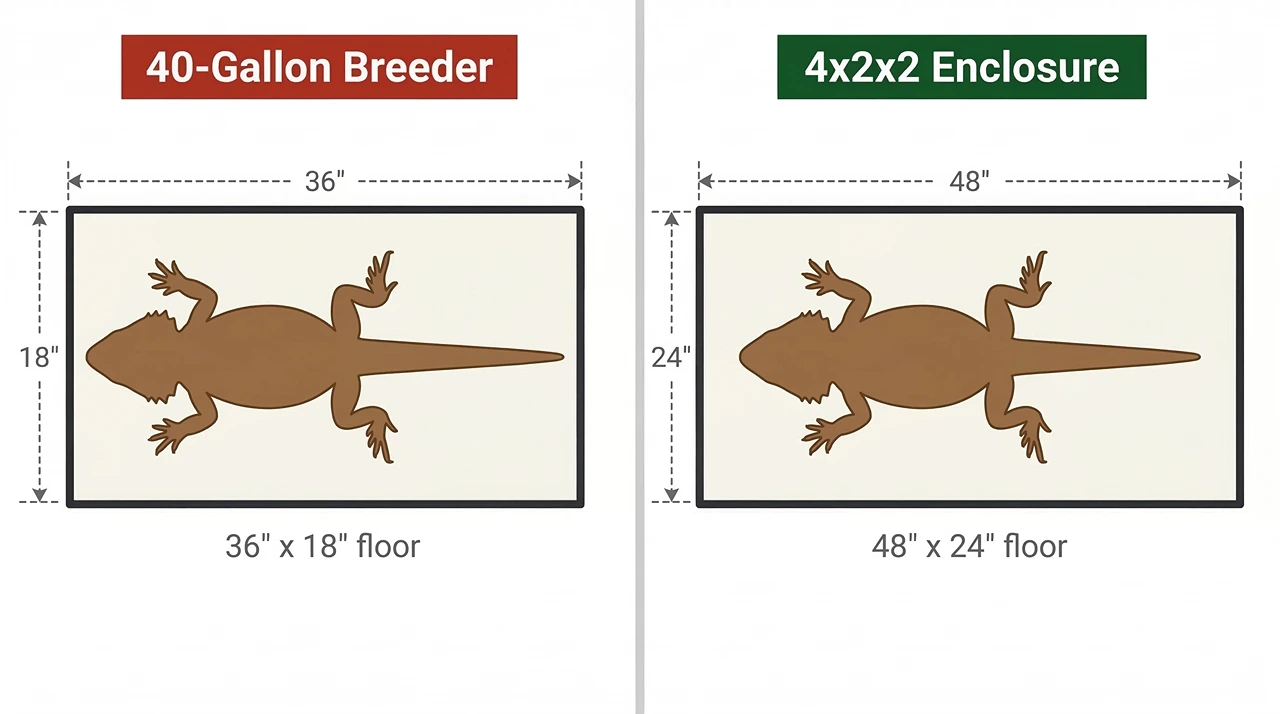
A 40-gallon breeder tank measures 36 inches long, 18 inches wide, and 18 inches deep. An adult bearded dragon commonly reaches 18 to 24 inches in total length.
If your dragon stretches out at the basking end, their tail may already reach the midpoint of the vivarium before they have moved at all. Getting the bearded dragon tank size right starts with understanding why this measurement never served adult animals in the first place. That is containment, not habitat.
What Bearded Dragon Tank Size Do You Actually Need
The table below gives the recommended enclosure size by life stage, based on current keeper standards. These are minimum and recommended figures. When in doubt, go larger.
| Life Stage | Age | Dragon Length | Minimum Enclosure | Recommended Enclosure |
|---|---|---|---|---|
| Hatchling | 0–3 months | Under 10″ (25cm) | 40-gal breeder (36″L x 18″W x 18″H) | 40-gal breeder or skip straight to 4x2x2 |
| Juvenile | 3–12 months | 10–16″ (25–41cm) | 75-gal (48″L x 18″W x 21″H) | 4x2x2 (48″L x 24″W x 24″H) |
| Sub-adult | 12–18 months | 16–20″ (41–51cm) | 4x2x2 (48″L x 24″W x 24″H) | 4x2x2 or larger |
| Adult | 18+ months | 18–24″ (46–61cm) | 4x2x2 (48″L x 24″W x 24″H) | 6x2x2 (72″L x 24″W x 24″H) |
The 4x2x2, approximately 120 gallons, is what most experienced keepers and current reptile welfare organisations treat as the minimum for an adult dragon.
The Federation of British Herpetologists’ 2022 reptile housing guidelines place the Pogona genus minimum at roughly 6x3x3 feet, a standard most North American keepers are still working toward. Dragons exceeding 22 inches, including giant morphs, should be considered candidates for a 6x2x2 as the minimum rather than the 4x2x2.
During the first three months, a 40-gallon breeder is workable. Treat it as temporary from day one.
Is a Big Tank Bad for Baby Beardies
The concern about putting a hatchling in a large enclosure is legitimate but solvable. It should not be used as a reason to size down the terrarium.
A dragon under 4 inches in a 6-foot tank will struggle to catch live feeders if insects can scatter across the full floor before the dragon lunges. The dragon exhausts itself hunting, eats inconsistently, and becomes stressed. That is a real problem with a direct fix.
Use a feeding station rather than a smaller tank. Place live feeders in a shallow ceramic bowl or small plastic tub inside the warm zone of the enclosure. The feeders cannot scatter, your dragon learns quickly where to find them, and the large tank becomes an advantage for thermoregulation rather than a problem for feeding.
A small hide positioned near the basking end also helps a young dragon feel secure in open space during the first few weeks.
Dimensions Matter More Than Gallons
Floor Length Is the Number That Counts
The gallon measurement is almost meaningless for bearded dragon vivarium size decisions because it describes volume, not shape. Two tanks both labelled 40 gallons can have completely different floor dimensions depending on whether the manufacturer built them tall and narrow or wide and low.
A tall 40-gallon has less usable floor space than a 40-gallon breeder, even though both hold the same volume of water.
Floor length drives every other aspect of the setup. Your dragon needs to walk from a hot basking zone at one end to a genuine cool zone at the other.
In any enclosure under 48 inches long, that temperature differential collapses before you have properly established it. The heat bleeds across too quickly, and your dragon ends up choosing between warm and slightly less warm rather than warm and genuinely cool.
Width and Height Still Matter
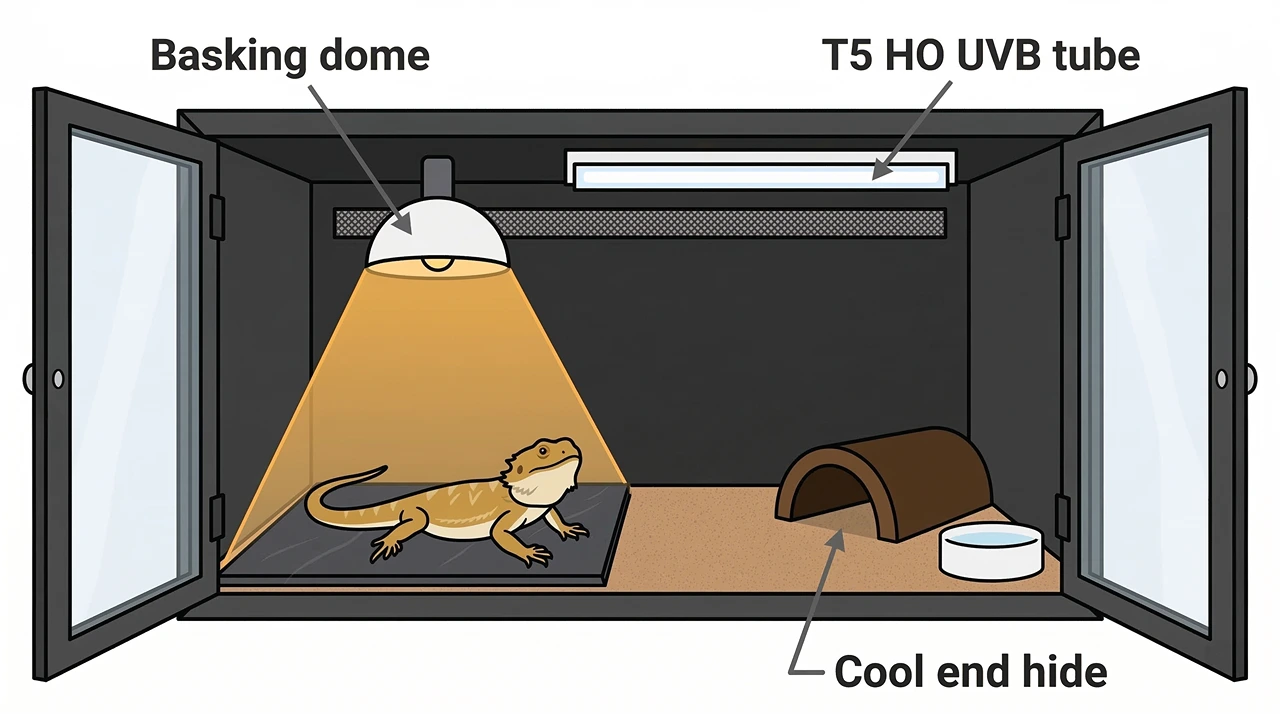
An 18-inch-wide enclosure creates real problems for UVB positioning. A T5 HO tube mounted at the correct height needs adequate width beneath it to cover the basking zone without the beam running off the edge of your decor.
In a 24-inch-wide enclosure, positioning is clean and flexible. In an 18-inch-wide tank, it requires precision and limits decor considerably.
Height matters for behaviour more than most guides acknowledge. Bearded dragons in the wild use elevated basking positions on rocks and low scrub, and they are more active climbers than their floor-hugging reputation suggests.
An enclosure with only 18 inches of vertical space limits this entirely to a single flat platform. At 24 inches of height, you can build two usable levels that your dragon will actually move between throughout the day.
Tank Size and Temperature Are Not Separate Problems
Getting the right bearded dragon enclosure size is not only about whether your dragon can turn around comfortably. It is about whether a functional temperature gradient can physically exist in that space.
This is the point most tank size articles miss entirely, and it matters more to your dragon’s long-term health than any single piece of equipment you can buy.
A properly set up basking zone runs at 95 to 110°F. The cool end should sit at 75 to 80°F, creating a differential of at least 20°F across the floor.
In a 36-inch-long tank, heat from the basking lamp spreads across the entire space within a few hours. There is no genuine cool zone — just a gradient that fades out within a foot or two of the basking spot.
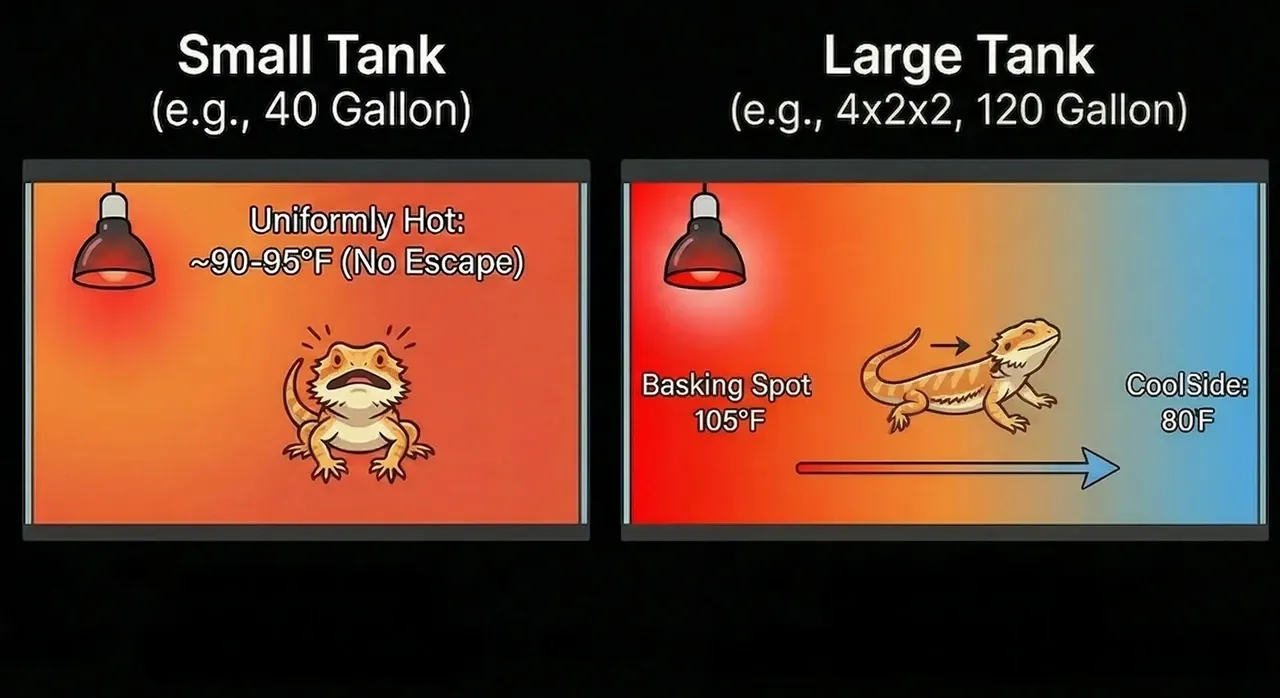
A 48-inch enclosure gives the heat room to dissipate. A 72-inch enclosure gives you a true cool zone where temperatures consistently sit below 80°F throughout the day.
Use two digital thermometers at each end to confirm the differential. Place one at basking surface level and one at floor level on the cool side. Any reading showing less than a 15°F difference is a sign the enclosure is too short, regardless of bulb wattage.
Glass vs PVC vs Wood for Bearded Dragon Enclosures
Glass is the most common enclosure material and the least forgiving for heat management. It radiates warmth outward efficiently, which forces your heating equipment to work harder and allows the cool end of the enclosure to drop sharply on cold nights.
Holding a stable gradient through an overnight temperature drop without supplementary heating is a real challenge in any small glass tank.
Glass also creates humidity problems that most guides skip over. Bearded dragons need ambient humidity in the 30 to 40% range, and that level dries out noticeably faster in glass because the material offers no buffering at all.
A correctly sized PVC or wood terrarium holds ambient humidity more naturally and requires less active adjustment throughout the day.
PVC and wood enclosures retain heat far better. A 4x2x2 PVC enclosure running a single halogen basking bulb holds a stable gradient far more easily than a glass tank of the same dimensions running the same wattage. The walls trap ambient heat, and the gradient stabilises more quickly after the lights come on each morning.
A thermostat controlling the basking bulb is useful in any setup, but in a glass enclosure it shifts from helpful to near-mandatory. PVC and wood are far more forgiving on that front.
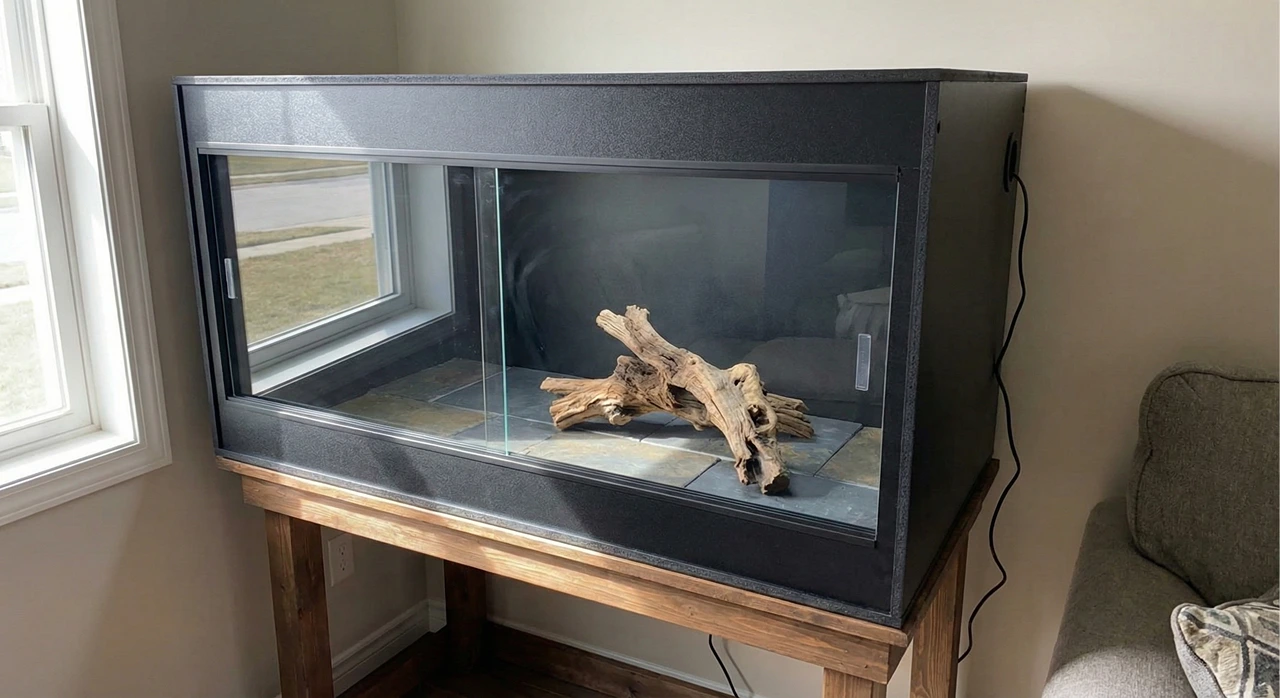
If you are building a long-term adult setup, PVC or wood with front-opening glass panels is where most serious keepers eventually land. Second-hand PVC and wood vivaria appear regularly on Facebook Marketplace for a fraction of retail price and are worth checking before committing to a new purchase.
Which Enclosures Are Actually Worth Buying
The real decision here is not which brand to buy. It is whether you want a PVC front-opener or a wood-framed slider, and whether long-term durability or lower upfront cost matters more to your situation.
Zen Habitats 4x2x2 PVC
Probably the most widely used adult beardie enclosure in the hobby right now. The front-opening doors make feeding and handling far less stressful for the dragon, and the build quality holds up well enough that owners are still running them five or six years later without issues.
Running a Zen 4x2x2 alongside a glass tank of identical floor dimensions, the PVC unit maintained a stable basking-to-cool differential two to three degrees more consistently throughout the day on the same bulb wattage. That difference shows up every time you check the thermometers.
Carolina Custom Cages 4x2x2 and 6x2x2
Wood-framed with tempered glass panels and the best value at larger sizes. The 6x2x2 in particular is where Carolina Custom Cages competes strongly on price. Solid heat retention, and the sliding glass doors provide full-width access.
These are not enclosures you move often once set up, but for a permanent adult installation they are difficult to beat at the price point. Before purchasing, confirm that listed dimensions are internal. Carolina Custom Cages and several other manufacturers quote external frame measurements, which puts the actual usable floor two to three inches shorter than advertised.
Custom Reptile Habitats
PVC and ABS plastic enclosures in 4x2x2 and 6x2x2 sizes, reliably available at retail across most of North America. Panel thickness sits slightly below Zen Habitats, but heat retention is good for a well-managed setup and the price is lower.
Is Your Current Tank Actually the Problem
Many keepers spend months adjusting bulb wattage, repositioning decor, and replacing thermostats before realising the enclosure itself is the constraint.
Before changing anything else, run this check. Place one digital thermometer at basking surface level and a second at floor level on the cool side. Leave both reading for two full hours after the lights come on.
If the difference between those two numbers is under 15°F, the enclosure is too short to support a functional gradient regardless of what equipment you are running inside it.
Then compare your dragon’s current length against the interior floor length of the enclosure. A dragon over 12 inches in an enclosure shorter than 48 inches needs an upgrade. A dragon over 18 inches in an enclosure under 48 inches needs one now.
Signs Your Dragon Has Outgrown Their Tank
Persistent glass surfing is the most common sign of a cramped enclosure. It looks like repeated runs along the front panel with front legs raised and head scanning upward.
It happens when a dragon cannot establish a proper territory within their space, or when the thermal gradient has collapsed and the dragon is trying to move somewhere cooler than anywhere inside the tank can actually provide.
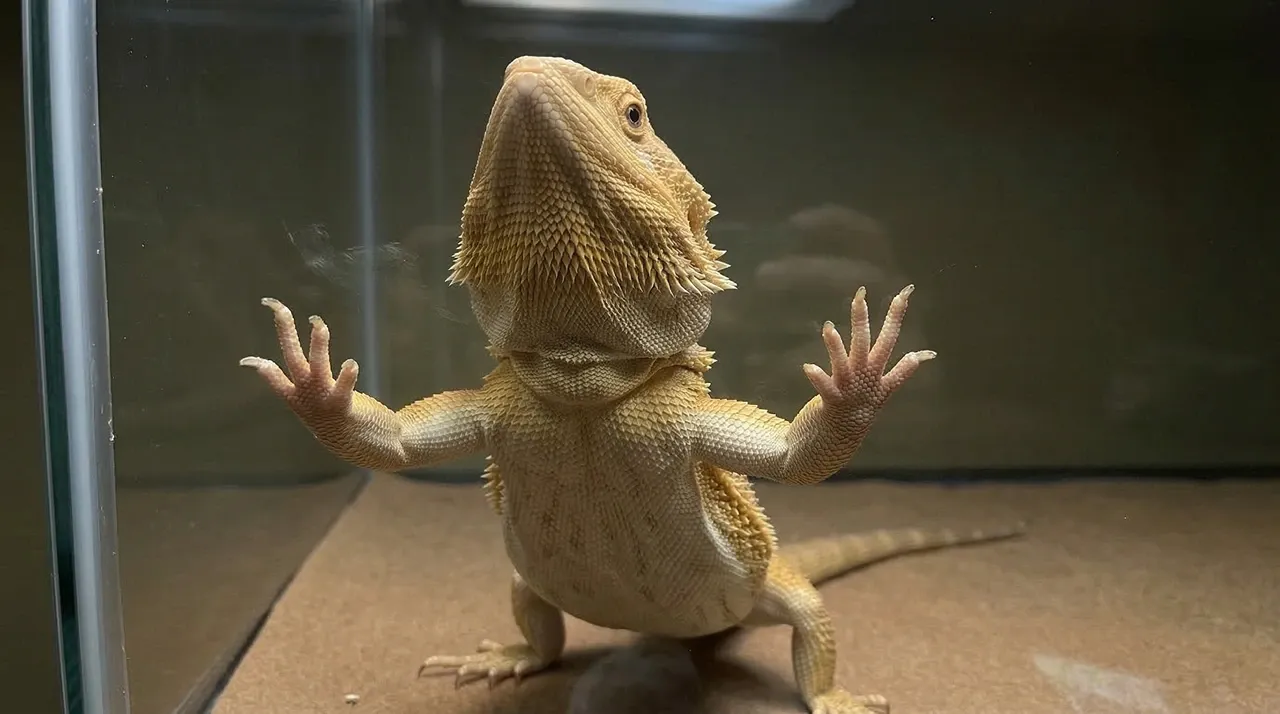
Glass surfing is not the only signal worth watching for. The table below covers the full range of signs linked to enclosure size problems, what typically drives each one, and what to do about it today.
| What You’re Seeing | Most Likely Cause | What to Do Today |
|---|---|---|
| Persistent glass surfing beyond 2–3 weeks | Collapsed gradient or inability to establish territory | Run two-thermometer test; if floor is under 48 inches, begin planning upgrade |
| Dark beard at cool end outside of threat displays | Thermal stress from a cool zone still running too warm | Measure cool-end floor temperature; reading should sit at 75–80°F |
| Sitting under basking light all day without moving | No genuine cool zone; dragon has nowhere to retreat | Two-thermometer test; check whether cool-end reading exceeds 85°F |
| Reduced appetite with no other illness signs | Chronic low-level stress from inadequate thermoregulation space | Check both temperature zones; if gradient is under 15°F, enclosure size is the issue |
| Poor shed quality — ragged pieces rather than clean sections | Inadequate thermoregulation affecting shed cycle and skin condition | Confirm gradient is correct and check that the substrate is not too dry |
| Visible weight loss despite regular feeding | Chronic digestive stress from prolonged heat without cool-zone access | Vet check plus full enclosure size and temperature gradient review |
| Lethargy outside of brumation season | Thermal stress or insufficient activity space | Measure both temperature zones and compare dragon length against enclosure floor length |
If an upgrade is still a few weeks out and the enclosure cannot support a proper gradient, supervised daily free-roam of thirty to sixty minutes on a properly heated surface reduces the daily thermal stress while you arrange the permanent fix.
It is not a substitute for the right enclosure, but it meaningfully lessens the impact on a cramped dragon in the short term.
Frequently Asked Questions
Is a 40-Gallon Fine for Baby Dragons
A 40-gallon breeder works for a hatchling under 10 inches, but treat it as temporary from the start. By around 6 to 9 months of age, most dragons have grown enough that the 40-gallon can no longer support a functional temperature gradient. Bypassing it entirely with a 4x2x2 from day one, combined with a ceramic feeding station in the warm zone, is the cleaner approach.
Will a 75-Gallon Work for Adults
A 75-gallon at 48″L x 18″W x 21″H is a workable minimum for an adult, but the 18-inch width limits UVB positioning and tightens the gradient considerably. A 4x2x2 at the same floor length but with 24-inch width and height makes the setup far easier to manage correctly, and it is worth the difference if you are upgrading anyway.
Can I Keep Two Bearded Dragons in the Same Tank
Housing two bearded dragons together is not recommended regardless of enclosure size. Males will fight, often seriously. Two females may appear to tolerate each other but will have ongoing dominance disputes that place chronic stress on the subordinate animal. Separate enclosures are always the right answer, and no amount of floor space changes the territorial dynamics between two adult dragons.
Does a Bigger Tank Make Heating Harder
In a glass enclosure, a larger footprint requires slightly more wattage to maintain the basking zone. In PVC or wood, a larger enclosure actually holds a more stable gradient because the walls retain ambient warmth. The answer is not a smaller tank. It is the right material combined with a correctly sized bulb.
What Is the Cheapest Way to Get a Properly Sized Enclosure
Second-hand PVC and wood enclosures on Facebook Marketplace or Craigslist regularly sell for half to a third of retail price. Zen Habitats and Carolina Custom Cages enclosures in good condition appear frequently. Keepers with basic carpentry skills also build in melamine or PVC board to their exact required dimensions for considerably less than most branded options.
Set This Up Before the Week Is Out
- Measure your current enclosure’s interior floor length. Not the gallon rating on the box. Write the actual number down. If it is under 48 inches, you already have your answer on bearded dragon tank size.
- Place a digital thermometer at basking surface level and a second one at floor level on the cool side. Record both readings two hours after the lights come on.
- If the difference between those two readings is less than 15°F, the enclosure is too short to support a functional gradient regardless of what equipment you adjust inside it.
- If an upgrade is still two to four weeks away, add thirty to sixty minutes of supervised daily free-roam on a heated surface while you wait. It partially compensates for gradient failure and noticeably reduces stress in a cramped dragon.
- If your dragon is over 12 inches and the floor is under 48 inches, begin researching 4x2x2 or larger enclosures. PVC and wood retain heat better than glass at the same dimensions and are worth the price difference for a permanent adult setup.
- When moving your dragon into a new enclosure, transfer the existing substrate, hides, and decor first before introducing the animal. Familiar scents in a new space settle a dragon faster than any other single action. Keep the lighting schedule normal from day one and hold off on handling for the first 48 hours.
Written by
Sarah ArdleySarah has kept bearded dragons for over ten years. She founded Beardie Husbandry after discovering that most mainstream care advice — including what she followed with her first dragon — was doing more harm than good. Every article on this site is grounded in veterinary research and real keeper experience.