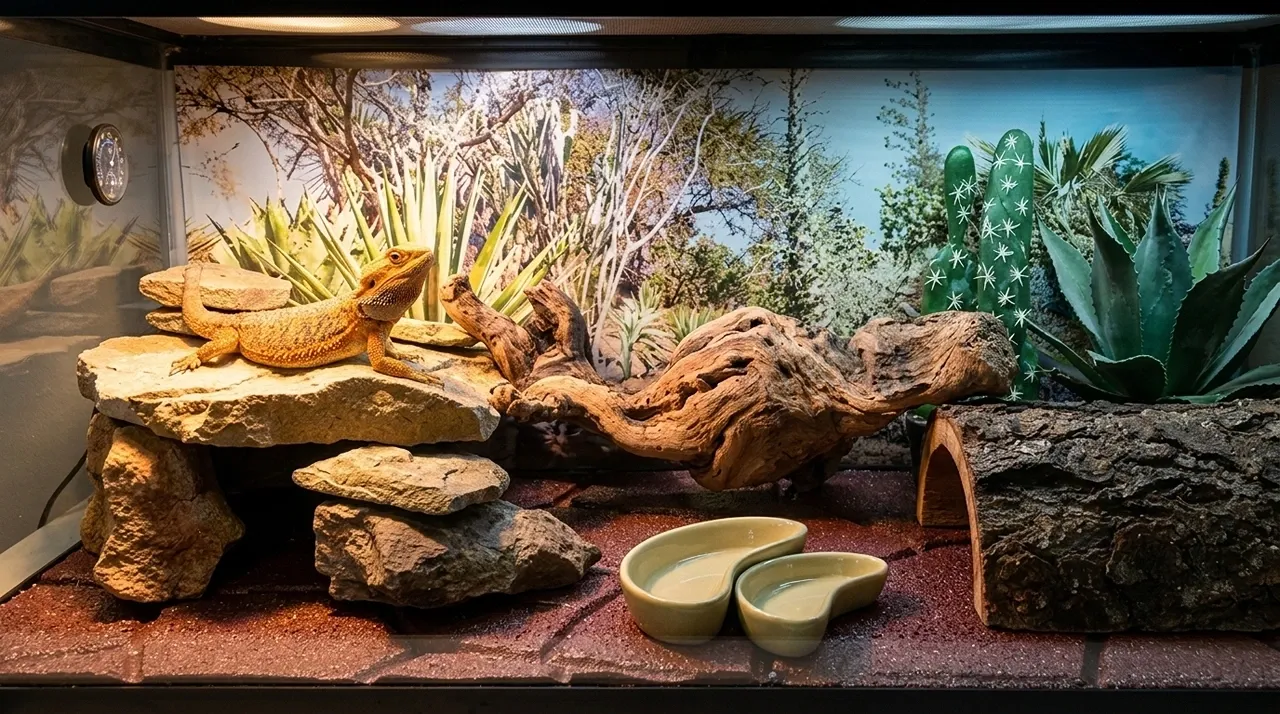
Do You Need a Thermostat for a Bearded Dragon Enclosure
A bearded dragon thermostat is not optional for most setups — but the type you need depends entirely on which heat source you are running, and getting that match wrong causes problems that most keepers never connect back to the thermostat at all. Bulbs failing early, basking spots that never hold temperature, dragons overheating in summer. Many of those trace back to a thermostat that is either missing or mismatched to the heat source.
Do You Actually Need One
For a ceramic heat emitter, yes. Always. For a halogen or incandescent basking bulb, a dimming thermostat is the right answer for most setups. The one scenario where you can run a basking bulb without a thermostat and maintain reasonable control is a stable room where a well-dialled wattage keeps the basking surface temperature correct year-round. Very few rooms qualify. Seasonal temperature drift alone — a room sitting at 68°F in January and 78°F in July — will push a fixed-wattage bulb from correct to dangerous without anyone noticing until the dragon starts overheating.
Why the Type Matters More Than Whether You Have One
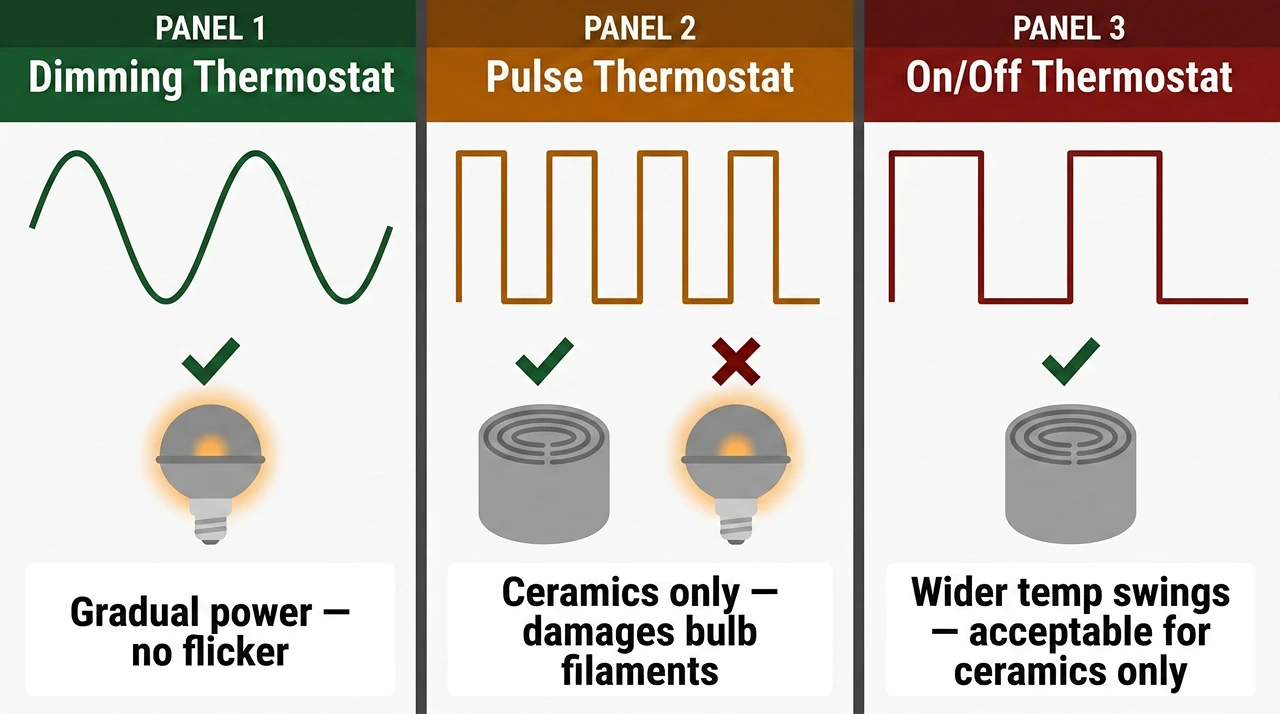
This is where most guides stop being useful. They tell you to get a thermostat without explaining that putting a pulse thermostat on a light-emitting basking bulb will shorten that bulb’s life and stress your dragon simultaneously. A pulse thermostat works by rapidly switching power on and off to regulate temperature. On a ceramic heat emitter, which produces no light, this is invisible and harmless. On a halogen or incandescent bulb, the rapid cycling produces a visible flicker that dragons notice, since light changes are not a subtle stressor for an animal that uses light cues for almost everything.
Repeated power cycling also degrades the bulb filament faster than continuous or gradually dimmed power. A bulb that should last six months on a dimmer will fail significantly sooner on a pulse thermostat. If you have gone through basking bulbs unusually quickly, check whether you are running the wrong thermostat type before buying replacements.
Use a Dimming Thermostat on Any Basking Bulb
A dimming thermostat regulates temperature by gradually raising or lowering the power output to the bulb. When the probe reads above the set temperature, the bulb dims. When the probe reads below it, the bulb brightens. The transition is smooth, the light change is minimal, and the filament is never subjected to the rapid cycling that shortens its life. For any halogen or incandescent basking bulb, this is the correct thermostat type.
Look for a high-range dimming thermostat rated to at least 600 watts, which gives you headroom for higher-wattage bulbs in larger enclosures without the unit working near its upper limit. Running a thermostat close to its maximum rated load shortens its lifespan, so spend slightly more on the wattage rating than your current bulb actually requires.
Pulse Thermostats Are for Ceramics Only
A pulse proportional thermostat sends rapid bursts of power to the heat source, modulating burst length and frequency as temperature approaches or moves away from the set point. On a ceramic heat emitter with no light output, this produces the most precise temperature control available. The flickering effect that makes pulse thermostats damaging to bulbs is physically irrelevant to a ceramic element.
Some keepers use a combined dimming and pulse thermostat with two independent outputs, one channel for the daytime basking bulb and one for the overnight ceramic. For a setup running both heat sources, one dual-output unit is the cleaner solution than two separate thermostats.
Where an On/Off Thermostat Actually Works
An on/off thermostat switches full power on when the probe reads below the set temperature and cuts it entirely when the probe reads above it. The result is a wider temperature swing than dimming or pulse control — the heat source overshoots before the thermostat cuts it, and undershoots before power is restored. For a basking bulb, those swings are too wide for stable temperature control.
For a ceramic heat emitter in a well-insulated wooden vivarium with a stable ambient room temperature, an on/off thermostat produces acceptable results. Wood retains heat well enough that the swings narrow considerably compared to a glass tank, where heat escapes faster between cycles. On/off thermostats are the cheapest entry point and a reasonable overnight ceramic controller in the right conditions, but not the right tool for daytime basking control in any setup.
Most Keepers Put the Probe in the Wrong Place
The probe measures temperature at one specific point and uses that reading to control the entire heat output. If the probe is in the wrong position, the thermostat is operating correctly on wrong data, and the basking spot will be wrong regardless of what the dial is set to. This is the most common cause of a basking spot that runs too hot or too cold despite a bearded dragon thermostat being present.
| Heat Source | Probe Position | Why |
|---|---|---|
| Basking bulb (dimming thermostat) | Taped flat on the basking surface, at the point where the dragon rests its body | Gives the thermostat the surface temperature the dragon actually experiences, not the air temperature above it |
| Overnight ceramic (pulse or on/off thermostat) | Cool end of the enclosure, a few centimetres above the floor | Measures ambient air at the lowest point — the relevant figure for maintaining overnight minimum temperature, not surface heat |
For a basking bulb on a dimming thermostat, secure the probe flat against the slate or tile — not on the wall, not suspended in air, not near the cool end. Surface placement at body level is the only position that gives the thermostat accurate data about what the dragon actually experiences during a basking session.
Secure the probe so a dragon cannot displace it by resting on it or pushing past during the night. A probe buried under substrate reads lower than the actual surface temperature and causes the thermostat to run the heat source hotter than intended. Check probe position whenever you deep clean the enclosure.
When the Room Temperature Fights Your Thermostat
A thermostat can only reduce power output to the heat source. It cannot add cooling when the room itself is too warm. If your room temperature rises by 10°F in summer, the thermostat correctly responds by dimming the basking bulb further. At some point the ambient room temperature alone pushes the basking surface above safe range with no bulb contribution at all, and the thermostat has no further intervention available.
Most keepers notice this as a basking spot running hot even though the thermostat is set correctly. It is set correctly. The room has changed around it. The fix is not to adjust the dial further — the fix is to swap to a lower-wattage bulb for summer so the thermostat regains a working output range. A temperature gun reading taken at the hottest point of the afternoon will tell you whether the surface is still within safe range when the room is at its peak.
Mercury Vapor Bulbs Cannot Be Thermostatted
Mercury vapor bulbs produce both heat and UVB from a single unit and cannot be connected to any thermostat. Reducing the power output of an MVB damages the bulb and affects its UVB output in unpredictable ways. Temperature control with an MVB is done entirely by raising or lowering the mounting distance above the basking surface. This makes MVBs poorly suited to enclosed vivariums where seasonal room temperature drift can push the basking spot above safe range with no thermostat to intervene.
If you run an MVB and your room temperature varies significantly between seasons, check the basking surface temperature more frequently during warm months and adjust mounting height accordingly. The UVB comparison guide covers the practical trade-offs between MVBs and T5 HO tube setups in detail.
What You Actually Need for Overnight Heating
Most homes in temperate climates stay warm enough overnight that supplemental heating is unnecessary for most of the year. Bearded dragons tolerate ambient temperatures down to around 65°F (18°C) without a heat source at night — they are inactive and their metabolic demand is minimal at that point, so the drop causes no harm. If your home consistently falls below that in winter, a ceramic heat emitter on a pulse or on/off thermostat is the right solution. No light output means no disruption to the sleep cycle.
Do not use coloured night bulbs — red or blue — as a substitute for a ceramic. Dragons can see those wavelengths and the light disrupts sleep. A ceramic on a thermostat is simpler, cheaper to run, and produces no light. More detail on whether overnight heating is actually needed for your specific setup is worth reading before buying additional equipment.
Why Your Basking Spot Ignores the Thermostat Setting
This almost always has one of four causes. Work through them in order before concluding the thermostat itself is the problem:
- The probe is not on the basking surface. It is on the wall, suspended in air, or buried under substrate. Fix probe position before adjusting anything else.
- The probe itself is failing. An ageing or damaged probe reading 5–8°F lower than actual temperature causes the thermostat to run the surface hotter than the set point — the display looks correct while the basking surface is too hot. If repositioning the probe does not resolve it, replace the probe.
- The thermostat wattage rating is too close to the bulb’s actual draw. Imprecise regulation near the unit’s upper limit produces a basking spot that cycles instead of holding steady.
- The thermostat is ageing. A unit that no longer regulates cleanly across its full output range will show the right set point while delivering inconsistent power.
Before replacing any equipment, confirm the probe is correctly placed and measure the basking surface with a temperature gun at the dragon’s dorsal height during a basking session, not at floor level. Reviewing the rest of your enclosure setup is worth doing if the problem persists after fixing the probe — thermostat issues often reveal underlying setup problems rather than existing in isolation.
Frequently Asked Questions
Do bearded dragons need a thermostat or is a temperature gun enough
A temperature gun tells you what the temperature is at a single moment. A bearded dragon thermostat keeps it stable without continuous monitoring. Manual measurement works if you check consistently and adjust seasonally, but most keepers do not catch gradual room temperature drift before it becomes a problem.
Can I use any thermostat with a halogen basking bulb
No — use a dimming thermostat only. A pulse thermostat on a light-emitting bulb produces visible flicker and accelerates filament failure. An on/off thermostat produces temperature swings too wide for accurate basking control.
Where exactly does the thermostat probe go for the basking bulb
Tape the probe flat against the basking surface at the point where the dragon rests its body. Probe position on the surface at body level is the only placement that gives the thermostat accurate data about what the dragon is actually experiencing.
My basking spot runs hot even though the thermostat is set correctly. What is wrong
The most likely cause is seasonal room temperature rise — the thermostat has already dimmed the bulb as far as possible and cannot compensate further. Swap to a lower-wattage bulb for the warmer months so the thermostat recovers a working output range, and verify the surface temperature with a temperature gun at the hottest point of the afternoon.
What thermostat do I need for a ceramic heat emitter at night
A pulse proportional thermostat gives the most precise control for a ceramic and is the recommended type. An on/off thermostat also works acceptably in a well-insulated wooden enclosure with a stable room temperature. Never use a dimming thermostat on a ceramic heat emitter.
Before You Buy or Adjust Anything — Check These First
- ✅ Identify your heat source type before buying a thermostat. Halogen or incandescent basking bulb needs a dimming thermostat. Ceramic heat emitter needs pulse or on/off. MVB needs neither — control temperature by adjusting mounting height only.
- ✅ Check probe position before touching the thermostat dial. If the basking spot is running wrong, probe placement is the most likely cause. Confirm it is taped flat to the basking surface at body level — not on the wall, not displaced, not buried in substrate.
- ✅ If probe position looks correct but the problem persists, replace the probe. An ageing probe reading low will run your basking surface hotter than the set point while the thermostat display shows nothing wrong.
- ✅ Check the thermostat wattage rating against your bulb. The thermostat should be rated significantly higher than the bulb’s draw. Running near the rated maximum causes imprecise regulation over time.
- ✅ Take a basking surface reading with a temperature gun in the afternoon during the warmest week of your local year. If the surface is running hot with the thermostat already at minimum output, switch to a lower-wattage bulb for summer — the thermostat cannot cool the enclosure, but a lower-wattage bulb gives it a working range again.
- ✅ If basking bulbs fail unusually quickly, check whether you are running a pulse thermostat on a light-emitting bulb. Switch to a dimming thermostat and bulb lifespan should recover.
- ✅ Overnight supplemental heat is only needed if your room drops below 65°F (18°C). If it does, a ceramic emitter on a pulse or on/off thermostat is the correct tool. Do not use coloured night bulbs.
Disclaimer: This article is for general husbandry guidance only and does not constitute veterinary advice. If your bearded dragon is showing signs of heat stress, burns, or temperature-related illness, contact a qualified reptile veterinarian.
Written by
Sarah ArdleySarah has kept bearded dragons for over ten years. She founded Beardie Husbandry after discovering that most mainstream care advice — including what she followed with her first dragon — was doing more harm than good. Every article on this site is grounded in veterinary research and real keeper experience.