Bearded Dragon Lifespan – What Actually Determines It
I have kept bearded dragons for over a decade, and the lifespan question comes up in almost every conversation with a new owner. Most have already read 10–15 years somewhere and want confirmation. I have seen dragons reach 13 or 14 years when everything was done right from the start. I have also seen dragons from the same clutch barely make it to 6 when the setup was not quite there. Same genetics, different outcomes. That gap is almost entirely husbandry.
The oldest confirmed bearded dragon on record was Sebastian, a UK-kept Pogona vitticeps who reached 18 years and 237 days. Worth saying plainly: most pet store dragons are mass-bred, which means their genetic starting point is different from a carefully line-bred animal. A mass-bred dragon kept perfectly may still not match Sebastian’s age, and setting that expectation early saves a lot of unnecessary guilt later. What the husbandry determines is how close to the upper end of that dragon’s individual range it gets to go.
What a Realistic Lifespan Actually Looks Like
Wild bearded dragons in central Australia typically live between 5 and 8 years. Predation, drought, food scarcity, and parasites take their toll in an environment with no veterinary care and no guaranteed meals. A captive dragon has none of those pressures working against it, which is why a well-kept captive animal routinely outlives its wild counterpart by several years.
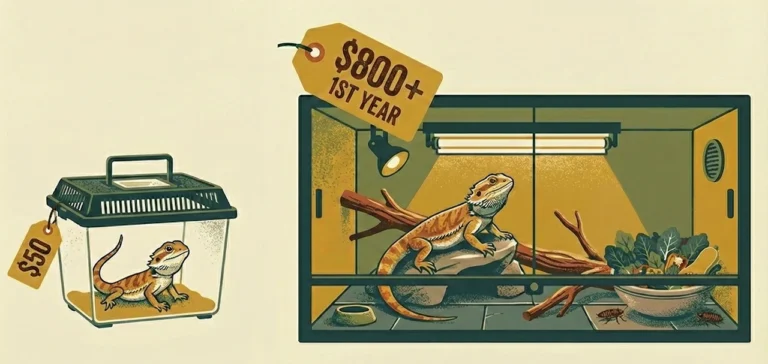
The gap between a 6-year captive lifespan and a 12-year one comes down to how consistently correct the husbandry was across the animal’s entire life. A dragon raised from the start on a quality T5 HO UVB tube, verified surface temperatures, and a rotating diet of varied feeders and fresh greens is not the same animal physiologically as one kept on a starter kit with a coil bulb and a diet heavy in crickets. Both are technically captive. Their outcomes will not be similar.
Your Dragon’s UVB Setup Determines More Than Anything Else
More captive bearded dragons die early because of incorrect UVB than from any other single cause. The damage takes months or years to appear, which is why it gets missed. By the time the consequences are obvious, the problem has often been running for most of the animal’s life.
Here is what inadequate UVB actually does over time:
- Prevents Vitamin D3 synthesis, which means calcium cannot be absorbed efficiently regardless of how much calcium powder goes on the feeders. The supplementation becomes irrelevant without the UVB to process it.
- Causes metabolic bone disease as calcium deficiency accumulates across months. Bones weaken, deformities develop, and eventually the dragon loses the ability to move and eat normally. Early MBD is reversible. Late-stage MBD is not.
- Suppresses immune function over years, making the dragon more susceptible to infections and parasite overloads that a correctly lit animal would fight off far more effectively.
- Produces damage that does not fully reverse when the lighting is corrected late. I have seen owners switch from a coil to a T5 HO at year three and see genuine improvement — better appetite, more active basking, better colour. What does not come back is the bone density and organ condition lost during those first three years. Getting it right early is what matters.
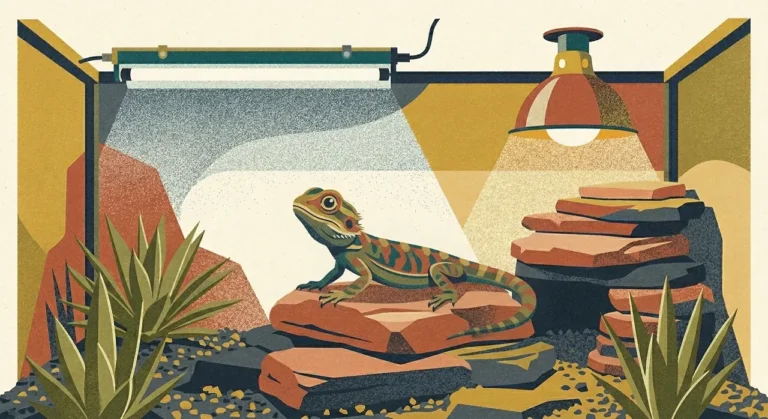
A 5.0 or 5% coil bulb, which ships in most starter kits, does not produce adequate UVB for a bearded dragon. The correct setup is a T5 HO linear tube at 10% or 12% output, positioned at the right distance without thick mesh reducing output before it reaches the dragon. Output requirements, mounting distances, and the specific models worth using are in the lighting guide.
What Running Too Cold or Too Hot Actually Does Over Time
Temperature problems are subtle in the short term and damaging in the long term. A dragon in a setup that is slightly off in either direction does not look obviously ill. It just ages faster than it should.
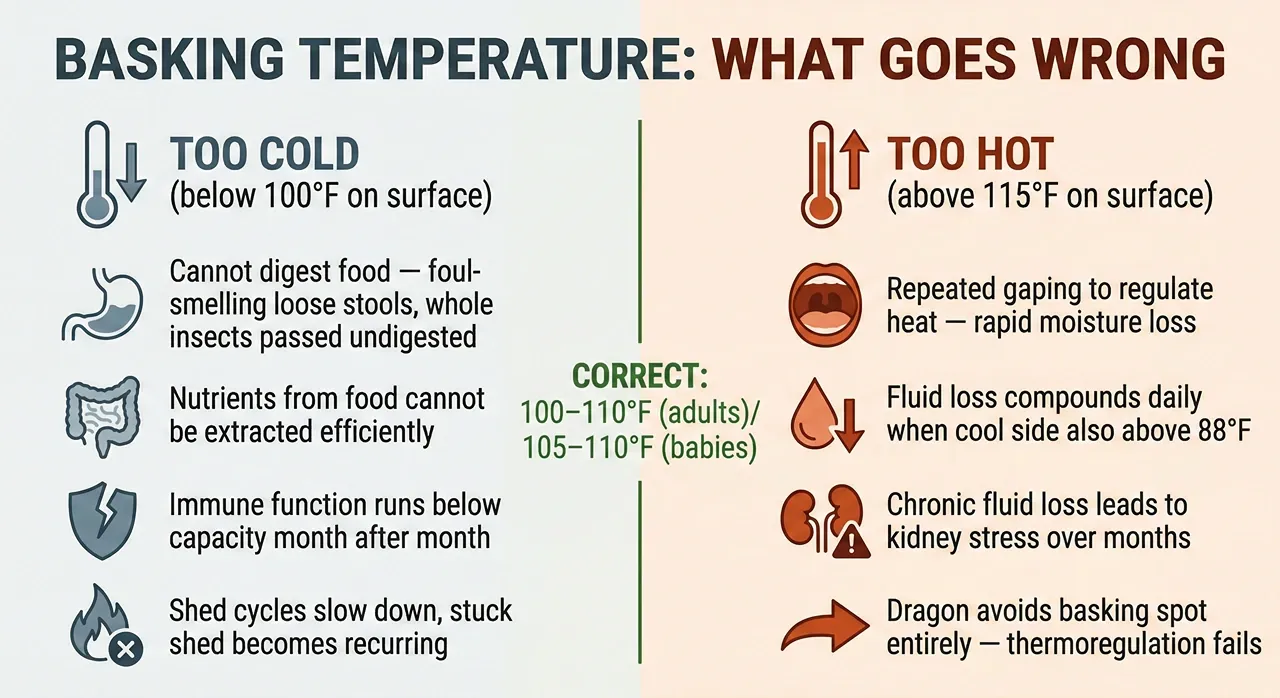
A basking spot running consistently too cold — 88–95°F on the surface rather than the correct 100–110°F — produces a dragon that cannot digest food properly. In practice, this shows up as foul-smelling, unusually loose stools containing undigested insect parts, and occasionally a dragon vomiting up whole feeders hours after eating. It is one of those things you see once and it sticks with you. The dragon is not acutely ill. It just cannot extract nutrition from what it is eating because the thermal conditions are not right. Over years, that daily deficit ages the animal faster than it should.
Overheating creates a different problem set. A basking spot consistently above 115°F forces repeated gaping to regulate temperature, losing moisture with every breath. When the cool side is also running above 88°F, there is nowhere to escape the heat and the fluid loss compounds across every day. Both extremes damage organ function when left uncorrected across months. Verifying actual surface temperatures with an infrared gun rather than relying on analogue gauges is what makes the difference — analogue thermometers routinely misread by 15–20°F in either direction.
What the Dragon Eats Across a Lifetime
A bearded dragon eating genuinely varied feeders, receiving appropriately dusted insects, and eating a range of leafy greens daily will have meaningfully better organ function at age eight than one fed primarily on crickets and iceberg lettuce. The difference does not show up at age two. It shows at age seven or eight, when cumulative nutritional gaps begin to manifest as liver disease, kidney disease, or the kind of chronic immune suppression that makes every subsequent illness harder to recover from.
Rotating feeder species and keeping greens genuinely varied across the dragon’s life — not occasionally, consistently — is what prevents this from building. A proper feeder rotation and supplementation schedule changes across life stages and is worth revisiting as the dragon moves from juvenile to adult.
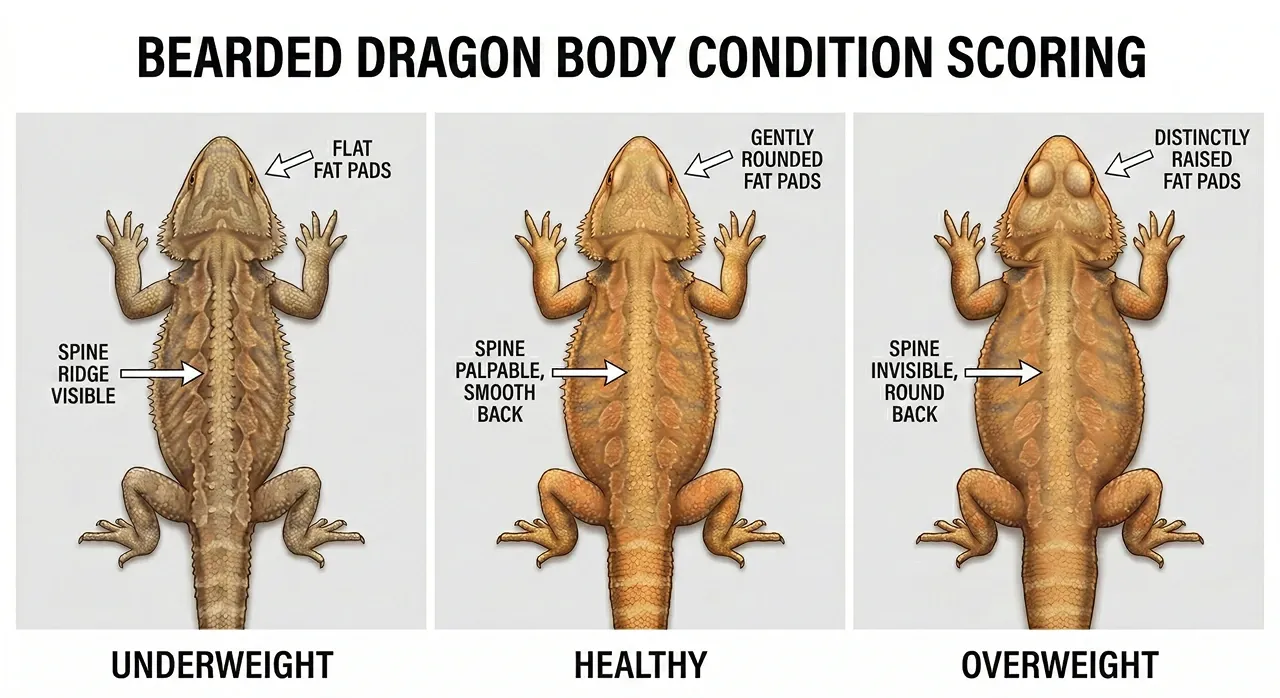
Obesity is a separate and increasingly common problem, particularly in adults that are overfed protein and under-exercised in small enclosures. A fat dragon looks healthy to a new owner — often it looks better than a lean one. The physical checks worth doing: feel the fat pads on top of the head, which become visibly raised and rounded in an overweight animal, and run a finger along the spine. A healthy dragon has a spine you can feel but not prominently see. A dragon where you cannot find the spine through the back fat, or where the fat pads sit noticeably higher than eye level, is carrying too much weight. Fatty liver disease develops silently in obese dragons over years and shows no obvious symptoms until it is well advanced.
The Hidden Cost of Egg Laying on Female Lifespans
Female bearded dragons lay eggs whether or not they have mated with a male. An unmated female producing infertile clutches undergoes the same physical process as a breeding female, with the same demands placed on her body. Each clutch takes a real toll:
- Calcium depletion is severe with each clutch. Without aggressive supplementation before and after laying, the body draws calcium from the bones to produce the shells — the same mechanism that causes MBD in poorly supplemented dragons.
- Protein and fat reserves are burned through producing and passing a full clutch. Most females finish a laying season noticeably thinner than when they started it.
- Recovery time between clutches matters enormously. A female producing two or three clutches per year without adequate recovery between each one is in a state of near-constant physiological stress across the laying season.
- The cumulative lifespan effect is real. I have seen females lose years compared to males from the same setup simply from repeated clutches without proper nutritional support between them.
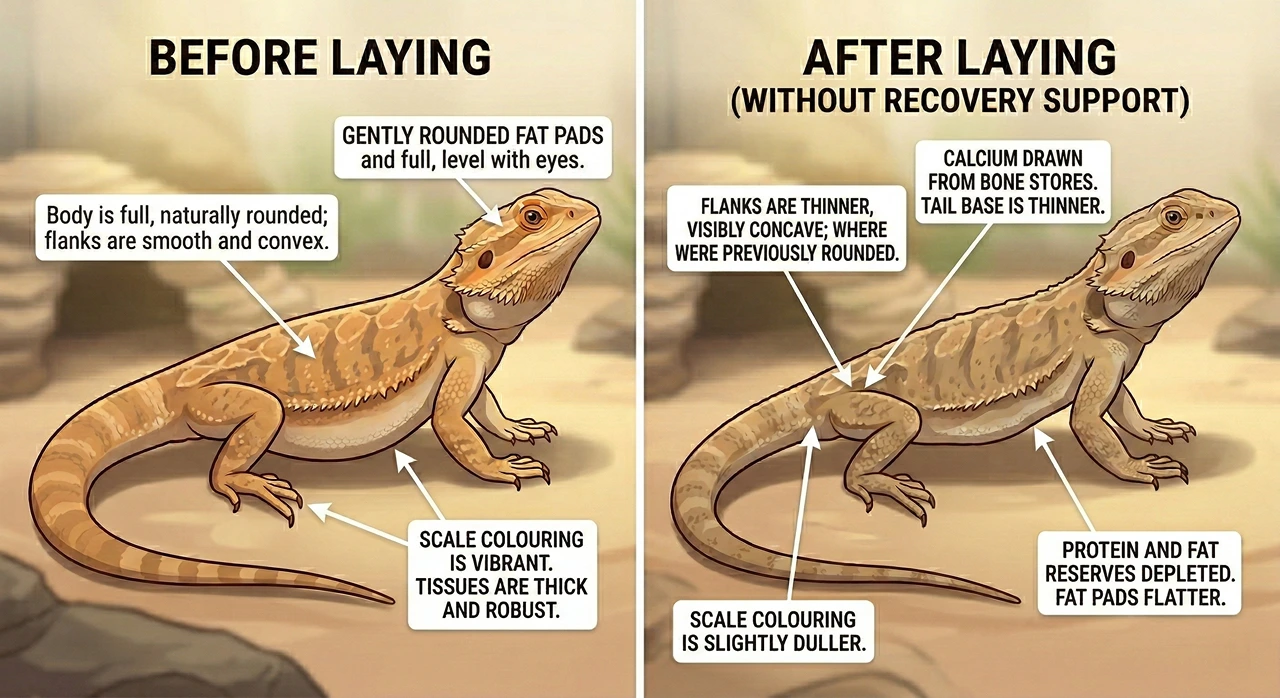
Males have a slight average lifespan advantage over females for exactly this reason. Females kept singly, fed a calcium-rich diet, and given proper recovery support after each laying season can match male lifespans — it requires more attentive management rather than fundamentally different care. How to identify a gravid female, how to set up a suitable laying site, and how to support recovery afterward is in the egg laying guide.
Cohabitation Stress Affects Both Dragons Over Time
Two bearded dragons housed together experience chronic low-level stress that suppresses immune function, disrupts consistent feeding, and affects basking behaviour in the subordinate animal. I have seen this in setups where the owner was completely convinced the dragons were getting along — no visible fighting, no obvious aggression, both animals appearing to eat. The stress response operates below the threshold of obvious symptoms, and a dragon carrying that chronic stress for years recovers more slowly from illness and shows accelerated ageing compared to a solitarily housed animal. This happens even in setups that appear peaceful, and separate enclosures are the appropriate long-term arrangement regardless of how the animals seem to interact day to day.
Parasites Running Unchecked for Years
A significant proportion of captive bearded dragons carry internal parasites, particularly those purchased from pet stores with communal housing. A low parasite load in a healthy, well-fed dragon may not cause obvious illness. What it does do, over years, is suppress immunity, interfere with nutrient absorption, and contribute to the gradual condition decline that many owners attribute to normal ageing. The subtle signs worth watching for are particularly foul-smelling loose stools that do not match the current diet, and a slow downward drift in body weight despite the dragon appearing to eat normally. Either of those, persisting over weeks, is worth a vet visit before assuming a dietary explanation.
Annual faecal float testing needs to specifically cover protozoa including coccidia — a standard worm-only test misses coccidia entirely, which is one of the most common silent health drains in captive dragons. It is one of the most cost-effective investments in long-term health a keeper can make, and most exotic vets can run it from a fresh dropping sample without a full consultation.
Kidney Disease and the Dehydration Connection
Something I see regularly in older dragons is kidney stress that has been building quietly for years before it becomes diagnosable. Without adequate fluid intake, the kidneys cannot flush uric acid efficiently. Over years, uric acid crystallises in the joints and tissues — a condition called gout — and kidney function deteriorates progressively. By the time it is diagnosed in an older dragon, the damage is usually well advanced.
The dragons most at risk are not ones with obviously bad setups. They are the ones where hydration was never quite a priority — water bowl always full, but urates running pale yellow for years, soaking done occasionally rather than regularly, greens offered dry rather than wet.
I weigh my adults every two weeks at feeding time, and that habit has caught slow weight loss from kidney stress more than once before it became a crisis. Checking urate colour at every defecation and building regular soaking into the weekly routine are habits that compound into meaningfully better kidney function in later life.
Bearded Dragon Lifespan by Setup Quality
| Setup Quality | Realistic Lifespan | Primary Lifespan Limiters |
|---|---|---|
| Starter kit, coil UVB, analogue thermometer, limited diet | 4–7 years | MBD, chronic malnutrition, kidney disease from dehydration |
| Adequate setup, some husbandry gaps, irregular vet care | 7–10 years | Parasite loads, diet deficiencies, obesity from overfeeding adults |
| Correct UVB, verified temps, varied diet, annual vet checks | 10–14 years | Age-related organ decline, genetic factors |
| Exceptional husbandry, attentive lifelong care | 14–18 years | Genetic ceiling, natural age-related decline |
Frequently Asked Questions
Is 10 years old considered old for a bearded dragon?
No — in a well-managed setup, 10 years is healthy middle age rather than exceptional longevity. Dragons with correct UVB, a varied diet, and regular vet care routinely reach 12 or more years. A dragon reaching 10 in a mediocre setup has likely already accumulated significant health stress and may be near the end of its realistic lifespan regardless of age.
Do male or female bearded dragons live longer?
Males generally live slightly longer on average. The primary reason is that females carry the physiological cost of egg production across their lifetime, depleting calcium and protein reserves with every clutch whether or not they have mated. A female with attentive post-laying nutritional support can match male lifespan, but it requires more active management to get there.
What is the most common reason bearded dragons die early?
Incorrect UVB leading to metabolic bone disease and chronic immune suppression is the most common underlying cause. This is frequently compounded by long-term dehydration contributing to kidney disease. Both develop silently over months and years, which is why they are regularly attributed to natural ageing rather than the preventable husbandry causes they actually are.
How do I know if my dragon is ageing normally or declining from poor health?
A normally ageing dragon slows down gradually, basks for shorter periods, and eats somewhat less — but maintains stable body weight, passes normal droppings, and has clear bright eyes. A dragon declining from health problems loses visible body condition, produces orange or dark urates, and shows sunken eyes alongside the lethargy. Weighing every two weeks is the most reliable way to distinguish the two, because weight change shows up before most other visible symptoms do.
Does where I buy my dragon affect how long it lives?
It can give you a better or worse starting point. Pet store dragons frequently carry parasite loads from communal housing and may arrive with early nutritional deficiencies from inadequate display tank UVB. A vet check and faecal float test within the first month catches these early when they are straightforward to treat. Husbandry after purchase ultimately determines lifespan far more than origin, but knowing what you are starting with lets you address existing deficits before they compound.
What to Focus on for a Long-Lived Dragon
Lighting and temperature first:
- ✅ Replace any coil or 5% UVB bulb immediately. A T5 HO linear tube at 10% or 12% output is the correct baseline. This is the single highest-impact change you can make.
- ✅ Verify basking surface temperature with an infrared gun. Target 100–110°F on the rock surface. Not the air. Not an analogue gauge reading.
Diet and weight:
- ✅ Rotate feeders and keep greens varied. No single feeder provides complete nutrition. Variety across a lifetime prevents the cumulative deficiencies that accelerate ageing.
- ✅ Check body condition regularly. Feel for the fat pads on top of the head and run a finger along the spine. Both invisible fat pads and a prominent spine are problems. Healthy sits between the two.
Hydration and health monitoring:
- ✅ Check urate colour every time the dragon defecates. Pale yellow means borderline. Orange means soak today. This habit alone prevents most long-term kidney disease from developing.
- ✅ Weigh adults every two weeks. Stable weight with gradual ageing changes is normal. A consistent downward drift over weeks needs investigation before it becomes a crisis.
- ✅ Get an annual faecal float test that covers protozoa. A worm-only test misses coccidia, which is one of the most common silent health drains in captive dragons.
Housing and female care:
- ✅ House dragons singly. Cohabitation stress suppresses immunity and shortens lifespan in both animals regardless of whether visible aggression occurs.
- ✅ Support females through and after laying seasons. Calcium supplementation, adequate recovery time between clutches, and a suitable laying site reduce the cumulative physiological cost that repeated egg production places on long-term health.
Disclaimer: This article is for general husbandry guidance only and does not constitute veterinary advice. If your bearded dragon is losing condition, showing signs of metabolic bone disease, or declining in a way that does not resolve with husbandry corrections, a qualified reptile veterinarian is the right next step.
Written by
Sarah ArdleySarah has kept bearded dragons for over ten years. She founded Beardie Husbandry after discovering that most mainstream care advice — including what she followed with her first dragon — was doing more harm than good. Every article on this site is grounded in veterinary research and real keeper experience.