Do Bearded Dragons Recognize Their Owners
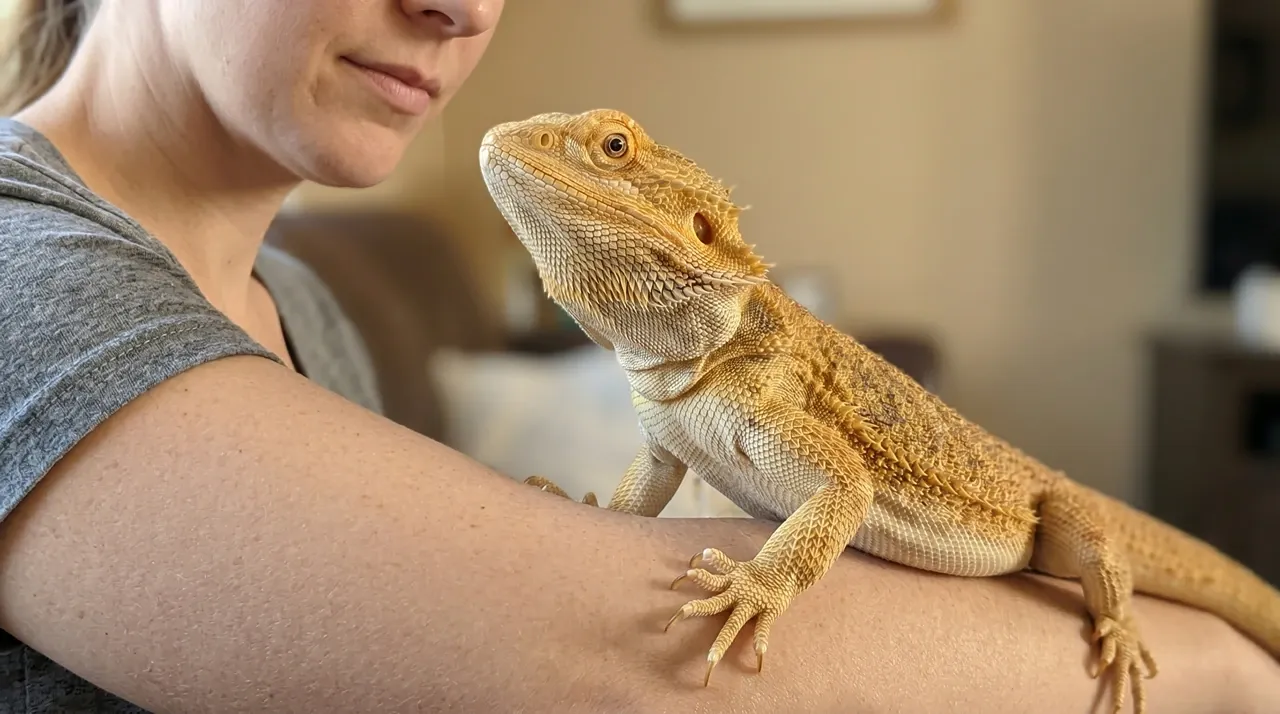
If you’ve ever walked into the room and watched your dragon’s head lift, the eye swing toward you, and the body angle shift toward the glass, you’ve already seen recognition at work. It looks nothing like a dog running to the door. The signal is quieter, slower, and easy to miss if you’re expecting mammal behaviour. But it’s real, and understanding how it works changes how you interact with your dragon every day.
The short answer is yes. Bearded dragons recognize their owners through a combination of sight, scent, and voice, and the recognition is genuine rather than pure coincidence. The longer answer, which almost no ranking article gets into honestly, separates genuine recognition from simple food association and explains the sensory machinery making it possible.
How Bearded Dragons Actually Recognize People
Dragons use three overlapping channels to identify you. Each channel works differently, and all three usually reinforce each other after a few weeks of consistent contact.
Scent Through the Vomeronasal Organ
When your dragon flicks its tongue as you approach, that’s not random. Bearded dragons have a specialised sensory structure in the roof of the mouth called the vomeronasal organ, or Jacobson’s organ. The tongue collects scent particles from the air and presses them against this organ, which reads them the way we read a face.
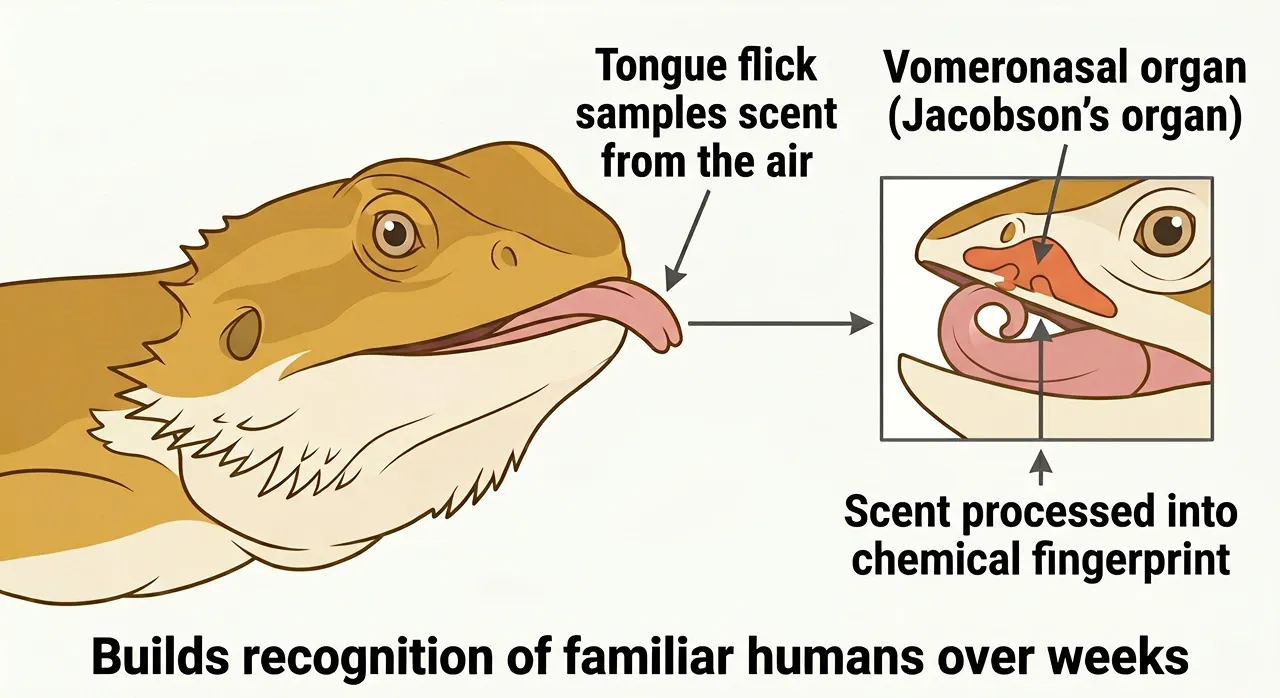
Your scent profile stays remarkably stable. Soap, deodorant, laundry detergent, skin oils, diet. Your dragon builds a chemical fingerprint of you over days and weeks. A worn t-shirt left in a new dragon’s enclosure helps settle it faster for exactly this reason. The scent becomes associated with no threat occurring, and eventually with food and warmth.
Visual Recognition of Your Shape and Movement
Bearded dragons have excellent colour vision and detect motion extremely well. They lock onto the silhouette of a regular keeper and treat it as safe. Change that silhouette and you get an interesting reveal of how much they rely on sight.
Put on sunglasses, a hood, or a hat you never normally wear, and many dragons will beard black or back away from a hand they’d normally climb onto. Speak, and they usually calm down within seconds. The shape confused them. The voice reassured them.
Voice and Vibration
Dragons don’t have external ears, but they hear well through bone conduction and detect airborne vibration at lower frequencies than people assume. Your voice, especially at normal conversational tone and pitch, becomes a predictable marker. Talk to your dragon every time you open the enclosure and within a few weeks the sound of your voice alone will often bring the head up from a nap.
Is It Recognition or Just Food Association
Here’s where honest keepers part ways with pet-blog optimism. A dragon that flips into feeding mode every time anyone opens the tank isn’t recognising you specifically. It’s recognising the event.
Genuine individual recognition shows up in behaviours that have nothing to do with food. A dragon that calms specifically when you pick it up but struggles with a housemate is discriminating between people. A dragon that watches you cross the room without tongue-flicking for food is tracking you socially.
The distinction matters because it shapes expectations. If your dragon only reacts at feeding time, don’t read that as a deep bond. If it reacts when you walk past the enclosure empty-handed, pays attention to your voice, and relaxes under your specific touch, that’s the real thing.
What the Science Actually Says
Reptile cognition research has moved fast in the last decade. A 2014 study from the University of Lincoln found that bearded dragons are capable of true imitation, learning to open a sliding door after watching another dragon do it. Before that, imitation was thought to be limited to mammals and some birds.
The finding matters because imitation requires noticing another individual, tracking their behaviour, and replicating it. All of which are the cognitive building blocks of recognising specific individuals. More recent work has confirmed that bearded dragons show behavioural preferences for familiar humans and respond to individual voices. They’re not emotional in the mammalian sense, but they are clearly capable of forming stable individual-level associations with specific people.
A Realistic Bonding Timeline
Bonding doesn’t happen on a fixed schedule, but there are markers most keepers see in roughly the same order.
| Week | What You’ll Typically See | What’s Happening |
|---|---|---|
| Week 1 | Hiding, stress glass-surfing, may not eat | Your dragon is processing the new enclosure and strange scents. No recognition yet. |
| Week 2 to 3 | Comes out during the day, accepts food, still flinches at hand movement | Environment has become predictable. You’re still unknown. |
| Week 4 to 6 | Tongue-flicks toward you, stops hiding when you approach, tolerates short handling | Scent and silhouette recognition forming. |
| Week 7 to 10 | Looks up when you enter the room, calms faster in your hand than others’ | Individual recognition established. |
| Month 3 onward | Glass-taps for attention, settles on you during handling, calms to your voice | Trust built on top of recognition. |
Rescue dragons and rehomes often take twice as long. A dragon that arrived stressed, underweight, or with a bad previous keeper experience may need three to six months before the markers above appear. That’s normal and not a sign you’re doing anything wrong.
Signs Your Dragon Recognises You Specifically
These are the behaviours that separate genuine individual recognition from a dragon that’s simply used to the enclosure being opened.
- Head lifts and tracks you when you walk past the enclosure, with no food in sight
- Calms faster in your hands than in anyone else’s, including stopping beard-darkening within seconds
- Comes to the front of the enclosure when it hears your voice from another room
- Tongue-flicks in your direction when you approach, even from across the room
- Accepts food from your hand but refuses it from a stranger during the same session
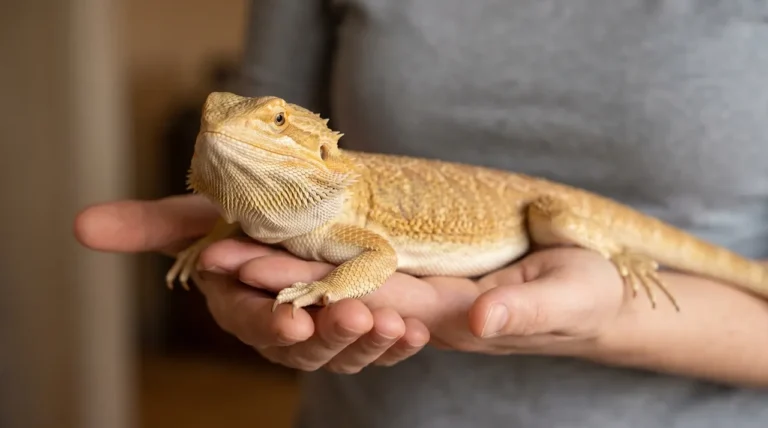
- Sits more loosely on your shoulder or chest than on other people, with legs relaxed rather than bracing
- Shows the head-tilt examination behaviour toward new visitors but not toward you
Not every dragon does all of these. Personality varies as much in beardies as it does in dogs. A bolder dragon will show more obvious reaching and glass-tapping. A shyer one might show recognition only by calming noticeably faster in your specific grip. Both are real recognition. What a calm confident individual looks like compared to one still in the cautious phase is easier to see than to describe.
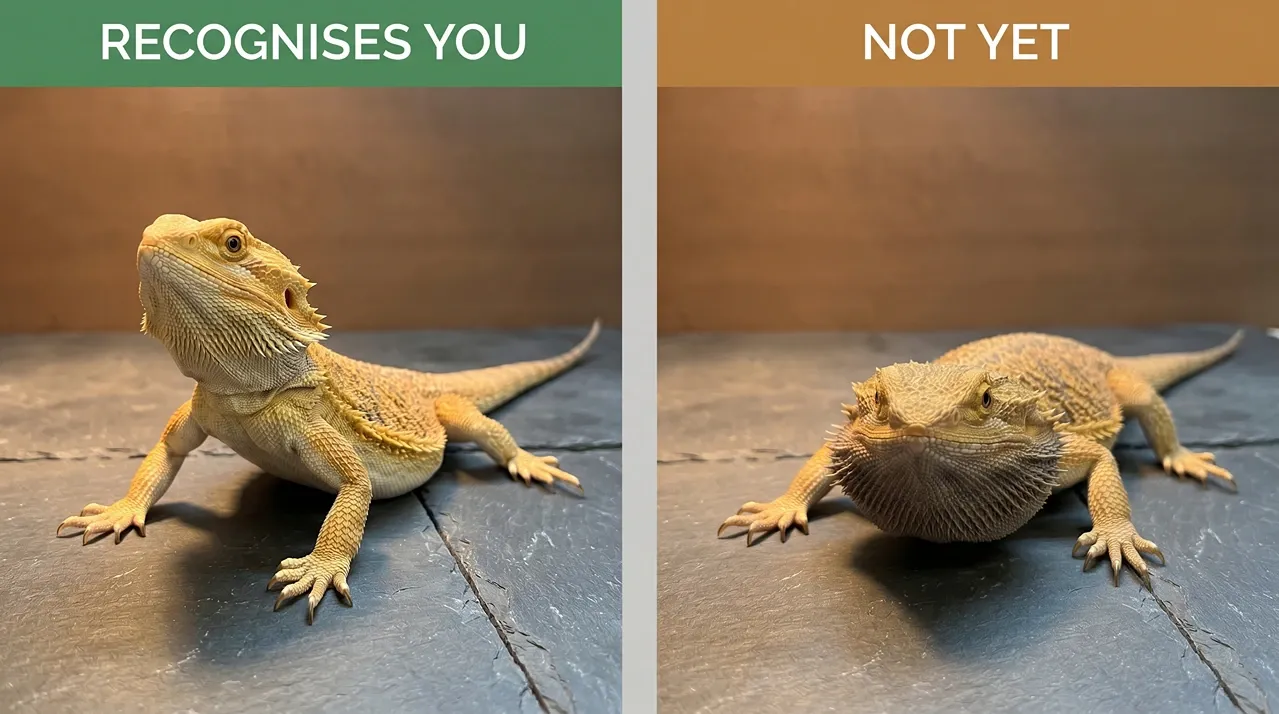
Signs Recognition Hasn’t Happened Yet
If your dragon has been with you for more than a few weeks and none of the markers above are appearing, something is interrupting the process. The usual causes are worth checking before you assume the dragon simply isn’t a bonding type.
- Husbandry stress, especially incorrect basking temperature or missing UVB, keeps a dragon in survival mode and blocks social learning
- Over-handling during the first two weeks, before the enclosure itself feels safe
- Multiple household members handling inconsistently, so no single scent profile dominates
- An enclosure positioned in high-traffic noisy areas, which keeps baseline stress elevated
- Recent illness or a course of medication, both of which can temporarily flatten engagement
A dragon that is hiding, darkening, or refusing food consistently won’t build recognition on top of that. Sort the husbandry first. Many of the signs people read as fear of the handler are actually stress from the environment, and the classic signals of a frightened or threatened dragon are worth learning so you can tell the two apart. Our full body language guide covers the reading of posture, beard colour, and eye bulging in detail.
What Breaks or Interrupts Recognition
Recognition isn’t static. The process can be temporarily disrupted in ways that catch keepers off guard. Knowing what disrupts it prevents you from misreading your dragon.
Visual changes to you. Sunglasses, a new hat, a face mask, or a heavy coat can all throw off the visual profile. The dragon often beards or retreats, then recovers within seconds once you speak.
Voice changes when you’re ill. A heavily congested voice with different pitch and resonance is sometimes enough to delay the calming response. Combining voice with your normal scent usually bridges it.
Long absences. After a holiday of two to three weeks, some dragons act slightly cautious for a day or two. Recognition returns fast but isn’t instant. Longer gaps, especially during brumation when the dragon is largely asleep, can produce a brief re-orientation period. If your dragon is emerging from brumation after a long winter sleep, expect a few days of sluggish engagement before normal responsiveness returns.
Moving house. A new enclosure location resets some of the environmental cues your dragon uses. You’ll still be recognised, but overall engagement usually dips for a week or two while the new baseline settles.
Multi-Person Households and Favourites
Dragons often bond more strongly with one person in a household. This pattern is well documented in forum reports and consistent with how individual recognition works. The favourite is almost always the person who handles most often, speaks to the dragon most, and is the calmest during interactions. Fear transmits through body tension. A nervous handler produces a nervous dragon, which slows recognition.
If you want your dragon to bond with multiple household members, the fix is simple. Everyone who handles should follow the same calm approach, use a similar greeting phrase, and participate in feeding occasionally. Recognition spreads to anyone who becomes a predictable part of the routine.
How to Build Recognition Faster
Most of the advice online stops at “hold them often.” That’s not wrong, but it’s incomplete. These are the habits that actively accelerate recognition.
Talk every time you open the enclosure. Use the same short phrase. Your dragon will start associating voice with the sequence of events that follows.
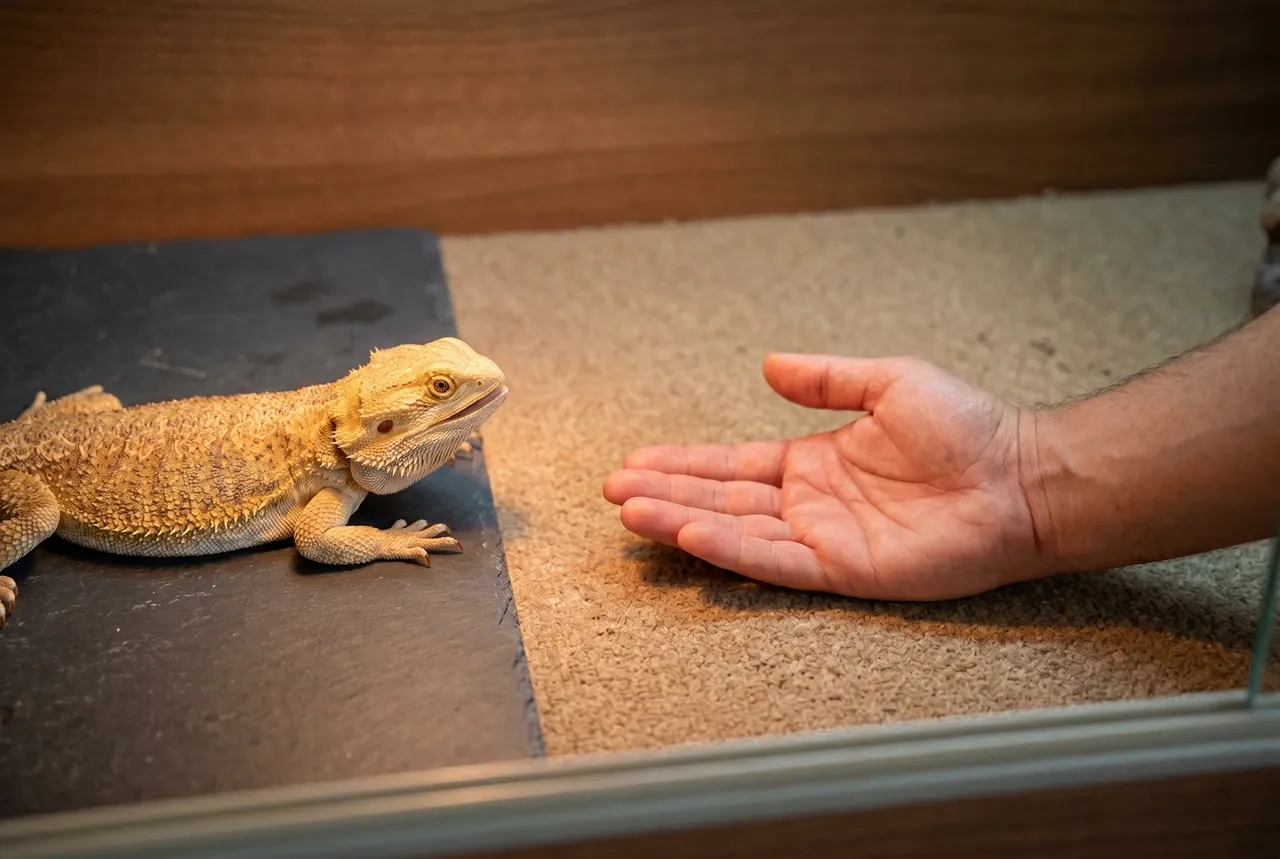
Approach from the same side and angle. Coming from above triggers the hawk-shadow reflex that’s wired deep into their brains. Approach from the side, at the dragon’s eye level, palm first.
Rest your hand in the enclosure without picking up. Five minutes a day of your hand just being present, not grabbing, teaches the dragon that your hand isn’t a threat. Many keepers skip this step and wonder why their dragon braces every time.
Feed by hand regularly. Dubia roaches, silkworms, or leafy greens all work. The feeding link matters for trust, even if it’s not the whole bond. The classic step-by-step handling approach pairs well with hand-feeding during the early weeks.
Leave a worn t-shirt in the enclosure for the first week. Old advice, but it works. The persistent scent presence during sleep accelerates scent recognition.
Offer enrichment outside the tank. Out-of-tank exploration in a safe area lets your dragon experience you as the anchor point in an unfamiliar environment. That’s a strong bond-builder. Safe out-of-tank play covers setups, supervision, and enrichment ideas that keep sessions positive.
Do Bearded Dragons Love You Back
Honest answer. Probably not in the way you feel about your dragon. Bearded dragons lack the neurological architecture mammals use for what we call love. Their hypothalamus and limbic system are structured very differently, and there’s no evidence they form emotional attachments comparable to a dog or cat.
What they do form is something genuinely interesting. Stable individual recognition, preference for familiar handlers, reduced stress responses in your presence, and behaviour that prioritises you over other humans. Call it trust, call it a bond, call it whatever you want. It isn’t mammalian love, but it’s not nothing either. The keepers who get the most out of their dragons are the ones who appreciate it for what it is rather than projecting dog behaviour onto it.
The Bottom Line
Bearded dragons recognize their owners. The recognition is built from scent processed through the vomeronasal organ, visual tracking of your silhouette and movement, and auditory recognition of your voice. Four to ten weeks is typical for a well-kept dragon to establish it, and longer for rescues. Genuine recognition shows up in behaviour that has nothing to do with food, including calming faster in your hands, tracking you across a room, and responding to your voice alone.
It isn’t love in the human sense. But it’s a real, stable, individual-level social bond that research increasingly supports. Treat it seriously and build it deliberately, and you’ll end up with a dragon that knows you the way a dragon can know a person. Which, once you see it clearly, turns out to be more than enough.
Frequently Asked Questions
How long does it take for a bearded dragon to recognize its owner
Most healthy dragons in good husbandry show clear individual recognition between four and ten weeks of consistent daily contact. Rescues, stressed dragons, and dragons in poor husbandry take significantly longer.
Can a bearded dragon forget its owner
Short absences of a few days change nothing. Absences of several weeks can produce brief caution on reunion, resolving within a day or two. True forgetting only happens over very long separations, and even then, scent and voice cues often trigger fast re-recognition.
Do bearded dragons like being held by their owner
Individual dragons vary. Many tolerate and some genuinely relax during handling once they recognise the handler. Signs of relaxation include loose limbs, closed or half-closed eyes, and no beard-darkening. A dragon that braces, squirms, or darkens isn’t enjoying the handling yet, regardless of how well it knows you.
Why does my bearded dragon scratch at the glass when I walk by
This is usually attention-seeking rather than distress, especially if it only happens when you pass. The behaviour indicates the dragon has recognised you and expects something to follow, often food, handling, or out-of-tank time. Persistent glass-scratching without you present is a different signal and usually means boredom or husbandry stress.
Can bearded dragons recognize multiple people
Yes. Dragons can learn to recognize everyone in a household who handles them regularly. They typically still develop a preference for one person, usually the primary caregiver, but can distinguish and respond appropriately to several individuals.
Is my bearded dragon really bonding with me or just associating me with food
Test it by walking past the enclosure empty-handed at non-feeding times. If your dragon looks up, tracks you, or moves to the front of the tank, that’s recognition beyond food association. If it only engages at feeding times with no other response, the bond is primarily feeding-based and can be built further through non-feeding interaction.
Written by
Sarah ArdleySarah has kept bearded dragons for over ten years. She founded Beardie Husbandry after discovering that most mainstream care advice — including what she followed with her first dragon — was doing more harm than good. Every article on this site is grounded in veterinary research and real keeper experience.