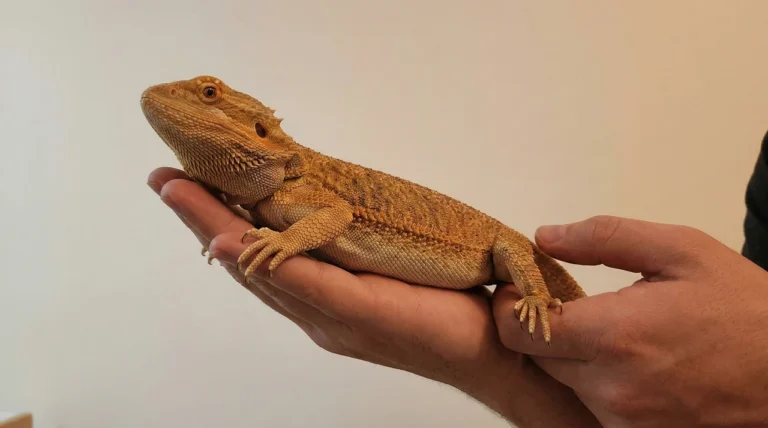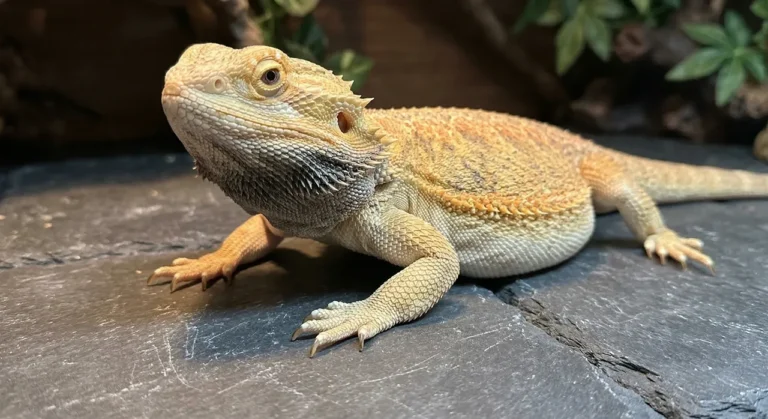
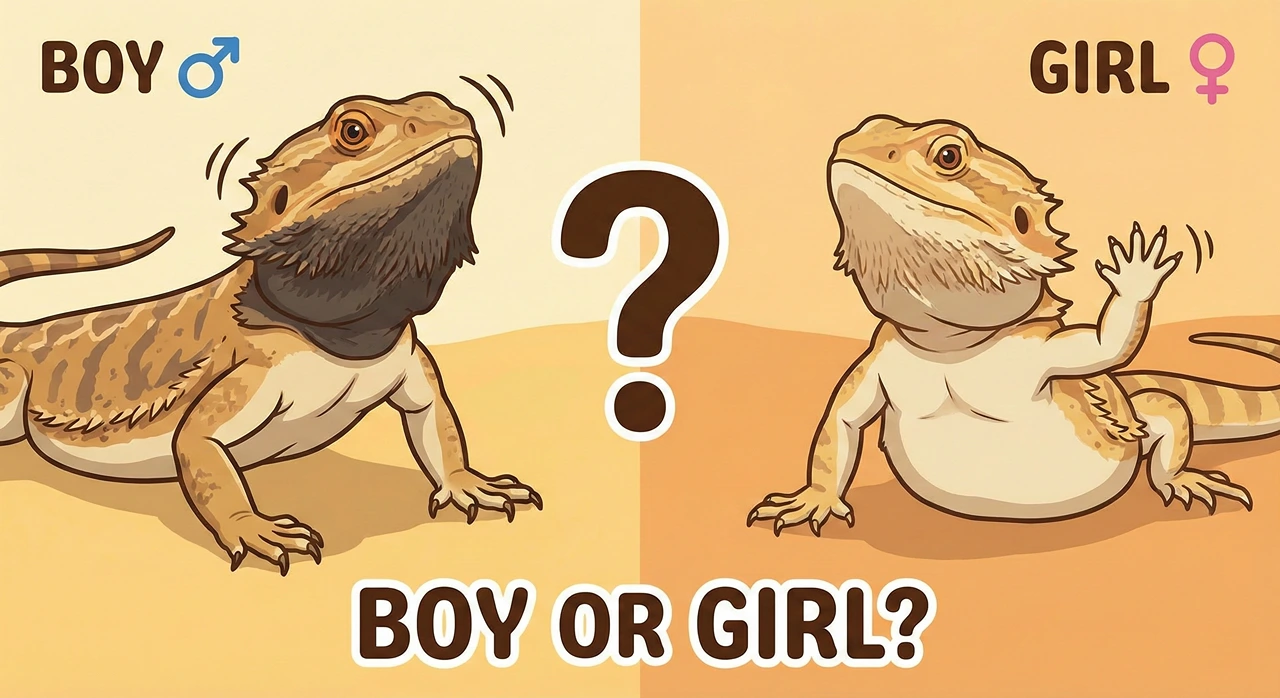
Male vs. Female Bearded Dragon: How to Tell the Difference
Pet stores routinely guess the sex of young dragons and frequently get it wrong. If you were told your hatchling is definitely female and are now watching it glass surf every spring while its beard darkens for no clear reason, that is worth investigating.
Knowing whether you have a male vs female bearded dragon matters well beyond satisfying curiosity. It shapes which health problems you watch for, how you read daily behaviour, and what you need to have in place before the first reproductive cycle arrives.
Why Knowing the Sex Actually Matters
Female bearded dragons produce eggs regardless of whether a male has ever been near them. In a well-fed adult female, this can happen twice a year or more.
Each clutch of infertile eggs carries a real risk of egg binding if the female is unwell, calcium-deficient, or cannot find a suitable laying site.
That risk is a fixed part of female ownership and it does not diminish with age. Owners who discover they have a female for the first time when she starts digging frantically and refusing food are already behind where they should be.
Male dragons carry none of that reproductive burden but have their own seasonal challenge. Come spring, a sexually mature male will often refuse food, pace the enclosure, and display with a restless urgency that alarms owners who have never witnessed mating season behaviour before.
That restlessness is not illness. Knowing you have a male means you can read those weeks for what they are and respond calmly, rather than chasing a health problem that does not exist.
Housing decisions also depend on sex. Two males cannot safely share an enclosure, and a male and female housed together will produce eggs whether you planned for it or not. If you are ever considering keeping a second dragon, confirming the sex of both animals first is not optional.
When Can You Reliably Tell the Sex
Sexing a bearded dragon under 8 weeks old is largely educated guesswork, even for breeders who have hatched hundreds of clutches. The hemipenal structures are present in males from birth but are so small and soft at that age that experienced keepers regularly misread them.
By 4–6 months, the physical markers become readable with reasonable confidence using the tail-lift method. By 8–12 months, the differences between a male and a female bearded dragon are clear enough that there is very little room for error if you use the correct technique.
If sex matters to you before purchase, buy a dragon that is at least 4 months old. If you are buying younger, ask for a written sex guarantee or a replacement policy. The answer given on a hatchling is always a probability, not a certainty.
How to Tell Male from Female Bearded Dragon
There are five physical markers used to distinguish a male vs female bearded dragon, but they are not equally reliable. The tail-lift method gives you the definitive answer. Everything else is a supporting clue that helps confirm what you have already found.
Start With the Tail Lift
Hold your dragon so its stomach rests in your palm, with the tail pointing away from you. Use your free hand to slowly lift the tail upward to approximately 90 degrees. Do not push past the natural range of movement. Stop the moment you feel resistance.
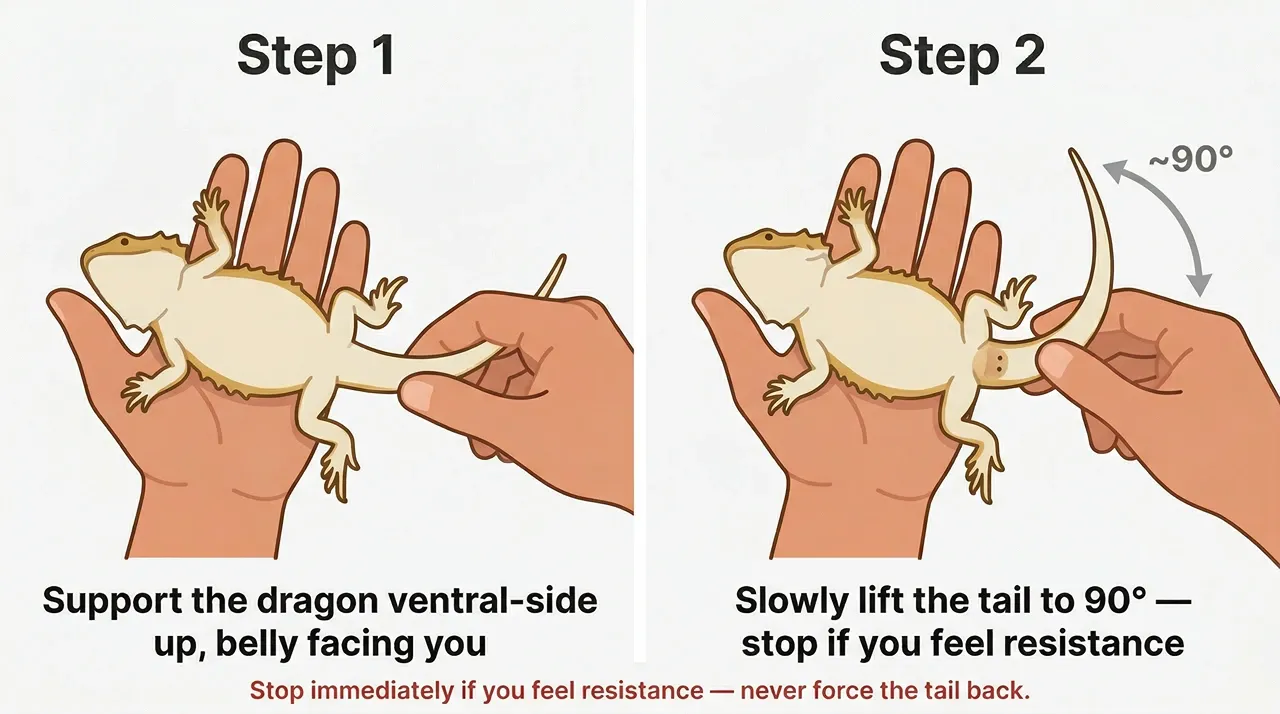
Look at the underside of the tail base, just above the cloacal opening. A male will show two distinct hemipenal bulges, one on each side of the tail midline, separated by a visible central indent running down the middle.
A female shows a single smaller bulge positioned centrally, or no obvious bulge at all. Once you have seen a confirmed male and a confirmed female side by side using this method, the difference becomes immediately obvious and you will not misread it again.
The Flashlight Test
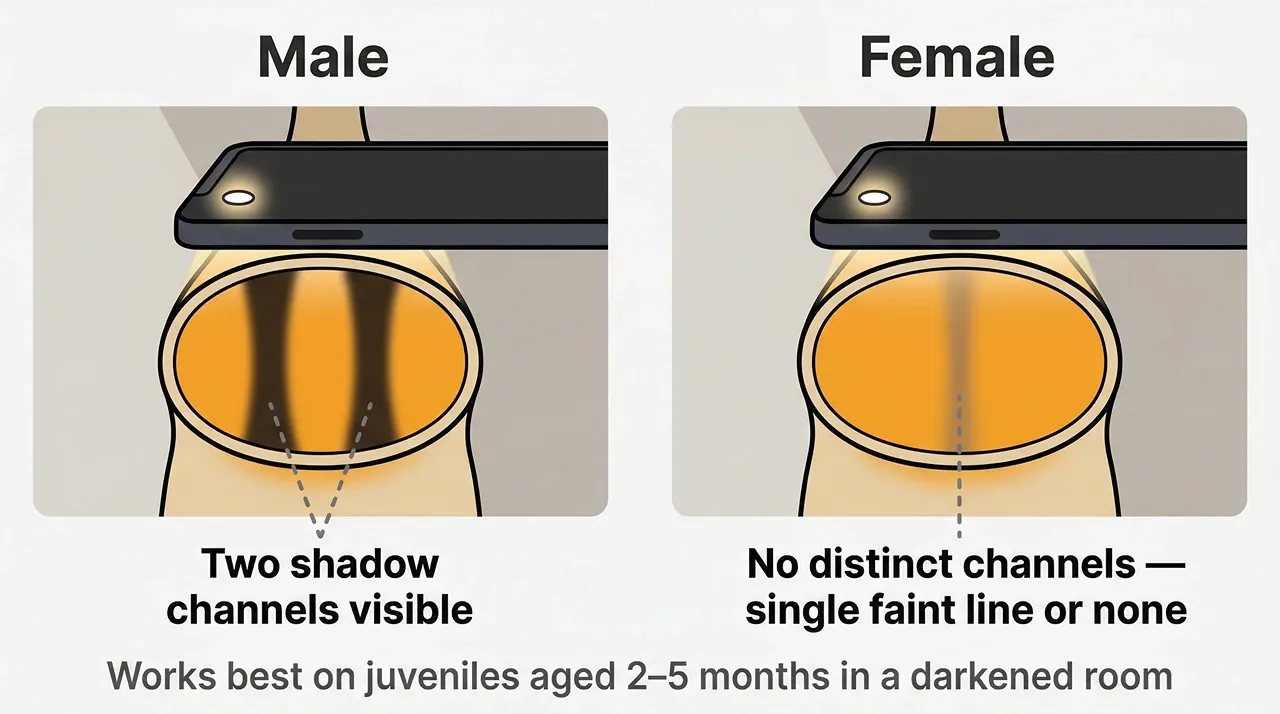
With the tail held in the same raised position, press the beam of a phone torch directly against the top surface of the tail base and shine it through the tissue. In a male, two clear shadow channels become visible through the skin, one on each side of the midline.
A female will show a single faint central shadow, or the light will pass through without producing any distinct channel at all. Dimming the room lights first makes the result much clearer, particularly with younger or darker-scaled dragons.
This method is most useful on juveniles between 2 and 5 months old, where the surface bulges are still developing and not yet obvious to the naked eye.
What the Femoral Pores Actually Tell You
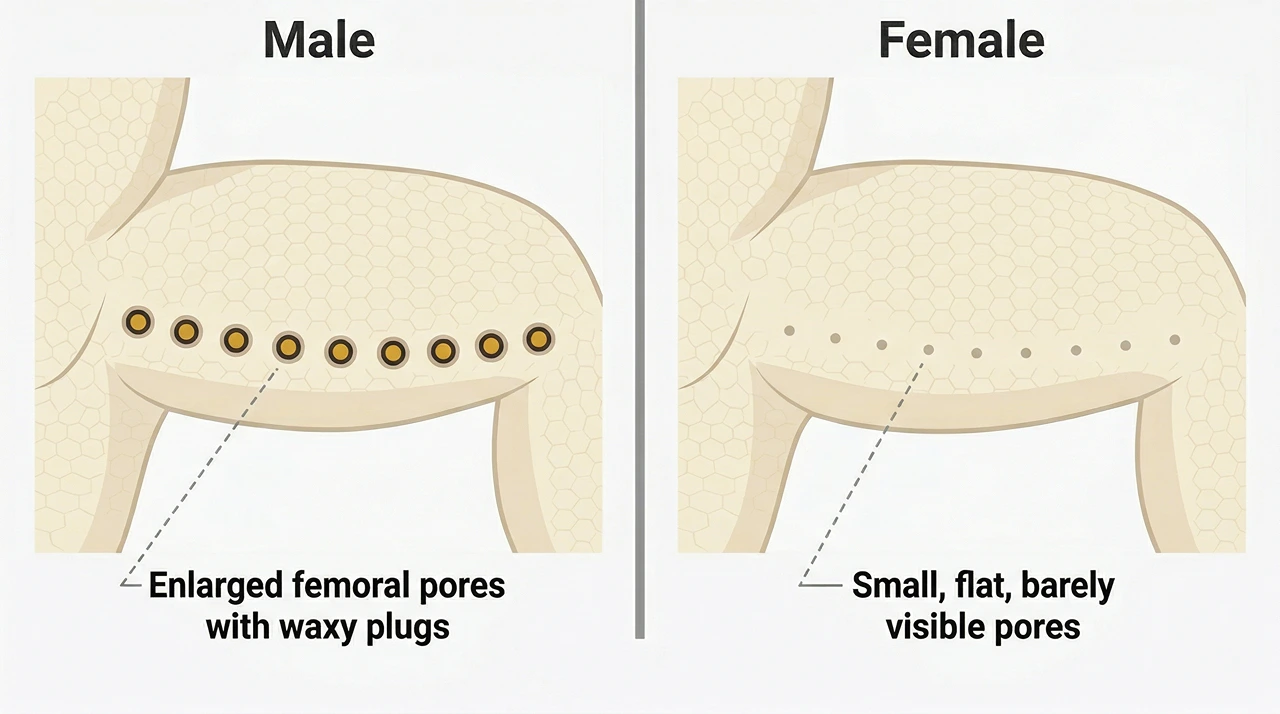
Both male and female bearded dragons have femoral pores, which trips up a surprising number of new owners who assume the pores are male-only. The pores run in two rows across the underside of the thighs, converging toward the vent.
In a sexually mature male, the pores are noticeably enlarged, often appearing waxy and plugged with a yellowish secretion. In a female, the pores are present but remain small, flat, and much less defined, particularly before adulthood.
Femoral pores are not reliable as a standalone sexing tool in dragons under 6 months old, and even in adults they vary enough between individuals to cause misreads. Use them to support your tail-lift findings, not to replace them.
How Body Shape Gives It Away
Males typically develop a noticeably wider, blockier head than females as they reach adulthood, and the tail base is often thicker relative to body size. A female’s tail usually tapers more quickly after the vent than a male’s does.
These are population-level tendencies rather than reliable markers for any individual animal. Some females develop broader heads than some males of the same age. Treat these as additional data points alongside the tail-lift method, never as the primary tool.
Check the Cloacal Opening Too
Male bearded dragons have a noticeably wider cloacal opening than females, which becomes more pronounced in adults. This is a supporting clue rather than a definitive test on its own.
Without a reference point to compare against, it is easy to mistake a normally-sized female vent for a male one, particularly in larger females. Always confirm with the tail-lift method first and use vent width as one extra data point in the overall picture.
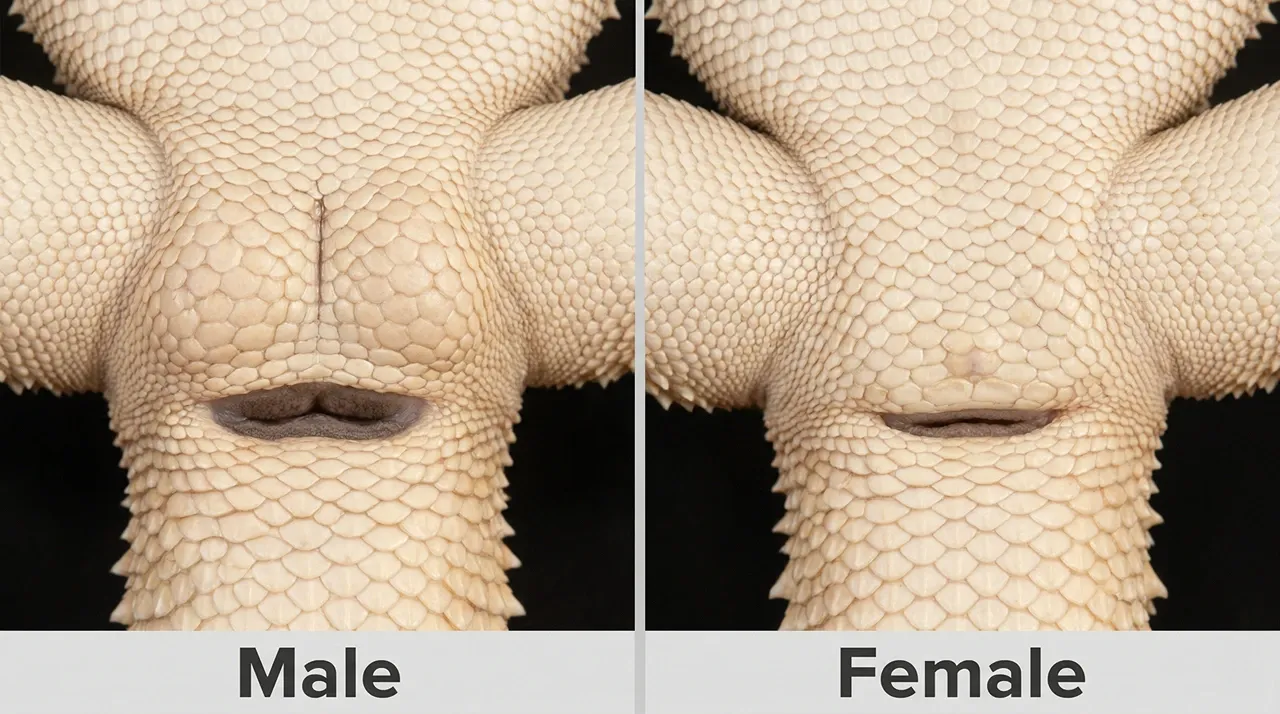
Across all five markers, the physical differences between a male vs female bearded dragon vary considerably in how early and reliably they appear.
| Trait | Male | Female |
|---|---|---|
| Hemipenal bulges | Two distinct bulges separated by a central indent | Single central bulge or none visible |
| Femoral pores | Large, visible, often waxy in adults | Present but small, flat, and less obvious |
| Head shape | Wider, blockier jaw in adulthood | Narrower, more tapered |
| Tail base | Thick and prominent | Tapers more quickly after the vent |
| Cloacal opening | Wider | Narrower |
| Adult length | Typically 18–24 inches | Typically 16–19 inches |
| Adult weight | Often 400–550g | Often 300–450g |
| Seasonal behaviour | Mating drive restlessness, food refusal in spring | Digging behaviour, infertile egg-laying cycles |
| Beard darkening | More frequent and more intense | Less frequent, but does occur |
| Arm waving | Observed, but less common | More frequently observed |
What Males and Females Do Differently
Behaviour alone cannot reliably sex a bearded dragon. Both males and females arm-wave, darken their beards, and go through periods of restlessness. That said, certain patterns run strongly along sex lines and are worth knowing before they catch you off guard.
How a Mature Male Actually Behaves
Once a male dragon reaches sexual maturity, typically somewhere between 12 and 18 months, he will go through at least one pronounced period of seasonal restlessness each year. Appetite drops, pacing increases, and the beard may darken repeatedly without any obvious stressor in the environment.
This pattern is driven by photoperiod changes and seasonal temperature shifts, the same external cues that regulate reptile reproductive biology in the wild, and has nothing to do with how well the enclosure is managed.
The restlessness typically passes within two to four weeks once the seasonal trigger fades and your dragon returns to his normal routine.
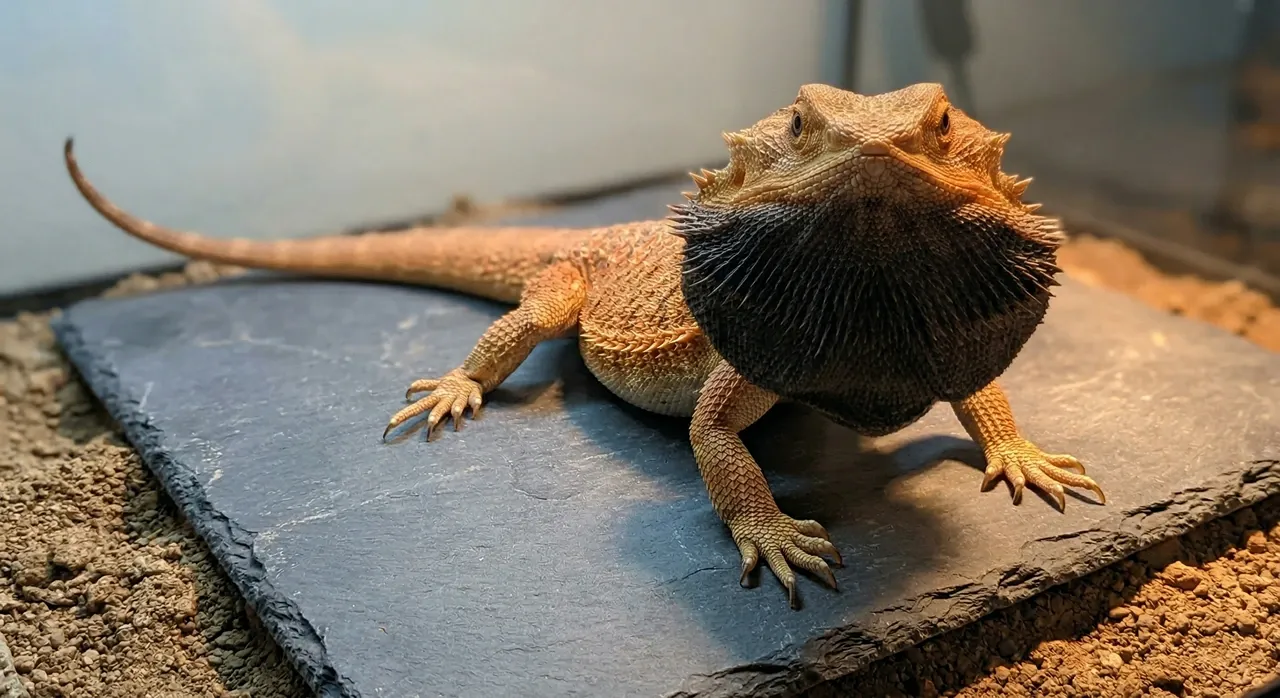
Head-bobbing is more frequent and more assertive in males than females, particularly when they see their own reflection in the glass. A male who bobs rapidly and darkens his beard at the enclosure wall is not sick. He is reacting to a perceived rival.
Learning to read bearded dragon body language as a whole makes it much easier to tell the difference between mating season behaviour and something that actually needs attention. The two can look superficially similar to a new owner.
What Only Your Female Will Do
A female bearded dragon will dig, and she will do it with obvious purpose. Systematic corner-scratching and substrate pushing, even through a bare tile floor, is her preparing to lay eggs. This can happen twice a year or more, regardless of whether she has ever been near a male.
When this digging behaviour starts, she needs a suitable lay box immediately. A container deep enough for her to burrow to her own body length, filled with slightly damp topsoil or play sand, gives her somewhere safe to deposit the clutch.
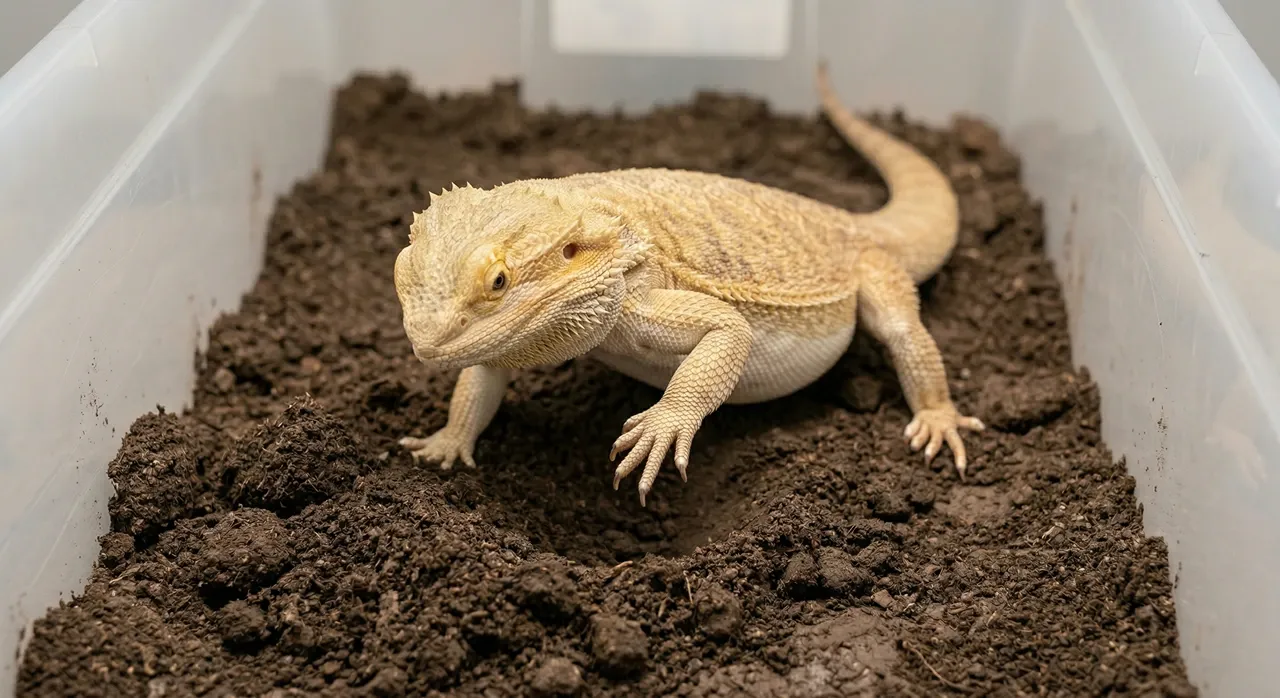
Without a lay box, a female laying infertile eggs can become severely stressed and refuse food for weeks while she searches for a site she considers acceptable. That stress compounds quickly and is entirely avoidable with some preparation.
Arm-waving is observed in both sexes but appears more frequently in females. It is a submissive signal, and a female arm-waving at her own reflection or seemingly at nothing is simply responding to a perceived movement or presence nearby.
Which Sex Makes the Better Pet
There is no universal answer when choosing between a male vs female bearded dragon. Males tend to grow larger, develop more visually impressive head and beard displays, and their seasonal restlessness is temporary and predictable once you have been through it once.
Females stay slightly smaller and are generally calmer between reproductive cycles. The significant caveat is that every sexually mature female will produce infertile eggs, and managing those cycles is a recurring responsibility with real health stakes attached.
Providing a lay box, monitoring for prolonged food refusal, and recognising the early warning signs of egg binding are non-negotiable parts of keeping a female. These responsibilities have no equivalent in male husbandry.
Neither sex is harder to care for in absolute terms. But they come with meaningfully different challenges, and choosing one knowing what those challenges are leads to a far better experience than learning them by surprise mid-season.
Sexing Mistakes Most New Owners Make
- Trusting a pet store’s sex determination on a hatchling under 8 weeks old, when even experienced breeders often disagree at that age.
- Assuming only males have femoral pores. Both sexes have them. The size and definition difference only becomes meaningful in adults.
- Looking at the top of the tail rather than the underside when checking for hemipenal bulges.
- Confusing a particularly prominent single female bulge for the two-bulge pattern in a male, especially in young animals where the central indent is not yet well-defined.
- Using behaviour alone to determine sex. Both males and females arm-wave, darken their beards, and glass surf at various points in their lives.
- Only ever sexing a dragon once and not revisiting the check at 6 and 12 months when the physical markers have developed considerably further.
Frequently Asked Questions
Can You Sex a Dragon From a Photo
Sometimes, with a sharp close-up of the tail underside taken from the correct angle. The tail-lift method requires slightly stretched skin to read clearly, and casual phone photos often give inconclusive results.
A video taken by a second person while you lift the tail will give you a far more usable image than trying to photograph it yourself one-handed.
Is the Male Always Bigger Than the Female
Generally, yes. Male bearded dragons typically reach 18–24 inches and weigh 400–550g at adulthood, while females usually top out at 16–19 inches and 300–450g. There is enough individual variation that some large females overlap with smaller males, which is why size alone should never be used to determine sex.
Can a Female Lay Eggs Without Mating
Yes. Female bearded dragons produce infertile eggs throughout their reproductive lives without any contact with a male. This is entirely normal and not a cause for concern on its own, though it requires the keeper to provide appropriate laying conditions and monitor for signs of difficulty.
What Age Can You Actually Tell the Sex
Most keepers and reptile vets recommend waiting until 4–6 months before drawing firm conclusions. The physical markers are present earlier but small enough in hatchlings to be misread even by experienced hands. By 8–12 months, the physical difference between a male vs female bearded dragon is clear and definitive.
Do Males Always Have a More Prominent Beard
Males tend to darken their beards more frequently and more intensely than females, particularly during mating season or territorial encounters. Females do darken their beards too, though, so beard colour is a mood and temperature signal rather than a reliable way to determine sex.
Which Sex Is Better for a First Owner
Both male and female bearded dragons make excellent pets for a prepared keeper.
Males are slightly lower-maintenance in the reproductive sense, since they do not lay eggs. Females require a lay box before they reach sexual maturity and some awareness of egg-related health risks. If you are not yet prepared to manage that, a male is the lower-complexity starting point.
What to Do With That Information Now
If you have a female:
- Set up a lay box before you need one. A 40-litre tub of slightly damp topsoil or play sand, deep enough for her to burrow fully, costs very little and removes a major stressor from the first laying episode.
- Learn the early warning signs of egg binding now, not after she has been lethargic for three days and the clutch is overdue. Early action is the only action that reliably works.
- Book an annual check with a reptile-experienced vet so that her reproductive health is assessed alongside everything else.
If you have a male:
- Note the timing of his first mating season episode so you are not caught off guard in subsequent years.
- Never house him with another male, even temporarily.
- If you are considering introducing a female, understand that breeding will almost certainly occur and plan for it properly before it happens.
If you are still unsure whether you have a male vs female bearded dragon:
- Book an appointment with a reptile-experienced vet who can perform a physical sex determination and, if the result remains ambiguous, an ultrasound for certainty. The Association of Reptilian and Amphibian Veterinarians maintains a directory at arav.org to help you find a qualified reptile vet near you.
- Do not make housing, diet, or breeding decisions on a guess from a hatchling. The consequences of getting it wrong in any of those areas are too significant to leave to chance.
Written by
Sarah ArdleySarah has kept bearded dragons for over ten years. She founded Beardie Husbandry after discovering that most mainstream care advice — including what she followed with her first dragon — was doing more harm than good. Every article on this site is grounded in veterinary research and real keeper experience.