Coil vs. Tube UVB: 5 Rules for Bearded Dragon Lighting
The coil vs tube UVB debate for bearded dragons was settled years ago, but pet stores keep selling coil bulbs in beginner kits because they are cheap to stock and easy to hand to someone who does not know what they actually need yet.
New owners buy them, follow the instructions on the box, and end up with a dragon basking under light that is barely producing any usable UVB at all. Getting that wrong is not always obvious. The bulb glows, the dragon basks, and the enclosure looks bright.
Softening bones, suppressed immunity, and stunted growth in juveniles can all build quietly over months before most keepers notice anything is wrong.
The 5 Rules
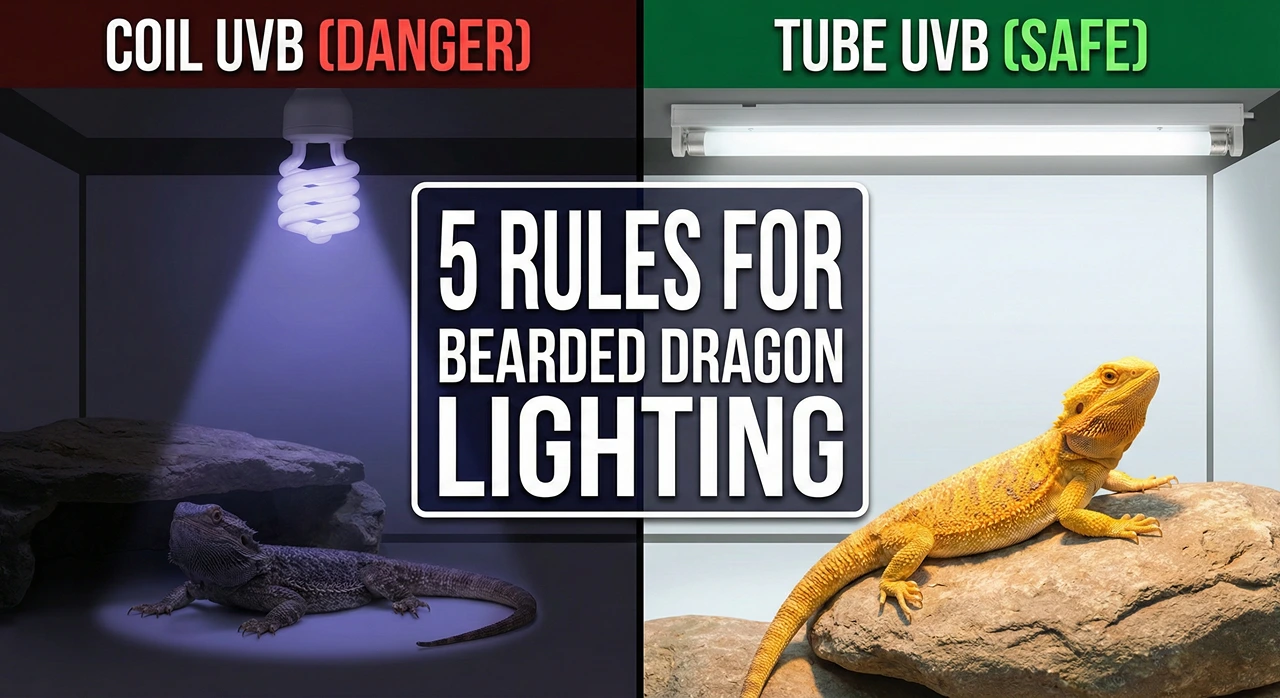
- Coil and compact UVB bulbs are not adequate for bearded dragons
- Choose a T5 HO tube over a T8 in any modern enclosure
- Fixture quality and reflector design control how much UVB actually reaches basking height
- Screen tops block 30–50% of UVB output and must be accounted for
- UVB tubes degrade invisibly. Replace on schedule, not when they stop glowing.
Coil UVB Bulbs Do Not Work for Beardies
Coil UVB bulbs, also called compact fluorescents or CFL UVBs, screw into a standard dome fitting and look like a miniature version of the spiral energy-saving bulbs most households used in the 2000s. They are inexpensive, widely available, and the wrong choice for bearded dragon setups.
The core problem is coverage. Bearded dragons are full-body baskers. In the wild, they expose their entire dorsal surface to direct sun simultaneously, absorbing UVB across their head, spine, limbs, and tail at the same time.
Coil bulbs produce a narrow, concentrated cone of UVB that drops off sharply outside a very small central area. A dragon’s head might receive adequate UVB while the rest of its body gets almost none.
A 2017 study at Wageningen University tested multiple compact fluorescent UVB bulbs on captive bearded dragons. After 120 days, most dragons had vitamin D3 plasma levels that were barely detectable. Wild bearded dragons maintained plasma D3 concentrations roughly ten times higher than the best-performing compact lamp group in the study.
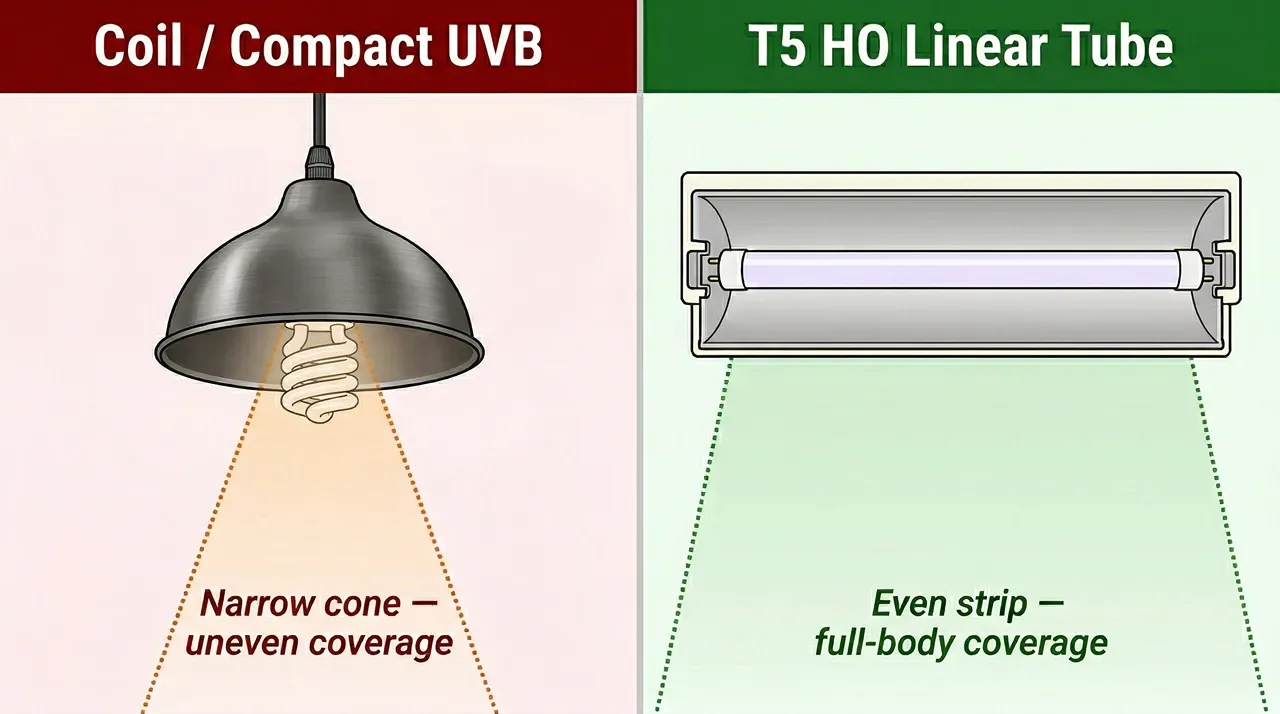
There is also a substantial body of keeper experience linking certain coil bulbs to eye problems, including squinting, prolonged eye closure, and reluctance to bask near the affected area.
The likely cause is concentrated UV intensity in a narrow beam rather than broad, even exposure. Defective coil bulbs emitting UVC have also been reported by keepers over the years.
T5 HO Beats T8 in Almost Every Modern Setup
The letters and numbers on tube UVB bulbs refer to the tube’s diameter, measured in eighths of an inch. A T8 is one inch across; a T5 is five-eighths of an inch.
The slimmer T5 high-output (HO) design packs considerably more power into that narrower profile, which is why it has largely replaced the T8 as the standard recommendation for bearded dragon enclosures.
T5 HO bulbs produce stronger UVB output and sustain usable intensity at much greater distances from the basking surface.
A T8 tube typically needs to be positioned 10 to 12 inches from the dragon’s back to deliver an acceptable UV index at the basking spot. Achieving that usually means mounting the fixture inside the enclosure rather than above the screen.
A T5 HO works reliably at 12 to 18 inches from basking height. Its stronger output means it can sit on top of a screen-topped enclosure and still deliver workable UVB at basking level. A T8 cannot do that adequately through a mesh barrier at any practical mounting distance.
T5 HO bulbs also degrade more slowly. A quality Arcadia or Zoo Med T5 HO maintains usable output for around 12 months at standard daily runtime. T8 bulbs typically fall below adequate UVB output within six months, even though they continue to emit bright visible light for considerably longer.
When a T8 Is Still a Reasonable Choice
T8 bulbs can work in short enclosures where the mounting height stays within 6 to 10 inches of the basking surface and the fixture goes inside the enclosure rather than above a screen.
If you already have a working T8 setup with correct inside mounting and verified distances, there is no urgent reason to switch mid-setup. For any new build, though, start with a T5 HO and avoid the compromise from day one.
The Fixture and Reflector Determine Real Output
A quality UVB tube inside a cheap, reflector-free fixture loses a substantial portion of its output before the light reaches the basking surface. The reflector redirects UVB that would otherwise scatter upward and sideways, focusing it downward into the enclosure where it can actually contribute to your dragon’s D3 synthesis.
Arcadia and Zoo Med both produce dedicated fixtures with built-in polished reflectors, designed specifically for their respective tube ranges.
A generic fluorescent fitting from a hardware store might accept the same tube, but without an effective reflector it will deliver meaningfully less UVB at basking height, with no visible difference to tip you off that anything is wrong.
Fixture length matters as much as reflector quality. The tube should cover roughly two-thirds of the enclosure’s total length, positioned above the basking side and running inward toward the centre.
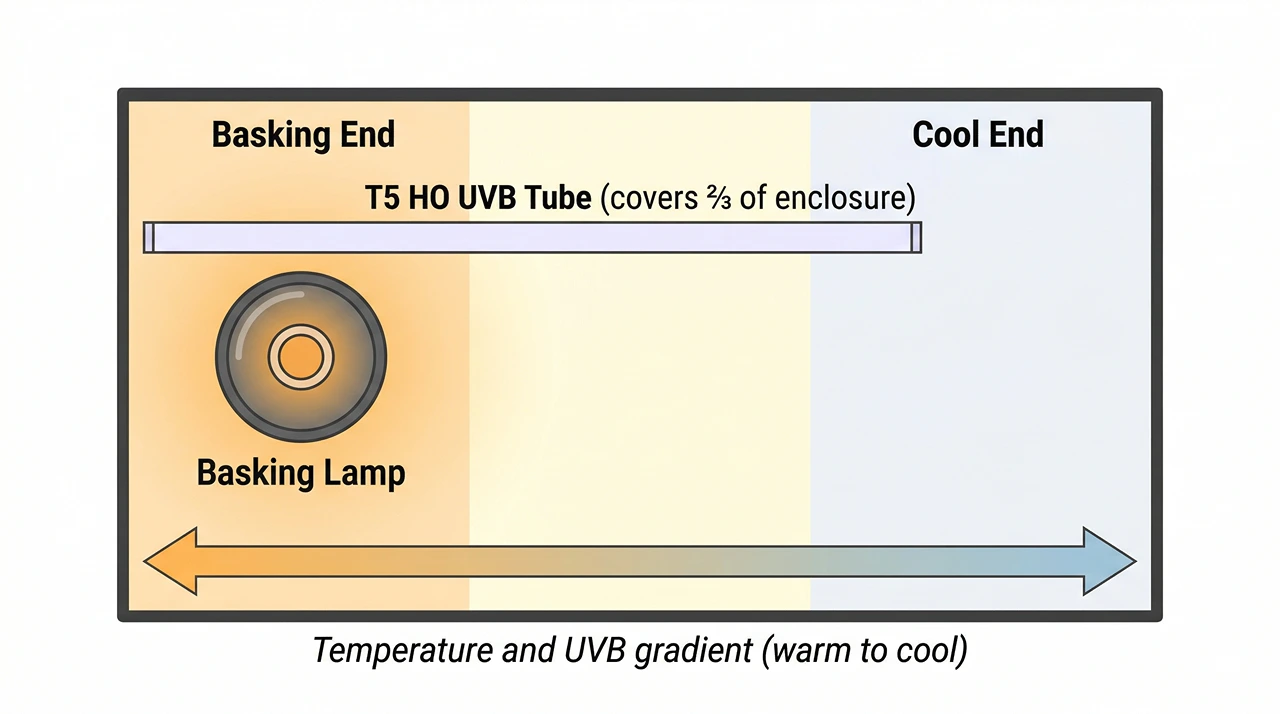
This creates a gradient: strong UVB at the basking spot, dropping off across the cooler end, which allows the dragon to self-regulate UV exposure the same way it manages body temperature.
Screen Tops Block More UVB Than You Think
Metal mesh screen tops block between 30 and 50 percent of the UVB output from any tube positioned above them, depending on mesh density. That is a large and largely invisible loss. A setup that looks correctly spaced from the outside can be substantially under-delivering at basking level.
For a T5 HO bulb over a screen, you need to reduce the distance between the tube and the basking surface by 2 to 4 inches compared to a screen-free setup, or mount the fixture inside the enclosure entirely.
For a T8 over a screen, the output loss is almost always too significant to compensate. T8 bulbs already produce modest UVB at close range, and mesh attenuation pushes them well below what a Ferguson Zone 3 species needs at the basking spot.
Glass and acrylic panels block UVB transmission almost entirely. Both materials absorb close to 100 percent of output regardless of bulb strength or distance. If your enclosure has a solid glass lid rather than a mesh screen, the UVB fixture must go inside the enclosure with the dragon.
That Glowing Bulb May Not Be Producing Any UVB
This is the most consistently missed point in home UVB setups. Fluorescent bulbs continue producing bright visible light long after their UV-emitting phosphors have degraded past any useful level.
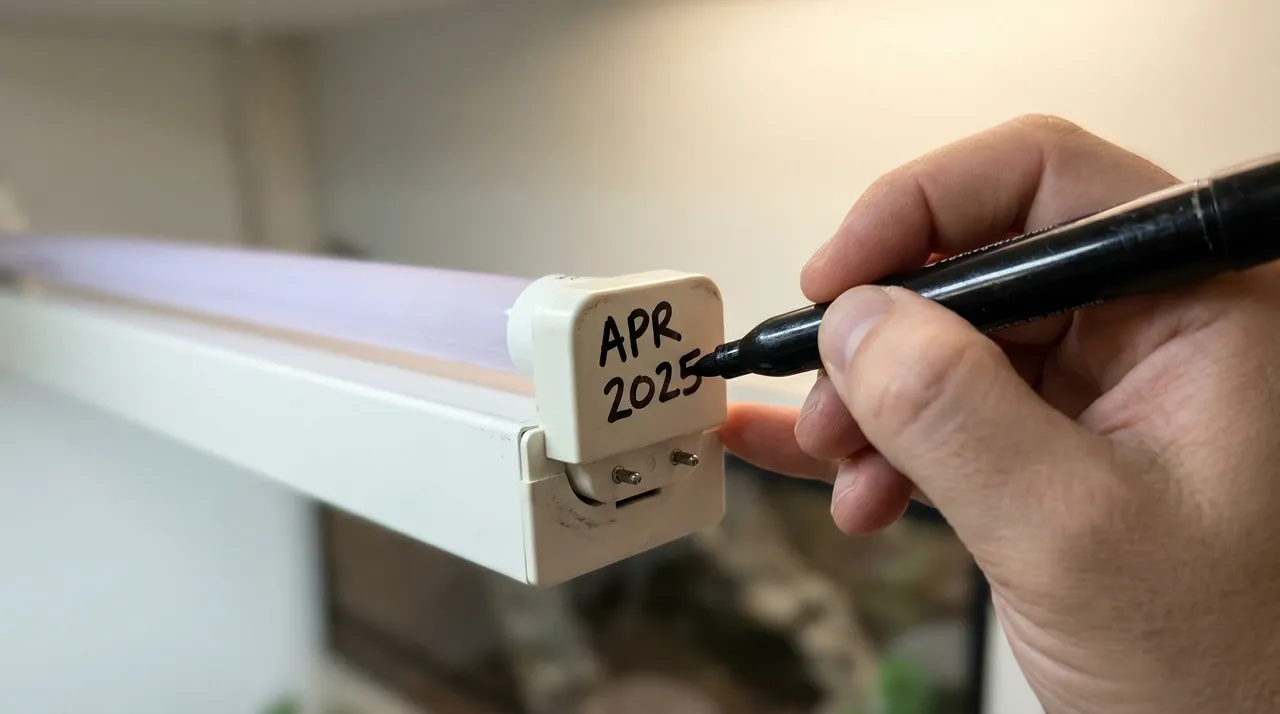
A bulb installed 14 months ago can look identical to a new one while delivering almost no UVB at the basking surface. There is no visible sign that anything has changed.
Replacement intervals by bulb type, assuming 10 to 12 hours of daily runtime:
| Bulb Type | Replace Every | Notes |
|---|---|---|
| T5 HO (Arcadia, Zoo Med) | 12 months | Mark the install date on the tube with a permanent marker |
| T8 (Arcadia, Zoo Med) | 6 months | More frequent changes increase the long-term cost of the cheaper bulb |
| Coil or compact UVB | 6 months | Should be replaced with a linear T5 HO tube regardless of age |
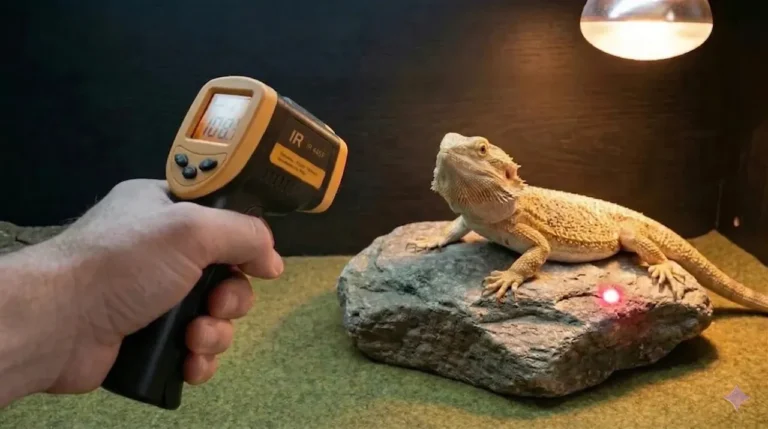
The only reliable way to verify actual UVB output at basking height is a Solarmeter 6.5 UV Index meter. It costs around $130 to $150 but removes all the guesswork from your setup.
Without one, follow the time-based replacement schedule above and write the installation date on the end of the tube the day you fit it so you are not relying on memory six months later.
Bearded dragons are Ferguson Zone 3 species, meaning they bask in open, high-intensity UV environments in the wild. The target UV index at the basking spot is 4.0 to 4.5, as measured by a Solarmeter 6.5.
Without adequate UVB, D3 synthesis slows dramatically, calcium absorption becomes unreliable, and metabolic bone disease can develop in dragons that appear otherwise healthy for months before the damage becomes visible.
Which Brands Actually Deliver
Two brands dominate responsible keeper recommendations: Arcadia and Zoo Med. Both are the most widely used and most thoroughly independently tested bulbs for bearded dragon setups.
Arcadia’s D3+ 12% T5 HO Desert tube and Zoo Med’s ReptiSun 10.0 T5 HO consistently deliver the UVI levels their specifications claim at the distances listed. Most of the market cannot say the same.
The Arcadia 12% tube tends to produce slightly higher UVI at equivalent distances compared to the Zoo Med 10.0.
Through a quality reflectored fixture without a screen, both should reach the 4.0 to 4.5 UVI target at 12 to 18 inches from the basking surface. With a screen, drop the distance by 3 to 4 inches or mount the fixture inside the enclosure.
Avoid the Zilla Desert Series and ExoTerra ReptiGlo for bearded dragons specifically. Both have been linked to eye problems and health issues in bearded dragon communities over many years. Independent UVI measurements have frequently shown output inconsistencies with these products that are not reflected in their marketing.
A Note on Mercury Vapor Bulbs
Mercury vapor bulbs (MVBs) combine UVB output and heat in a single screw-in lamp. That sounds appealing for simplifying a lighting setup, and they can work well in the right enclosure, but they are not a good fit for most beginner builds.
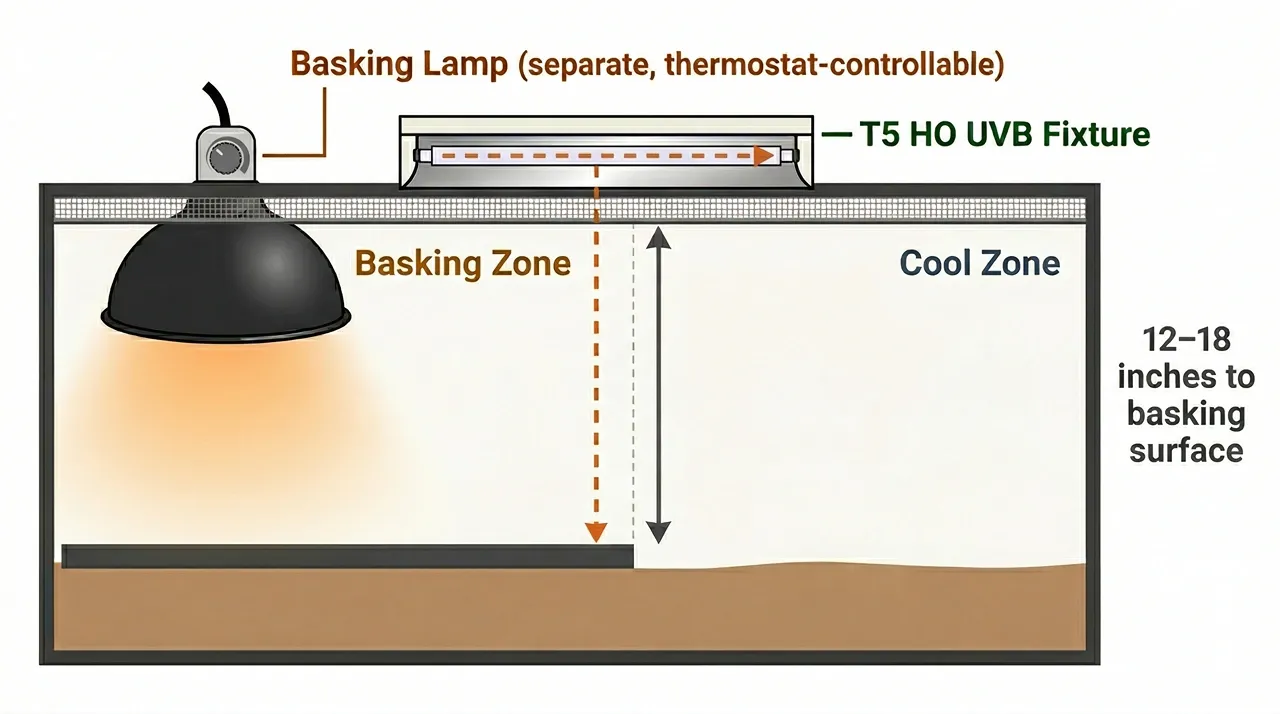
MVBs cannot be controlled by a thermostat because they generate too much heat for standard thermostat circuitry to handle safely.
You adjust UVI and temperature by physically raising or lowering the lamp. That works well on open-topped tortoise tables or large custom enclosures but becomes difficult to manage in a standard screen-top tank where mounting height is fixed.
For most keepers setting up a first bearded dragon enclosure, a T5 HO tube paired with a separate basking bulb is the more controllable and forgiving approach. MVBs are worth revisiting once you are comfortable managing heat gradients and have the enclosure space.
Full Bulb Comparison
| Bulb Type | Coverage Pattern | Works Through Screen | Lifespan | Suitable for Beardies |
|---|---|---|---|---|
| Coil or compact UVB | Narrow cone | No | 6 months | No |
| T8 linear tube | Even strip | No | 6 months | Inside mounting only |
| T5 HO linear tube | Wide even strip | Yes, with distance adjustment | 12 months | Yes — recommended choice |
| Mercury vapor bulb | Concentrated cone | Not reliably | 12+ months | Yes, but not for beginners |
Frequently Asked Questions
Is a Coil or Tube UVB Better for Bearded Dragons
A linear tube is always the better choice. The coil vs tube UVB question for bearded dragons has a clear answer backed by research and years of keeper experience.
Coil bulbs cannot cover a full-body basking species, and scientific testing has shown they leave most dragons with dangerously low D3 plasma levels. A T5 HO tube from Arcadia or Zoo Med is the appropriate primary UVB source for any home bearded dragon setup.
How Far Should a T5 HO Be From My Dragon
Without a screen top: 12 to 18 inches from the bulb to the dragon’s back at the basking surface. With a screen top: reduce that distance by 3 to 4 inches, targeting roughly 9 to 14 inches.
Always measure to the dragon’s back at the highest point of the basking platform, not to the floor of the enclosure.
Does UVB Pass Through Glass or Acrylic
No. Both materials block UVB transmission almost entirely regardless of the bulb’s strength or proximity.
Metal mesh screen tops reduce UVB by 30 to 50 percent but allow meaningful output through if mounting distances are adjusted correctly. Glass or acrylic lids require the UVB fixture to be mounted inside the enclosure without exception.
Can D3 Supplements Replace UVB Lighting
Not reliably over the long term. Oral D3 from supplements is a useful safety net, but it does not replicate what consistent UVB exposure provides in terms of self-regulated D3 synthesis.
Under proper UVB, your dragon produces D3 based on its actual needs and downregulates when it has enough. Supplements require precise dosing and leave no margin for error.
A well-structured calcium and D3 dusting schedule should work alongside good UVB, not as a replacement for it.
What About Mercury Vapor Bulbs
MVBs can work well once you are comfortable managing your enclosure temperatures manually and have a setup with adequate height and open airflow.
They cannot be thermostat-controlled, and their concentrated output requires careful distance calibration. Too close and you risk eye damage or overheating; too far and UVI drops below functional levels.
Experienced keepers find them useful in large or custom builds, but beginners are better served starting with a T5 HO and a separate basking bulb.
Do Silkback or Translucent Morphs Need Different UVB Settings
Yes. Reduced-pigmentation bearded dragon morphs, including silkbacks, translucents, and hypomelanistics, have less melanin available to protect the skin from UV exposure and are more sensitive to high UVI levels.
The maximum recommended UV index for these morphs at the basking spot is around 3.0 rather than the standard 4.0 to 4.5. Use a lower-output bulb or increase the mounting distance. A 6% T5 HO rather than a 12% tube will get you where you need to be.
How Long Should UVB Stay On Each Day
12 to 14 hours during summer months, tapering to around 10 to 12 hours in winter if you want to replicate seasonal light variation. Many keepers run a consistent 12-hour on, 12-hour off schedule year-round without any issues.
Run the UVB and basking lamp on the same timer so photoperiod stays consistent regardless of your own daily schedule, and keep both lights off at night entirely.
Check Your Setup Right Now
Run through these four checks before your next basking session:
- Bulb type: Is it a linear T5 HO tube from Arcadia or Zoo Med? If it is a coil bulb or any compact fluorescent, order a T5 HO replacement today.
- Install date: When did you last change the UVB tube? If you cannot remember, write today’s date on the tube with a permanent marker and plan to replace it at 12 months from now.
- Screen top distance: If mesh sits between the tube and the basking spot, is the basking surface within 12 to 14 inches of the bulb? If not, raise the basking platform closer to the tube.
- Fixture position: Is the UVB tube on the same side as the basking lamp, covering roughly two-thirds of the enclosure length from the basking end inward?
Photoperiod, heat lamp coordination, and nighttime temperature all feed into whether your UVB setup does its job consistently. Those interactions make more sense once you have worked through your full lighting schedule as a system.
Written by
Sarah ArdleySarah has kept bearded dragons for over ten years. She founded Beardie Husbandry after discovering that most mainstream care advice — including what she followed with her first dragon — was doing more harm than good. Every article on this site is grounded in veterinary research and real keeper experience.