The Complete Baby Bearded Dragon Care Guide (0 to 6 Months)
Baby bearded dragons are more demanding in their first six months than most care guides let on. The issue is not fragility in the way a hatchling tortoise is fragile, but a narrower tolerance for setup errors and faster consequences when something goes wrong.
The reassuring part is that almost every problem new keepers run into is predictable. Get the basking zone calibrated correctly, feed the right-sized insects often enough, and give a new arrival time to settle before pushing for interaction. Those three things cover most of what can go wrong.
What Baby Bearded Dragons Need From Day One
Most setups get assembled in a rush before the dragon arrives. Some work fine. Others have the basking spot running fifteen degrees low, a coil UVB bulb delivering almost no usable UV, and a bag of loose sand waiting as substrate.
Getting the setup verified and stable before the dragon arrives is the highest-value step a new keeper can take.
Enclosure Size for the First Six Months
The idea that baby dragons need a small tank or they will feel lost is not accurate. In the wild, hatchlings emerge into open scrubland and navigate toward warmth instinctively, not by stumbling across it in a small box.
A 4 ft x 2 ft x 2 ft enclosure (roughly 120 gallons) works from hatching through adulthood, primarily because it creates a temperature gradient that standard 40-gallon setups simply cannot achieve. Starting with adult-sized space also avoids the stress of a second enclosure transition later.
Keep decor minimal for the first few months. Crickets hide in clutter, a hunting hatchling wastes energy chasing them, and appetite problems follow.
Basking Temperatures That Actually Work
Baby bearded dragons are ectotherms, meaning digestion, immune function, and growth all depend on reaching the right body temperature through external heat. This is not a comfort issue; it is physiological.
An underpowered basking spot does not just make a dragon uncomfortable. It stops the dragon from processing food, which means growth stalls.
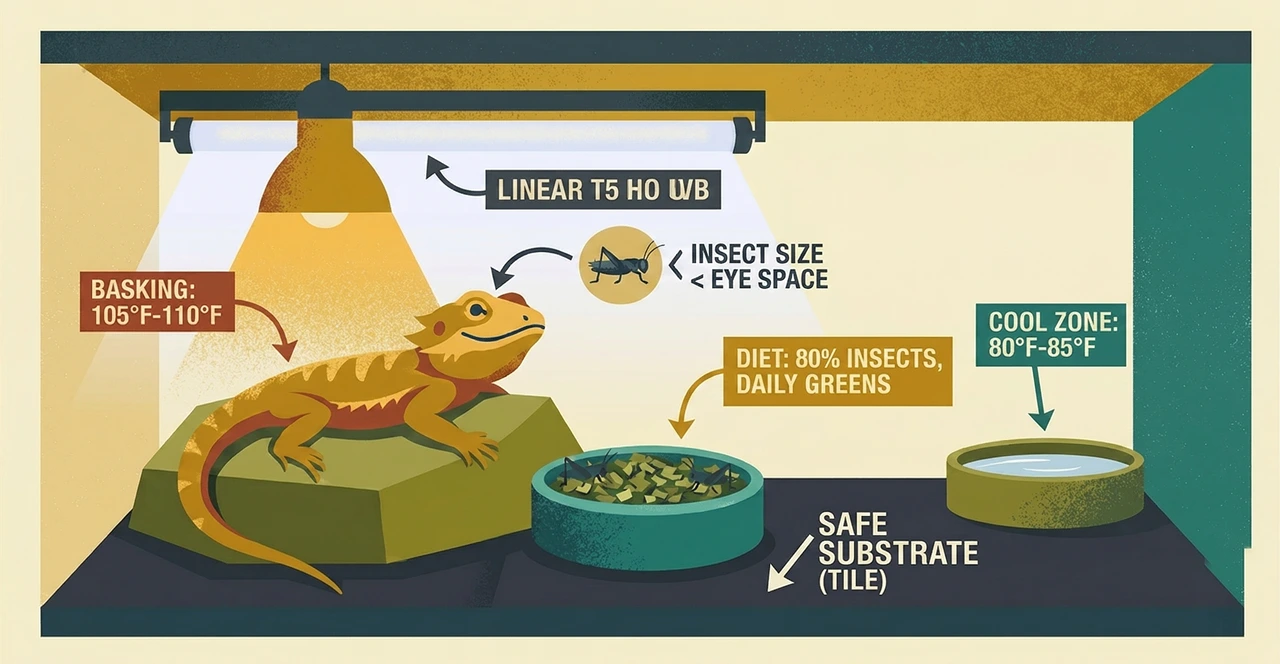
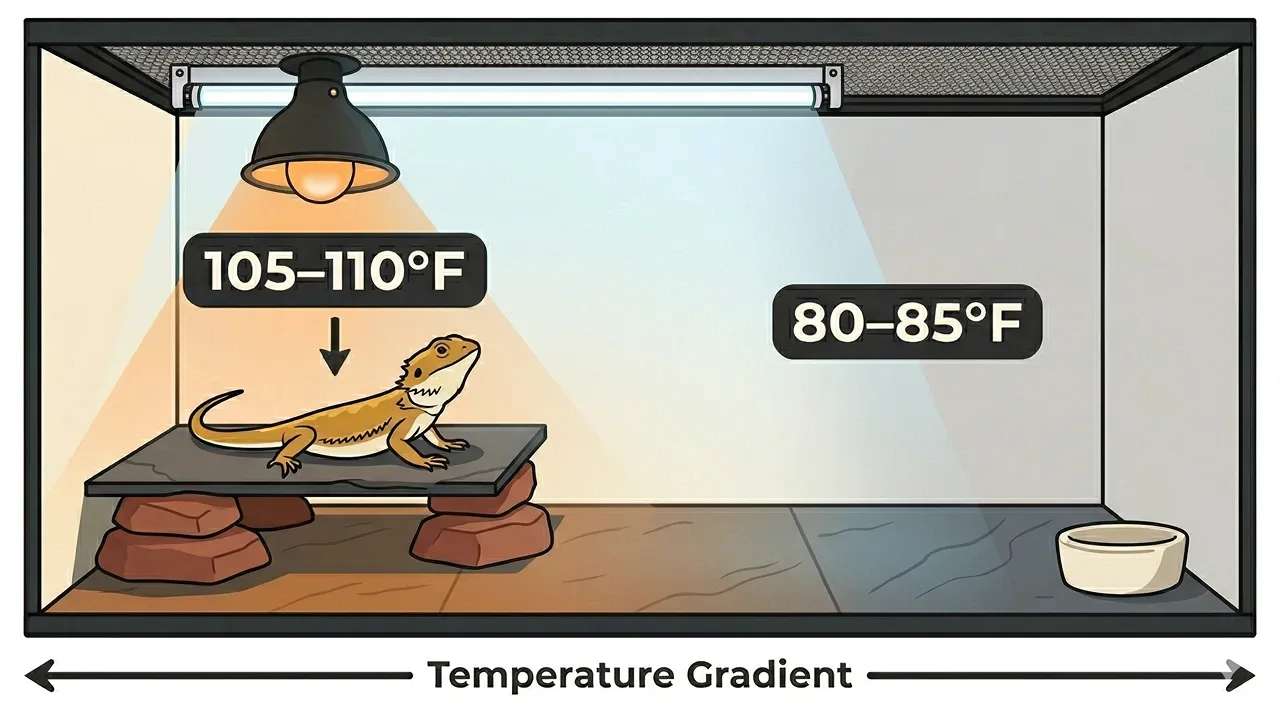
The basking surface needs to sit between 105°F and 110°F for dragons under six months, not the air temperature above it. The cool end should stay between 80°F and 85°F during the day.
Reading both zones with the right thermometer type removes the guesswork from daily checks. Nighttime drops to the low-to-mid 70s°F are fine, but anything below 65°F needs a ceramic heat emitter to compensate.
Avoid heat mats, heat rocks, and under-tank heaters as primary heat sources. Baby bearded dragons cannot detect belly heat the way they detect radiant heat from above, and a hatchling will sit on a running heat mat without showing distress until the internal damage is already done.
UVB Lighting Is Not Optional
Baby bearded dragons are entirely dependent on UVB light to synthesise vitamin D3, which drives calcium absorption. Without adequate UVB, calcium from food and supplements cannot be processed properly, and metabolic bone disease can begin developing within weeks in a fast-growing hatchling.
The current standard is a T5 HO tube bulb, either a Zoo Med ReptiSun 10.0 or an Arcadia Dragon 14%, spanning at least two-thirds of the enclosure length and mounted inside rather than over glass or plastic.
Many first-time setups use coil bulbs because they are cheaper, but the UVB output difference between coil and T5 HO tubes is large enough to change health outcomes over six months. It is one of the most common budget mistakes in new setups.
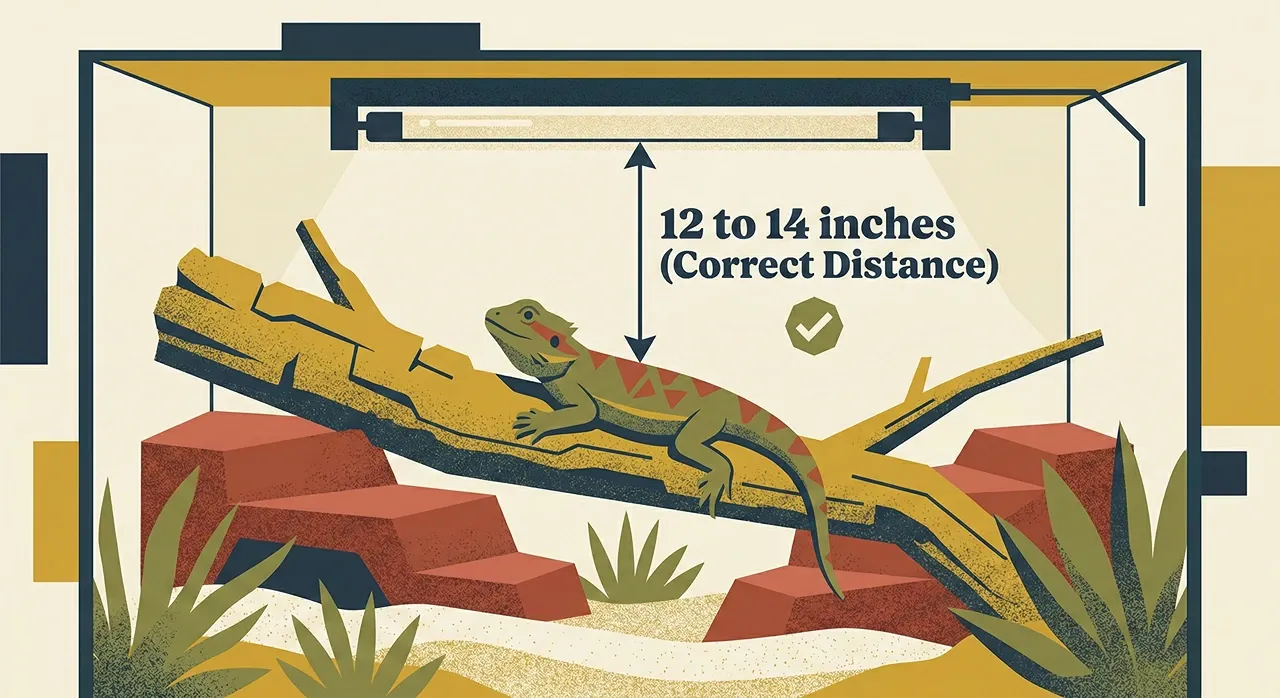
Placement matters as much as bulb choice. For a T5 HO 10.0 over mesh, the basking platform should sit approximately 12–15 inches below the bulb. For the Arcadia 14%, 15–20 inches is appropriate.
The target is a Ferguson Zone UVI reading of 4.0–6.0 at the basking spot, which is achievable without specialist meters if manufacturer mounting guides are followed precisely.
Replace T5 HO tubes every 12 months for Arcadia, every six months for Zoo Med. The visible light may still work past those points, but UV output drops well below usable levels before the bulb stops glowing.
Loose Substrate Is Risky Before Six Months
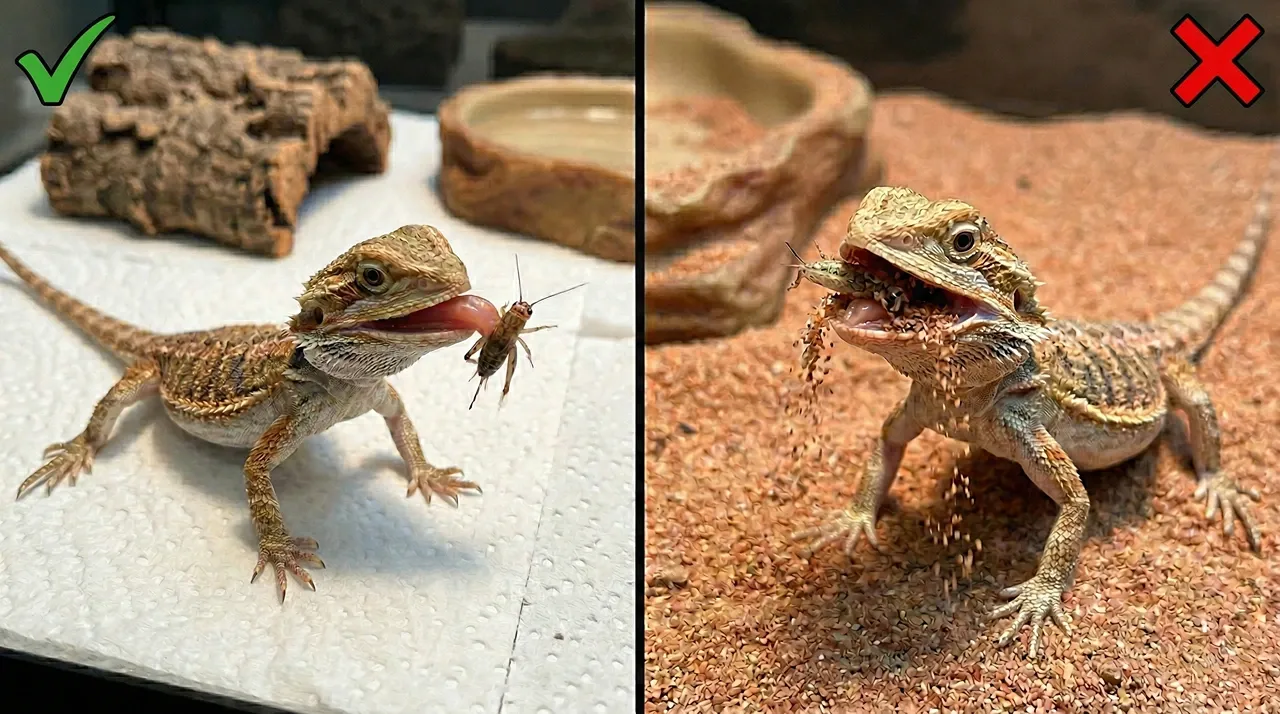
Loose particle substrates such as sand, calci-sand, wood chips, and bark carry real impaction risk for dragons under six months. A hunting hatchling lunges fast and ingests substrate with its prey.
This is not a remote possibility. It is one of the most common presentations in young dragons at reptile vet clinics, and it is entirely avoidable.
Slate tile, ceramic tile, or non-adhesive shelf liner are the safest options for the first six months. They hold warmth from the basking zone, clean quickly, and eliminate ingestion risk entirely.
Reptile carpet works if washed frequently, but fibres pulling loose with age become a claw and jaw hazard. Loose substrates that perform well in older dragon setups still carry real ingestion risk before six months.
How to Feed a Baby Beardie
Baby bearded dragons are insectivores first. During the first six months, insects should make up roughly 70–80% of the diet by volume.
Leafy greens should be offered daily from week one, even if the dragon ignores them completely. The habit of greens being present matters more at this age than whether they are eaten.
Why Insect Size Matters So Much
The rule is simple: never offer an insect larger than the distance between the dragon’s eyes. Most keepers assume this is about choking risk. It is not.
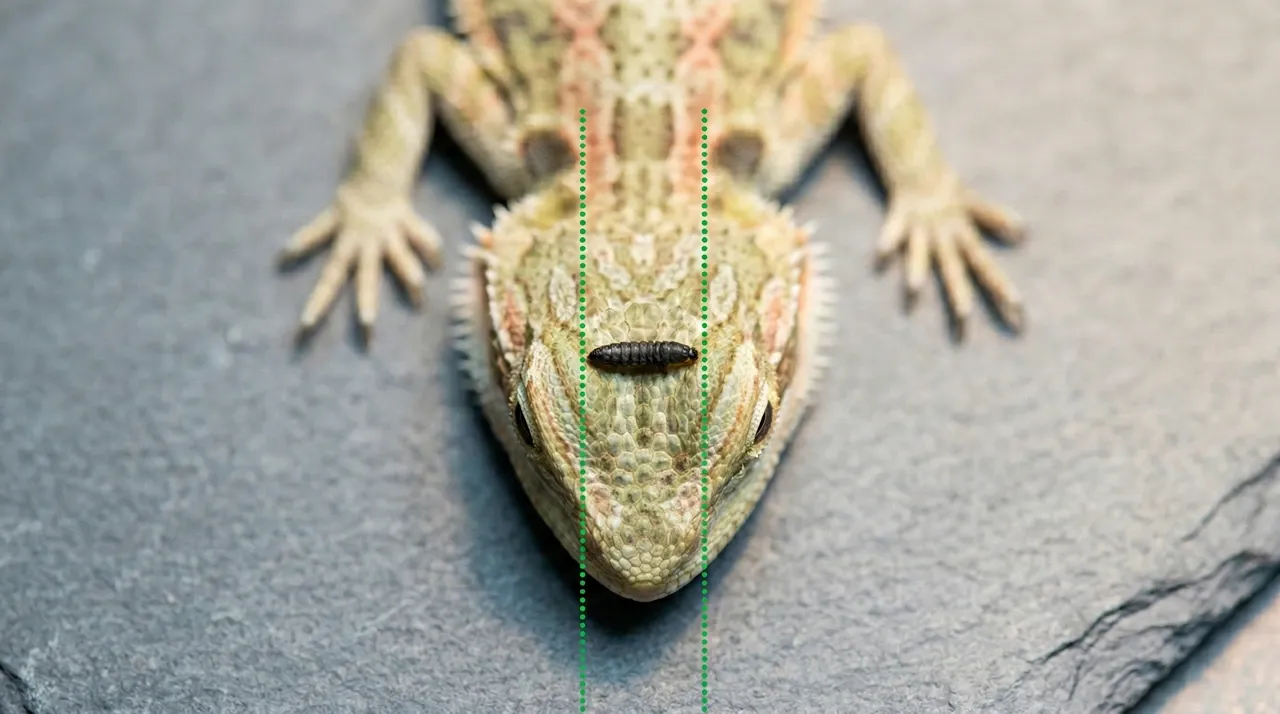
The real concern is neurological. Oversized prey swallowed whole can cause partial gut blockage, and there are documented cases where sustained pressure near the spinal column from an impacted gut has caused hind-leg paralysis in young dragons.
Small crickets and small dubia roaches are the standard staples for hatchlings. At hatching, that typically means 1/4-inch crickets. By two months, 3/8-inch works for most dragons. By four to five months, small adult dubias or 1/2-inch crickets are appropriate.
How Often Babies Actually Need to Eat
Two feeding sessions per day is the right frequency from hatching through six months. Each session should run about ten minutes.
Offer insects until the dragon stops actively hunting, then end the session. A healthy hatchling can consume fifteen to thirty small crickets per session without difficulty.
Remove uneaten crickets after each session. Crickets left overnight bite sleeping dragons, which causes stress, minor injury, and often a food refusal the following morning. It is an easily avoided problem that comes up constantly in new setups.
At the six-month mark, daily insect frequency drops and greens start to dominate the diet in a meaningful way.
Greens for Dragons Under Six Months
Collard greens, mustard greens, and turnip greens make the best daily staples: high-calcium, low-oxalate, and accepted by most young dragons somewhere around the two-to-three month mark once they start exploring plant matter.
Chop greens finely. A baby that bites off a piece it cannot manage tends to become avoidant of greens altogether, which creates a bigger problem at six months when greens need to form a larger share of the diet.
Finely shredded leaves also make calcium dusting more effective, since supplement powder sticks to cut surfaces rather than sitting on top of whole leaves. Rubbing a feeder insect briefly across the greens before serving leaves a scent trail that triggers hunting interest in reluctant eaters.
Supplementation in the First Six Months
Baby bearded dragons are growing faster than at any other point in their lives, and the calcium-to-vitamin D3 balance during this window matters more than most keepers realise.
Too little calcium causes metabolic bone disease in weeks. Too much supplemental D3 causes hypercalcaemia, which damages kidneys. The right balance depends on how strong your UVB setup is.
| Supplement | Frequency (0–6 months) | Notes |
|---|---|---|
| Calcium without D3 | Every feeding | Staple dusting; use with a functioning T5 HO UVB in place |
| Calcium with D3 | 2–3 times per week | Reduce to once weekly if T5 HO UVB is strong and properly placed |
| Multivitamin (Repashy Supervite or Herptivite) | Once weekly | Do not exceed; fat-soluble vitamins accumulate over time |
A common keeper error is assuming that a tube UVB replaces all need for supplemental D3. It does not. Calcium without D3 should still be applied at every feeding; the tube just reduces how often calcium-with-D3 is needed on top of that.
How to Keep Baby Dragons Hydrated
Baby bearded dragons are native to semi-arid Australia and obtain most of their moisture through food and brief environmental contact, not standing water. A water dish in the enclosure is fine, but most hatchlings will not drink from one voluntarily.
Twice-weekly shallow baths work well. Use lukewarm water around 90–95°F at a depth no higher than the dragon’s elbows, and keep each session to about ten minutes.
Baths provide hydration through skin contact and occasional drinking, help with the frequent early sheds, and give you a regular chance to check body condition without the distraction of a full handling session.
Do not mist the enclosure as a primary hydration method. Raising ambient humidity increases respiratory infection risk in a setup that should stay between 30–40%.
The First Two Weeks in a New Home
A baby dragon that does not eat for seven to fourteen days after arriving home is not sick. It is stressed and recalibrating.
Baby bearded dragons are hard-wired to freeze, hide, and stop eating when their environment changes. It is a survival response, not a setup failure on your part.
The markers that separate a settling dragon from one that needs a vet are: body weight holding steady or gaining, basking occurring daily, and the dragon tracking insects with its eyes even when it does not give chase.
A new beardie refusing food follows a predictable pattern, and knowing the specific escalation points before it happens removes most of the panic from those first two weeks.
Stress marks are dark wavy lines that run across the belly and lower flanks. They are normal in new arrivals and should lighten within a few days as the dragon settles in.
If they persist past two weeks, the setup is still triggering a stress response. The most common culprits are temperatures running slightly low, too much foot traffic near the enclosure, or placement near a vibration source like a speaker or washing machine.
Baby Bearded Dragons Are Rapid Growers
Growth rate is one of the clearest indicators of whether the setup is working. A healthy hatchling gains roughly a quarter to half an inch per week in the early months, which means the gap between a well-kept and a poorly-kept baby becomes visible quickly.
| Age | Expected Length (snout to tail) | Expected Weight |
|---|---|---|
| Hatchling (0–1 month) | 3–6 inches | 4–6 grams |
| 2 months | 5–9 inches | 8–40 grams |
| 3 months | 8–11 inches | 22–110 grams |
| 4 months | 9–12 inches | 41–115 grams |
| 5 months | 11–16 inches | 85–115 grams |
| 6 months | 11–18 inches | 115–188 grams |
These ranges are wide because genetics and individual variation both play a large role. A dragon consistently at the lower end is not automatically a problem.
A dragon that has stopped growing for four or more consecutive weeks during an active phase, or is losing weight outside of a brumation period, needs attention. Weight is more useful than length as an ongoing indicator because it is harder to misread.
How to Handle Your Baby Beardie
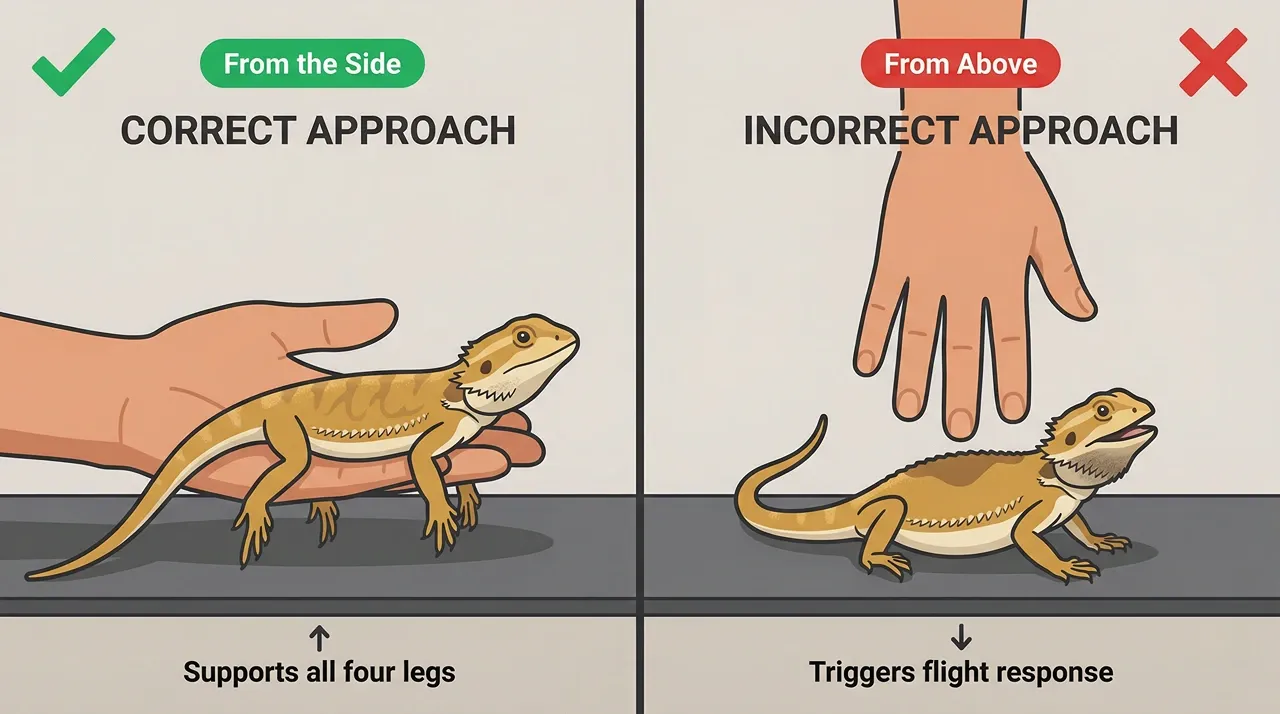
Baby bearded dragons are prey animals and interpret fast movement from above as a predator strike. The default threat response of a hatchling is to run, and the first few handling attempts will often produce a panicked scramble.
That does not mean the dragon is aggressive or will stay that way.
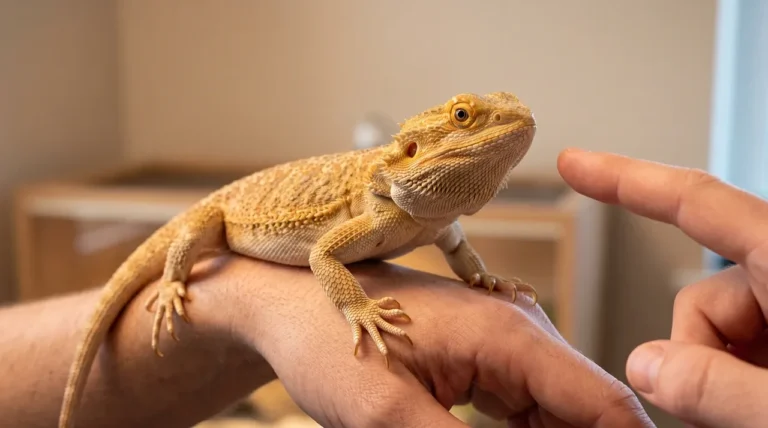
Always approach from the side, never from above. Slide one hand underneath the dragon and support all four legs and the tail from below. Keep early sessions to five to ten minutes in a calm room with no other pets present.
Increase duration gradually over two to three weeks as the dragon stops tensing and starts resting on your hand without looking for an exit.
Avoid handling for at least 48 hours after a meal. A dragon pulled from its basking spot right after eating cannot thermoregulate properly and may regurgitate. That creates a negative association that takes weeks to undo.
Consistent, patient handling from below is the difference between a dragon that tolerates contact and one that actively seeks it out.
Health Warning Signs Under Six Months
Baby bearded dragons are more vulnerable to husbandry errors than adults, and they deteriorate faster when something is wrong. The same mistake that a one-year-old dragon might absorb for a week can put a four-month-old into a medical situation within days.
When to Act Immediately
- Hind leg weakness, dragging, or tremors: these suggest early MBD or spinal involvement from oversized prey; get a vet the same day
- Mouth gaping with no nearby heat source: possible early respiratory infection or mouth rot; both progress fast in hatchlings
- Watery or bloody stools for more than one day: parasites are common in pet-store hatchlings and require a faecal test to confirm and treat
- Swollen limbs or facial swelling: potential abscess or infection; do not wait to see if it resolves on its own
- Any dragon under six months that has not eaten in more than ten days: past the settling window; a vet assessment is warranted
What Is Probably Normal
- Dark beard first thing in the morning: normal thermoregulation; a dark surface absorbs heat faster
- Colour changes throughout the day: babies shift colour more dramatically than adults, and stress marks lighten as temperatures stabilise
- Brief lethargy after a large meal: digestion requires basking, and a full dragon will stay still for extended periods
- Frequent shedding: a healthy baby may shed every three to four weeks during peak growth; that frequency is a good sign
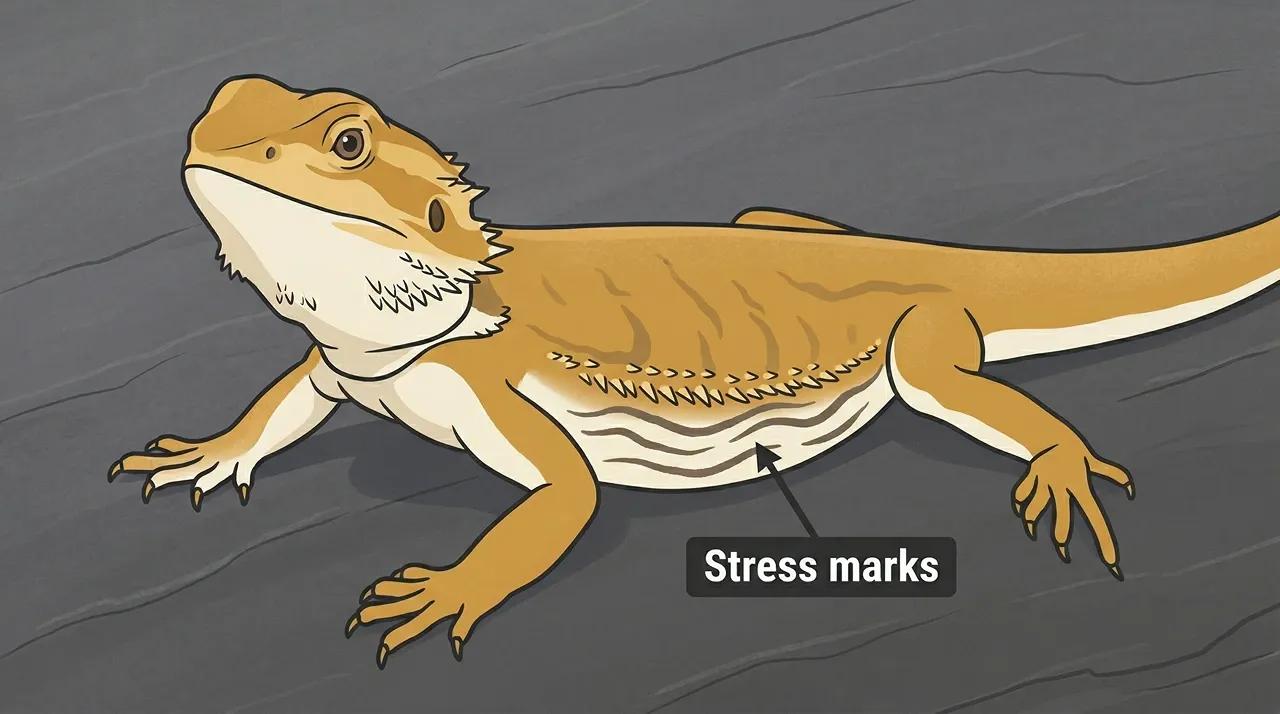
New keepers often mistake settling stress marks and morning bearding for signs of illness. If the dragon is basking daily, tracking prey with its eyes, and holding weight, it is almost certainly adjusting rather than sick.
Any genuine uncertainty is worth a phone call to a reptile-specialist vet. Most clinics will answer a brief question without requiring a formal appointment.
Can Baby Dragons Brumate
Technically, yes. In practice, a dragon under six months should not be allowed to brumate. One showing prolonged hiding, food refusal, or unusual sleep duration is almost always reacting to a setup problem rather than genuine seasonal dormancy.
True brumation is driven by photoperiod shifts and happens in dragons that have built adequate fat reserves. A baby under six months does not yet carry what it needs to safely fast through a dormancy period.
The growth loss that follows an early brumation attempt can set development back by weeks. When lethargy and hiding appear in a hatchling, check the basking surface temperature first. A spot running five to ten degrees low is a far more common cause than seasonal brumation.
If temperatures and UVB are confirmed correct and the behaviour persists past two weeks, a vet check is the right call. Adult brumation patterns look different enough from illness-driven lethargy that the comparison is worth making before assuming either explanation.
Common Questions About Baby Beardie Care
How often should I feed a baby bearded dragon?
Twice daily, with each session lasting around ten minutes. Offer small-sized insects until the dragon stops actively chasing, then remove any uneaten feeders immediately. This frequency continues through the six-month mark, when it shifts down.
Can baby bearded dragons eat vegetables?
Yes. Baby bearded dragons are omnivores by nature, but during the first six months they strongly prefer insects. Offer finely shredded collard greens, mustard greens, or turnip greens daily from week one even if the dragon ignores them at first.
What temperature does a baby bearded dragon need?
Baby bearded dragons are ectotherms, meaning the basking surface needs to sit at 105–110°F for proper digestion. The cool side should stay 80–85°F during the day, and nights should not drop below 65°F. Verify these with a digital infrared thermometer aimed at the surfaces, not the air.
How often should I bathe a baby beardie?
Two to three times per week in lukewarm water (90–95°F) at elbow depth for about ten minutes. Avoid daily baths; they raise ambient humidity and increase respiratory infection risk in a setup that should stay between 30–40%.
When is a baby dragon ready for more handling?
After a two-week settling period in the new enclosure. Begin with five-minute sessions approached from the side, and increase duration gradually as the dragon relaxes. Most hatchlings are comfortable with regular handling by six to eight weeks in, provided post-meal gaps are respected.
Before Your Baby Dragon Comes Home
Run through this list before the dragon enters the enclosure. Every item addresses one of the predictable failure points in baby dragon care, and sorting them in advance removes the scrambling that happens when a new arrival refuses to eat and the keeper does not know what to check first.
- Enclosure running and temperatures stable for at least 48 hours before arrival
- Basking surface confirmed at 105–110°F with a digital infrared thermometer
- Cool side confirmed between 80–85°F
- T5 HO tube UVB installed at the correct mounting distance, not a coil bulb
- Slate tile, ceramic tile, or shelf liner in place; no loose particles of any kind
- 1/4-inch crickets or small dubias sourced and gut-loaded before the first feeding
- Calcium without D3 and a multivitamin ready for dusting
- Shallow water dish in place and bath schedule set for twice weekly
- Reptile-experienced vet identified and contact saved before the dragon arrives home
Written by
Sarah ArdleySarah has kept bearded dragons for over ten years. She founded Beardie Husbandry after discovering that most mainstream care advice — including what she followed with her first dragon — was doing more harm than good. Every article on this site is grounded in veterinary research and real keeper experience.