Bearded Dragon Lighting: Setup, UVB, and Heat Explained
Setting up bearded dragon lighting correctly is where most first-time keepers quietly make their worst mistake, and the frustrating part is that pet stores are actively working against them. The shelves are full of bulbs that look convincing on the box and do almost nothing useful at real keeper distances inside an enclosure. I bought three of them before I understood why Spike was declining.
Good bearded dragon lighting is not about brightness. It is about replicating specific wavelengths of the Australian sun closely enough that your dragon’s body can function the way it evolved to.
Get it right and you will have an active, well-fed animal with strong bones. Get it wrong and you are looking at slow deterioration that is easy to miss until it is already serious.
This is the setup I run, the mistakes I see repeated constantly in keeper communities, and the reasoning behind every decision.
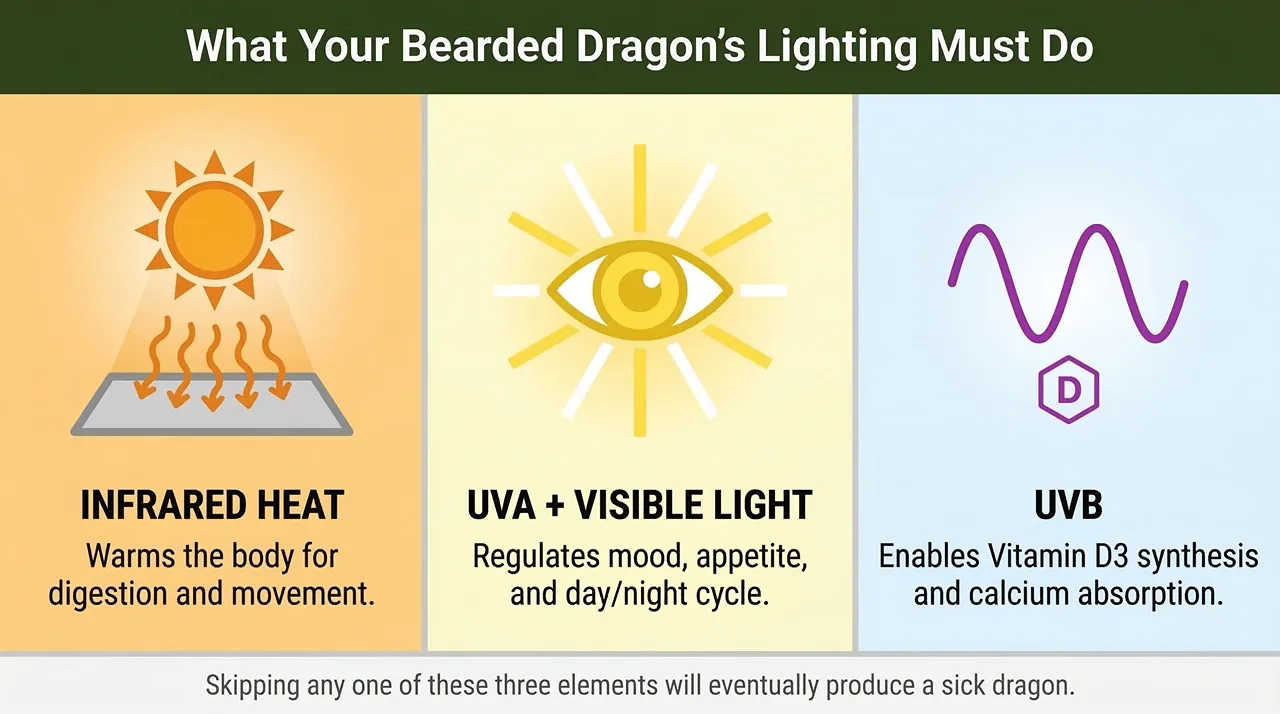
Bearded Dragon Lighting Has to Do Three Jobs at Once
Think of this as rebuilding the Australian sun inside a box rather than simply buying bulbs. The sun does three distinct things your enclosure must also replicate.
A setup that gets two out of three right will still produce a sick dragon eventually, and the failure is rarely obvious until months of subclinical decline have already happened.
- Infrared heat: This warms your dragon’s body so they can move, hunt, and digest properly. Low basking temperatures are the real reason most dragons refuse greens. A cold dragon instinctively avoids hard-to-digest plant matter, and inadequate heat is also the leading husbandry cause of gut impaction.
- Visible light and UVA: These signal daytime and regulate mood, activity level, and circadian rhythm. A dragon without adequate visible light and UVA eats less reliably, stays less alert, and shows fewer natural behaviours throughout the day.
- UVB: The invisible wavelength that allows your dragon to synthesise Vitamin D3. Without it, calcium absorption fails completely regardless of how well you dust feeders.
You cannot get all three effectively from a single bulb. Mercury Vapor Bulbs claim to do it, but their output is inconsistent and difficult to control at the distances required for a full-size enclosure.
Separate fixtures for heat and UVB give you independent control over both, which matters when you need to adjust one without destabilising the other. The basking platform material plays into heat delivery too. The wrong surface can undo even a correctly placed bulb.
Why Getting UVB Wrong Slowly Destroys a Dragon
If your basking temperatures are slightly off, your dragon gets lazy and digests slowly. Those are visible, fixable problems.
If your UVB is wrong, your dragon develops Metabolic Bone Disease, where the skeleton softens because the body cannot process calcium. It is painful, largely irreversible once established, and it progresses faster than most guides acknowledge.
What Happens Inside the Body Without UVB
Bearded dragons are heliotherms. They seek out the sun deliberately and spend hours under it in the wild. Their skin converts UVB rays into Pre-Vitamin D3 through a photochemical reaction that only works at the correct wavelength and intensity.
No UVB means no D3. No D3 means calcium cannot be absorbed regardless of how consistently you dust feeders. The body then starts pulling calcium from the dragon’s own bones to keep the heart and muscles running. That slow process is what MBD actually is.
You can use the best calcium powder available and dust every single feed. Without working UVB it will not matter.
Oral D3 supplements bridge short gaps but carry toxicity risk at high doses and are not a long-term substitute for correct lighting. A well-structured supplement routine works alongside good UVB, not instead of it.
Why Coil Bulbs Fail Every Time
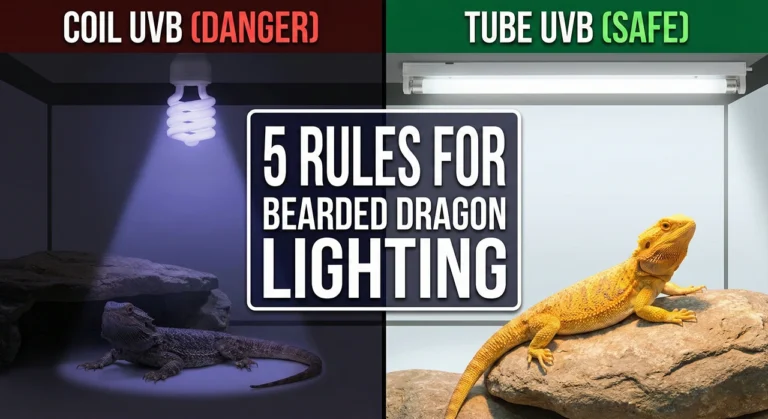
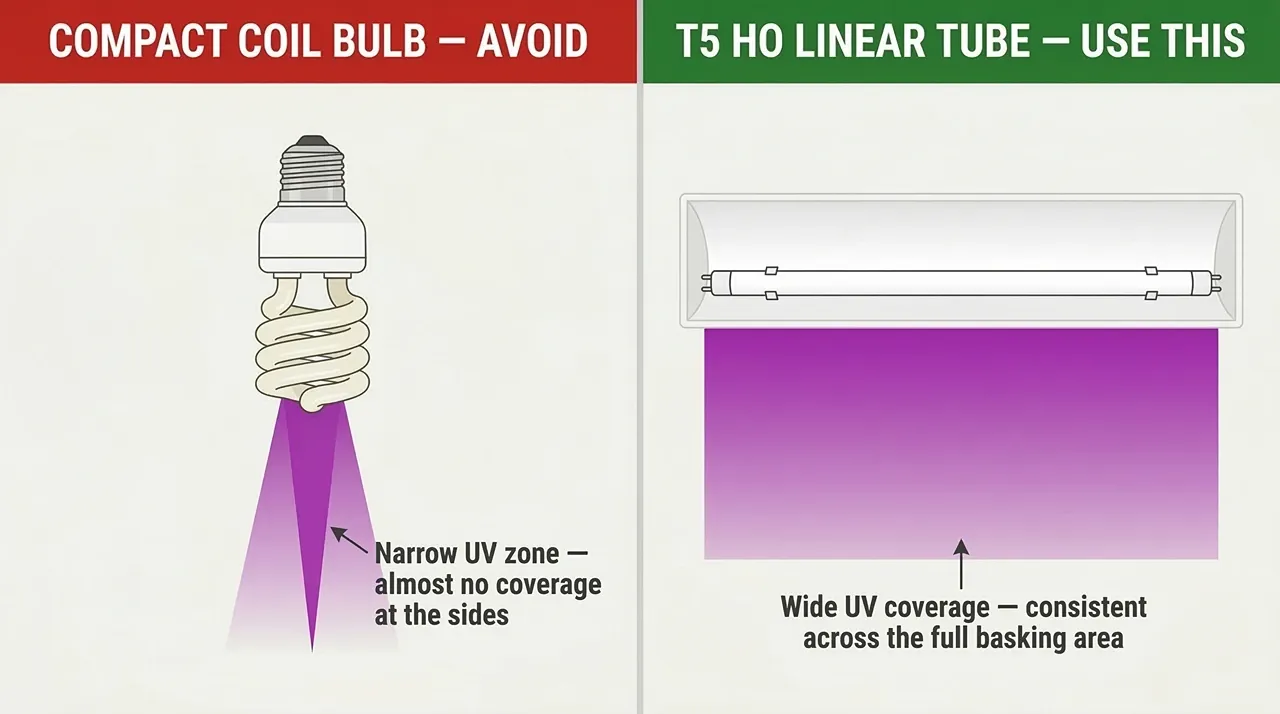
Pet stores push compact coil bulbs hard because they are cheap and fit standard dome fixtures. Coil bulbs concentrate UVB into a narrow beam. Unless your dragon sits directly underneath at exactly the right distance, they receive almost zero usable UV.
Earlier generations also emitted short-wave UV spikes that caused photokeratoconjunctivitis in reptiles, effectively snow blindness. Newer bulbs have addressed the safety issue. The fundamental coverage problem remains.
Linear T5 HO tubes spread UVB across a wide area, covering two-thirds of your tank with consistent, usable light. Your dragon can bask, hunt, and move around while still receiving UVB throughout. No dead zones.
Coil bulbs are not appropriate as a primary UVB source for bearded dragons. The output data between formats makes this gap concrete if you want the actual numbers.
The Only Two UVB Bulbs Worth Buying
Most UVB tubes on the market are not independently tested. The numbers on the packaging tell you nothing reliable about actual output at real keeper distances.
Two brands are consistently proven by herpetological researchers and long-term keepers to deliver correct UVB levels for a full 12 months.
Arcadia ProT5 Kit
The gold standard in the hobby, particularly in the UK and Europe. The Arcadia kit comes with a high-quality reflector built into the fixture. That reflector alone produces a measurable increase in usable UV reaching your dragon.
- 12% Dragon bulb: The right choice for most setups where the fixture mounts inside the enclosure with minimal mesh obstruction.
- 14% Dragon bulb: The stronger option for setups where the light sits on top of a mesh screen and loses significant output through it.
Zoo Med ReptiSun 10.0 T5 HO
The trusted North American standard. The fixture and bulb are often sold separately, so buy the ReptiSun Hood alongside it rather than fitting it into a standard dome.
Always buy the 10.0 Desert version, not the 5.0 Tropical. The 5.0 is calibrated for geckos and frogs and is far too weak for a bearded dragon’s UV requirements.
Why T8 Bulbs Are Not Worth It
Older T8 bulbs are still on shelves at lower prices. T8s are thicker, weaker, and need replacing every six months.
They must be mounted inside the enclosure within 6 to 8 inches of your dragon to produce adequate output. T5 HO bulbs penetrate mesh significantly better and maintain output for 12 months. The cost difference over time does not justify T8 for a bearded dragon setup.
Getting the bulb right is only half the equation. The next significant source of UV loss most keepers overlook sits directly above your dragon, between the light and the basking zone.
Your Mesh Lid Is Blocking More UVB Than You Think
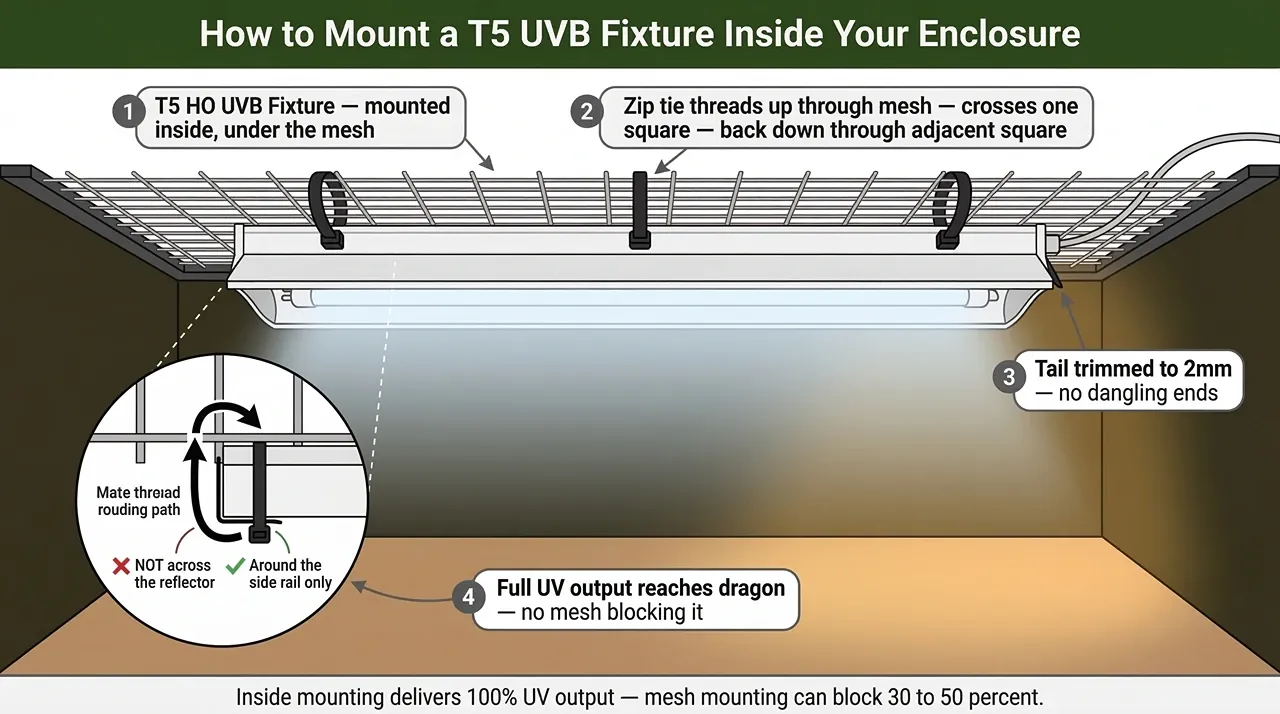
Standard aluminium mesh lids, the type included with most quality enclosures, block between 30 and 50 percent of UVB passing through them.
A 10.0 bulb sitting on top of dense mesh routinely delivers the effective output of a 5.0 bulb to the dragon below. That is the difference between adequate and inadequate UV exposure, caused entirely by one layer of mesh.
If you are using a glass or acrylic-topped terrarium, the situation is worse. Glass and acrylic filter out nearly all UVB. Your bulb must be mounted inside the enclosure with nothing solid between it and your dragon.
If your setup looks correct on paper and your dragon is still lethargic, or your vet flags calcium issues on bloodwork, the lid material is the first place to look.
Mounting Inside the Enclosure
This is the preferred method. Use the mounting clips that come with your fixture, or a few zip ties, to hang the tube from the ceiling supports inside the tank. Your dragon receives 100 percent of the UV output with nothing between the tube and the basking zone.
- Distance: Keep the basking platform 12 to 15 inches below the bulb for a T5 HO tube mounted inside.
- Safety: Position the fixture so your dragon cannot jump up and contact it.
Mounting on Top of the Mesh
If you must rest the fixture on the screen, three adjustments partially compensate for the UV loss:
- Use a fixture with a quality built-in reflector
- Raise your basking platform so the spot sits roughly 9 to 11 inches below the light
- Switch to the 14 percent Arcadia Dragon bulb rather than the 12 percent to restore the output lost through mesh
Heat and UVB Need to Come From the Same Direction
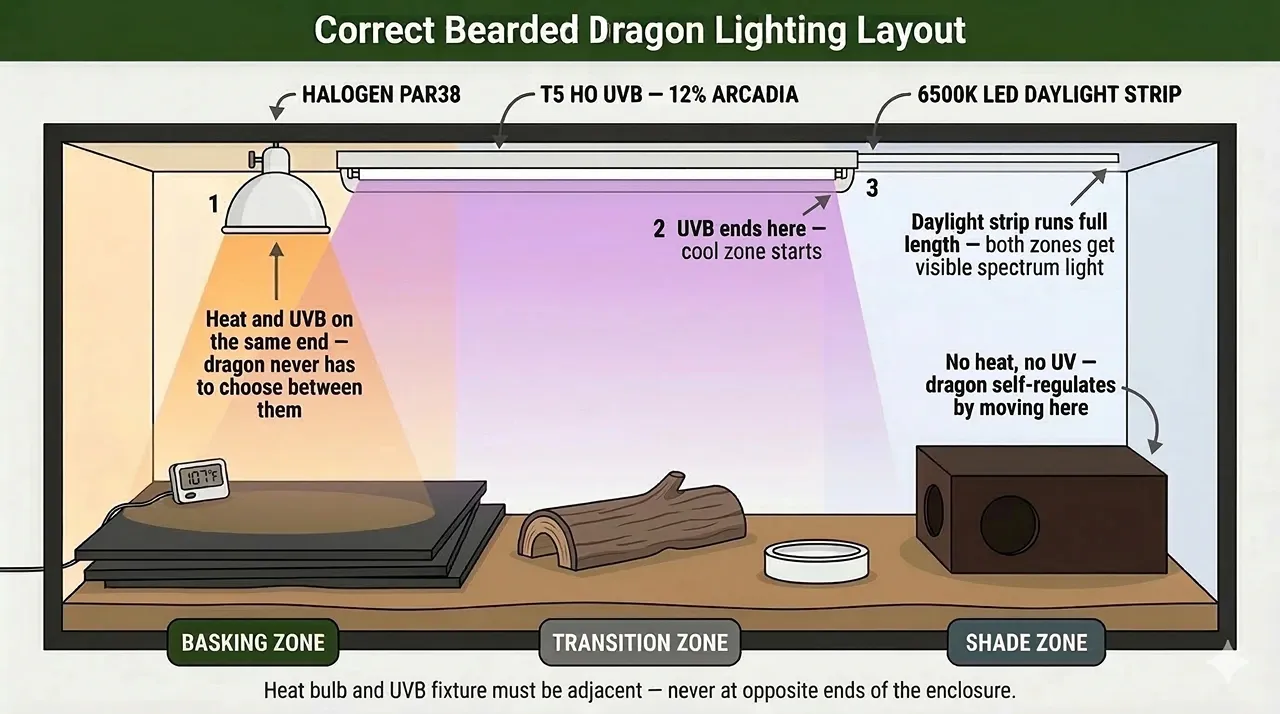
In nature, heat and UV both come from the sun. They arrive from the same direction — directly above. Position your heat bulb directly alongside your UVB fixture so the basking spot receives both simultaneously.
If the heat lamp is at one end and the UVB tube is at the other, your dragon has to choose between warmth and UV. They will almost always pick warmth, spending the day in heat with no UV at all. That is the exact outcome you are trying to prevent.
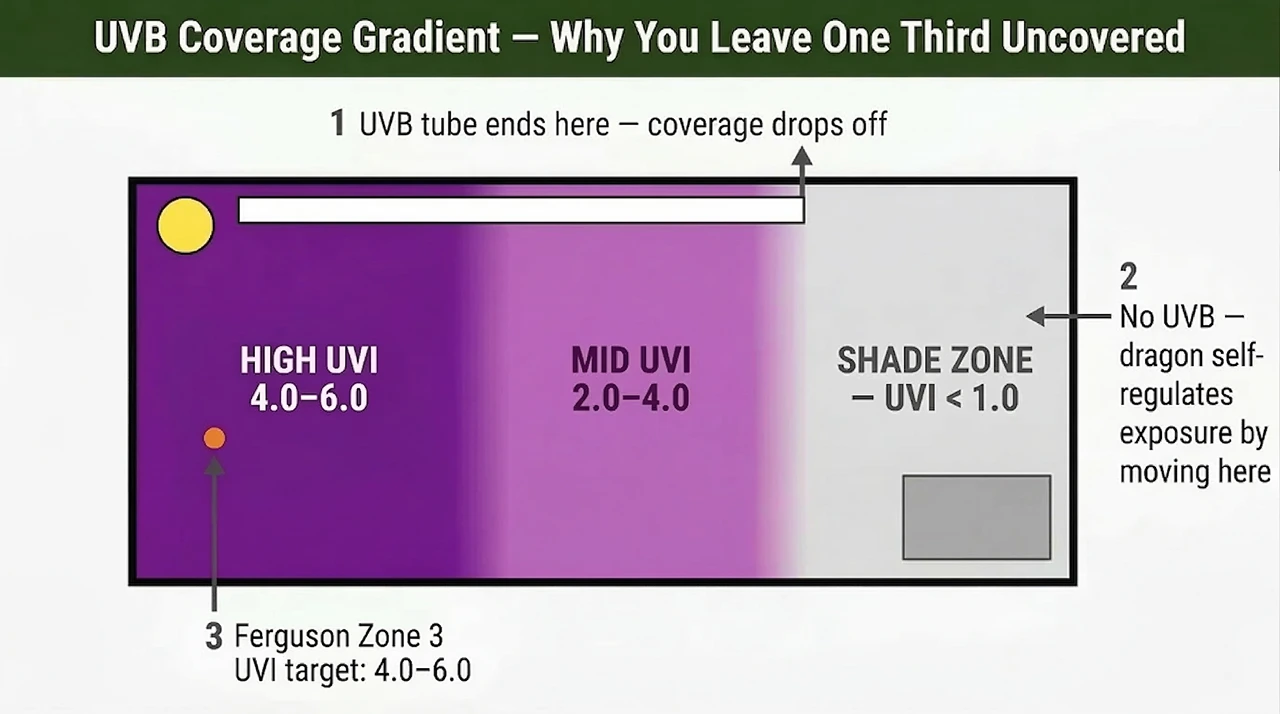
The cool end of the tank should have neither heat nor UVB. That is the shade zone, and dragons use it to self-regulate both temperature and UV exposure throughout the day.
Ferguson Zone 3 and Your Dragon’s UVB Requirements
The science behind correct bearded dragon UVB setup comes from Dr. Gwynn Ferguson’s field research on reptile UV exposure in wild populations. Ferguson categorised reptile species into zones based on how much UV they naturally seek out.
Bearded dragons fall in Zone 3, partial sun and open basking species, which means they need a UV Index of roughly 4.0 to 6.0 at the basking spot to replicate what their bodies are designed to receive.
A Solarmeter 6.5 is the tool reptile vets and serious keepers use to verify this directly. At around $200 it is steep for most hobbyists, but it is the only accurate way to confirm actual UVI without guessing.
Frances Baines’ UV Guide is the definitive reference on reptile UV measurement, the source most reptile vets and researchers cite, and worth bookmarking if you want to understand the Ferguson Zone methodology in full detail.
UVB coverage should span only half to two-thirds of the tank length. The uncovered half creates a natural UV gradient your dragon retreats into when they have had enough.
Reptiles self-regulate UV exposure the same way they manage temperature. Give them the gradient and they handle the rest accurately on their own.
Bearded dragons are remarkably accurate at self-managing UV exposure when you give them the gradient to work with. The same instinct that moves them toward the warm end in the morning shifts them away from peak UV intensity once they have had enough.
Why a Hardware Store Halogen Beats Every Reptile Basking Bulb
The best heat source for a bearded dragon is not a branded reptile bulb from a pet store. It is a standard PAR38 halogen flood light from a hardware store, the kind used in outdoor garden lighting, available for a fraction of the price of reptile-branded alternatives.
The reason comes down to infrared physics. Halogen bulbs produce high amounts of Infrared-A radiation. IR-A penetrates deep into muscle tissue, mimicking the way solar heat warms a basking reptile from the inside out.
Standard incandescent bulbs produce mostly IR-B and IR-C, which warm the skin without the same depth of penetration.
Combined with a natural stone basking platform, the difference in how actively your dragon basks is noticeable within a week of switching. Research points to underbelly heat from a warm surface aiding digestion, which is why the basking spot setup matters as much as the bulb above it.
Use a Dimmer Switch to Control Temperature
Selecting the correct wattage halogen for your exact enclosure is nearly impossible without a dimmer. A plug-in lamp dimmer, available for under fifteen dollars at any hardware store, lets you adjust the basking surface temperature without swapping bulbs.
This is how you reliably hit 105°F instead of guessing between a 50W and a 75W. It also extends bulb life.
For a standard 4x2x2 foot enclosure, a 100W PAR38 halogen on a dimmer gives you enough range to handle seasonal room temperature variation without changing equipment. For most setups, overnight supplemental heat is only needed when room temperature drops below 65°F, so measure your room before buying any additional equipment.
What Temperatures Your Setup Needs to Hit
| Zone | Baby (0 to 6 months) | Juvenile (6 to 18 months) | Adult (18+ months) |
|---|---|---|---|
| Basking surface | 105 to 110°F | 105 to 110°F | 100 to 105°F |
| Warm side ambient | 85 to 90°F | 85 to 90°F | 80 to 85°F |
| Cool side ambient | 78 to 82°F | 78 to 82°F | 75 to 80°F |
| Night minimum | 68°F | 65°F | 65°F |
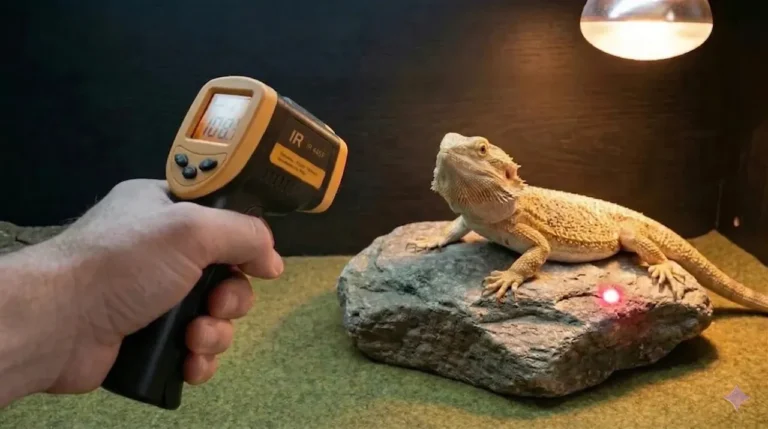
Ditch the stick-on analogue thermometers permanently. They are notoriously inaccurate, sometimes off by 20°F. Use a digital temperature gun to read the actual surface temperature of the basking rock. That number determines whether your dragon can digest its food, not the ambient air reading.
Babies need higher basking temperatures because of the metabolic demand of rapid early growth. An adult that cannot reach 100°F on its basking surface will almost always refuse greens, and the connection between refusing greens and surface temperature is more direct than most keepers realise.
Night heat is a solved problem. A CHE on a thermostat means you are never choosing between warmth and sleep quality.
The Daylight Bulb Most Bearded Dragon Setups Are Missing
Your UVB tube alone does not replicate the full visible light spectrum a bearded dragon receives in the wild. Keeper experience and available research consistently show that dragons housed under bright, full-spectrum daylight lighting at 6000 to 7000K colour temperature are more alert, eat more reliably, and show more natural behaviour than those without it.
This is not an optional extra. It is part of replicating what the Australian sun delivers in terms of visible wavelengths.
A T5 HO UVB tube covers the UV portion. A separate LED strip or fluorescent bulb rated at 6000 to 7000K handles the visible spectrum. LEDs are the practical choice: they run cool, use minimal energy, and will not destabilise your temperature gradient.
Run everything on the same plug-in timer. A dragon whose lights come on at random times is being stressed in a way that is invisible but accumulates over weeks.
For keepers who want to replicate seasonal photoperiod changes to support natural behaviours including brumation cycles, a summer schedule of 14 hours on and a winter schedule of 10 hours on mirrors the natural Australian photoperiod. A consistent 12/12 cycle works well for most setups.
What Your Dragon Is Telling You About the Lighting
You can have the right bearded dragon lighting installed correctly and still have a placement or intensity problem your equipment cannot reveal. Your dragon communicates through body language, and if you know what to look for, the signals are obvious.
- Mouth open while basking (gaping): Thermoregulation. They have reached optimal temperature and are venting excess heat. Your basking spot is working correctly.
- Staying on the cool side all day: A dragon that won’t use the basking spot usually has a spot that is too hot, above 115°F, or UVB intensity that is too high at the basking distance. Check both.
- Constant glass surfing: This repetitive glass surfing often means the cool side is too warm. Above 85°F leaves no genuinely cool zone. Check cool-end ambient temperature first.
- Squinting or closing one eye while basking: Your UVB fixture is angled into their eyes rather than coming from directly overhead. Reposition so light falls from above.
- Lethargic despite a normal appetite: Check UVB bulb age first. A tube past 12 months can produce bright visible light while delivering almost no usable UV.
- Refusing greens but eating insects normally: Basking surface temperature is almost always the cause. Measure directly on the rock, not the ambient air.
When Something Looks Wrong
| What You Are Seeing | Most Likely Cause | First Fix |
|---|---|---|
| Dragon won’t bask | Spot too hot or too weak | Check surface temp with gun; adjust dimmer or mounting height |
| Lethargic all day | UVB bulb past output life | Replace tube if over 12 months, even if it still lights up |
| Eyes puffy or swollen | Coil bulb or bad fixture angle | Switch to T5 HO immediately; reposition to come from overhead |
| Refusing greens only | Basking surface below 100°F | Measure rock surface directly with infrared gun and adjust |
| Constant glass surfing | Cool side above 85°F | Check cool-end ambient temp; reduce warm-end heat output |
| Dragon choosing heat over UV | Heat and UVB fixtures separated | Move both fixtures to the same end of the enclosure |
| Minimal activity despite correct temps | No daylight spectrum bulb | Add a 6000 to 7000K LED strip alongside the UVB fixture |
| Bulb flickers | Loose connection in fixture | Reseat bulb in socket and check fixture contacts for corrosion |
| Tank too hot overall | Wattage too high for enclosure | Use a dimmer to reduce output — do not swap bulbs blindly |
If your dragon is showing health symptoms that do not resolve within 48 hours of correcting an identified lighting issue, that is a veterinary situation rather than a husbandry adjustment. The ARAV vet directory is the fastest way to find a qualified reptile specialist in your area.
Frequently Asked Questions
Can I Use a Regular Household Bulb for Heat
A standard incandescent bulb produces some heat but outputs mostly surface-level IR-B and IR-C radiation rather than the deep-penetrating IR-A your dragon needs, and produces zero UVB. A PAR38 halogen flood from a hardware store is a significantly better heat source at a lower price, and you still need a separate T5 HO UVB tube alongside it regardless of which heat bulb you choose.
How Far Should the UVB Bulb Be From My Dragon
For a T5 HO tube mounted on top of mesh, the basking spot should sit 9 to 11 inches below the light. Mounted inside the enclosure with no mesh between tube and dragon, increase that to 12 to 15 inches. Always check the manufacturer’s published output chart — Arcadia and Zoo Med both publish these, and the numbers differ meaningfully between products.
Do Bearded Dragons Need UVB at Night
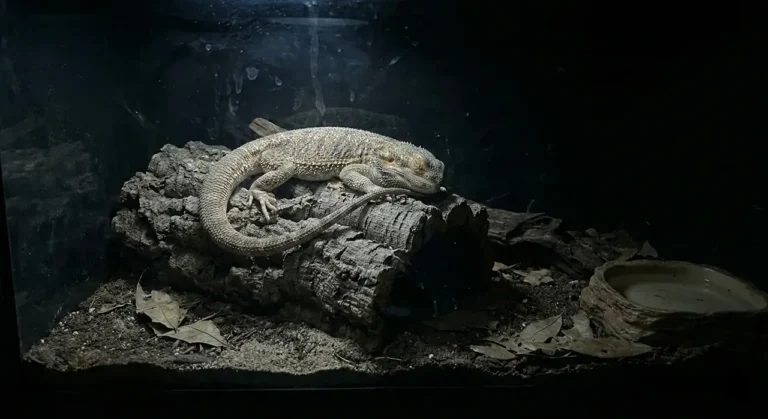
No. All lights off at night without exception. Complete darkness is required for correct circadian rhythm and sleep quality. If your room drops below 65°F overnight, a Ceramic Heat Emitter on a thermostat provides heat with zero light output. It is the only appropriate overnight heat source for bearded dragons.
What Happens If a Bearded Dragon Gets No UVB
Without UVB they cannot synthesise Vitamin D3, meaning calcium absorption fails regardless of supplementation. Over weeks to months this produces Metabolic Bone Disease, a softening and deformation of the skeleton that is painful, progressive, and largely irreversible once established. It is one of the most preventable conditions in the hobby and one of the most commonly seen by reptile vets.
How Do I Know If My UVB Bulb Has Stopped Working
You usually cannot tell by looking at it. Visible light output lasts long after UV output has decayed to useless levels. Replace T5 HO tubes every 12 months on a calendar reminder regardless of appearance. A Solarmeter 6.5 is the only tool that accurately verifies live UVI output at the basking surface.
Before Your Dragon Goes In
Every item on this list represents a failure point I have either experienced personally or seen produce sick animals in keeper communities. Run through it before your dragon enters any new or revised setup, and return to it any time behaviour signals something might be off.
A dragon with correct UVB, correct heat, a proper gradient, and a quality daylight spectrum will digest well, grow consistently, and behave like an animal that actually wants to be awake. The rest of the enclosure matters too, but nothing moves the needle on long-term health like getting the bearded dragon lighting right.
- ✅ UVB: T5 HO linear tube — Arcadia 12% or Zoo Med ReptiSun 10.0, spanning half the enclosure length on the warm side
- ✅ Morph check: Hypomelanistic, translucent, or silkback — use a lower-output bulb, verify UVI does not exceed 3.0
- ✅ Daylight: 6000 to 7000K LED strip running alongside the UVB fixture for the full photoperiod
- ✅ Heat: 100W PAR38 halogen flood on a plug-in dimmer — not a branded reptile basking bulb
- ✅ Measurement: Digital infrared thermometer for surface readings plus a digital probe on the basking spot — never stick-on strips
- ✅ Night heat if needed: Ceramic Heat Emitter on a thermostat only — heat with zero light output, triggered only if room drops below 65°F
- ✅ Positioning: Heat bulb and UVB fixture side by side at the same end of the enclosure — never separated
- ✅ Mounting: UVB tube inside the enclosure where possible; 9 to 11 inches over mesh or 12 to 15 inches with no mesh between tube and dragon
- ✅ No glass or acrylic between UVB bulb and dragon
- ✅ Schedule: Everything on a plug-in timer — 12 hours on, 12 hours off minimum
- ✅ Replacement reminder set: T5 HO every 12 months, T8 every 6 months
- ✅ Basking temps verified on the actual rock surface: 105 to 110°F for babies and juveniles, 100 to 105°F for adults
- ✅ No red bulbs, no blue bulbs, no heat rocks
Written by
Sarah ArdleySarah has kept bearded dragons for over ten years. She founded Beardie Husbandry after discovering that most mainstream care advice — including what she followed with her first dragon — was doing more harm than good. Every article on this site is grounded in veterinary research and real keeper experience.