Do Bearded Dragons Need Heat at Night? (Nighttime Temp Guide)
A lot of new owners worry the first time they turn off their bearded dragon’s tank lights. It feels wrong to leave a desert reptile in the dark at room temperature. Pet stores often make this confusion worse by selling red “night bulbs” to keep the tank warm.
You don’t need the red bulb, and in most cases, you don’t need nighttime heat at all.
Bearded dragons are built for the Australian outback. When the sun goes down, temperatures drop quickly—and their bodies expect it. That nightly cooldown is essential for proper sleep and metabolic recovery.
Keeping a tank warm around the clock prevents that natural slowdown, leading to poor rest, stress, and long-term health problems.
The 65°F Rule: Why Cold is Good
In the wild Australian desert, winter night temperatures regularly drop into the 40s and 50s. Your dragon’s body is hardwired to survive—and expect—this drop.
When the temperature falls, their metabolism slows down, allowing them to enter a deep, restful sleep. If you keep their tank at 85°F all night long, their body never fully powers down. They will wake up exhausted, grumpy, and lethargic.
The Safe Zone: A nighttime temperature drop down to 65°F (18°C) is completely safe and highly recommended for a healthy adult dragon. Most modern homes never drop below 68°F at night, which means your room temperature is already perfect. You do not need to buy any extra equipment.
A 65°F room is perfectly safe. However, a cold breeze from an open window or an AC vent blowing directly into the tank is dangerous. Drafts pull body heat away from the reptile far too quickly and can cause a Respiratory Infection. Make sure the tank is in a draft-free corner of the room.
When DOES a Dragon Need Night Heat?
There are only three scenarios where you should actively heat your tank at night:
- Your house is an icebox: If your home regularly drops below 60°F (15°C) at night during the winter, you need supplemental heat to prevent hypothermia or an unwanted brumation cycle.
- You have a sick dragon: A reptile’s immune system is tied to its body temperature. If your dragon is recovering from an illness or a heavy parasite load, bump their nighttime temperatures up to around 75°F to help them heal.
- You have a tiny baby: Hatchlings (under 3 months old) have very little body mass and dehydrate or freeze much faster than adults. Keep their night temps strictly around 70°F to 75°F.
The Red Light Problem (Do Not Use Them)
Pet stores have sold red “nighttime” bulbs for decades, claiming that reptiles cannot see the color red. This is a myth.
Bearded dragons have excellent color vision. They can see the red light just as brightly as you can. Worse, they have a “third eye” on the top of their head called a parietal eye. This eye detects shadows and changes in light to help them set their circadian rhythm (their internal clock).
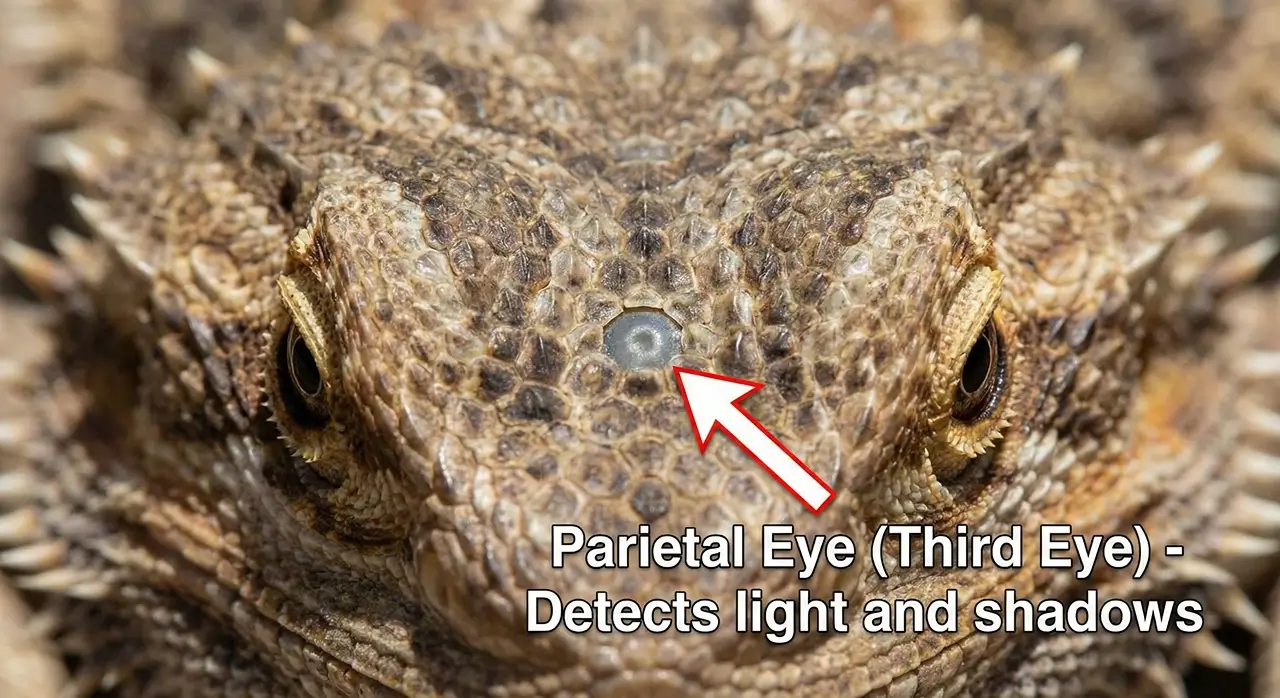
If you leave a red light on all night, their parietal eye tells their brain that the sun is still up. They will not sleep properly. Over time, this chronic sleep deprivation destroys their immune system, wrecks their appetite, and leads to severe behavioral stress.
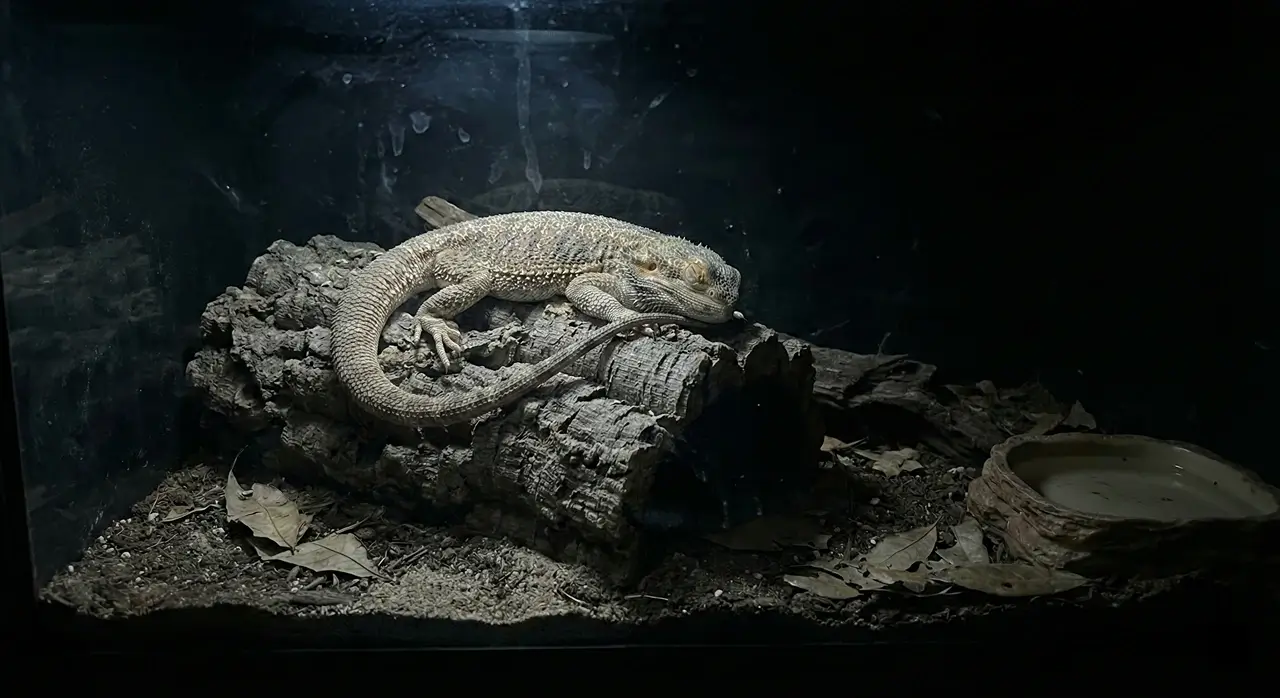
The Rule: If your dragon is sleeping, their tank must be pitch black.
How to Safely Add Heat at Night (If You Need It)
If your house drops below 60°F, you need a heat source that produces zero light. You have two safe options.
Option 1: Ceramic Heat Emitter (CHE)
A CHE is a solid ceramic bulb that screws into a standard dome fixture. It gets incredibly hot, but it emits absolutely no light. This is the gold standard for nighttime heating in the reptile hobby.
Because they get so hot, you must connect the CHE to a simple on/off thermostat. Set the thermostat probe near the dragon’s sleeping area and set it to 65°F. The CHE will stay off all night, but if the room drops to 64°F, it will kick on, warm the air slightly, and turn back off. It acts as a perfect safety net.
Option 2: Deep Heat Projector (DHP)
A DHP is a more modern bulb that projects infrared heat deep into the dragon’s muscle tissue without emitting visible light. These are fantastic, but they are slightly more expensive than a standard CHE. Like the CHE, a DHP must be run through a dimming thermostat to prevent overheating.
Do not buy under-tank heaters (UTH) or electric heat rocks for your bearded dragon. Dragons have a thick “heat shield” on their belly scales and very few thermal sensors on their stomach. They are designed to absorb heat from the sun above them. If a heat rock malfunctions and gets too hot, your dragon will not feel it burning their stomach until the tissue is permanently destroyed. Stick to overhead heating only.
The Thermostat Probe Mistake
Buying a thermostat for your Ceramic Heat Emitter (CHE) is only half the job. If you place the sensor probe in the wrong spot, you will accidentally freeze or roast your dragon.
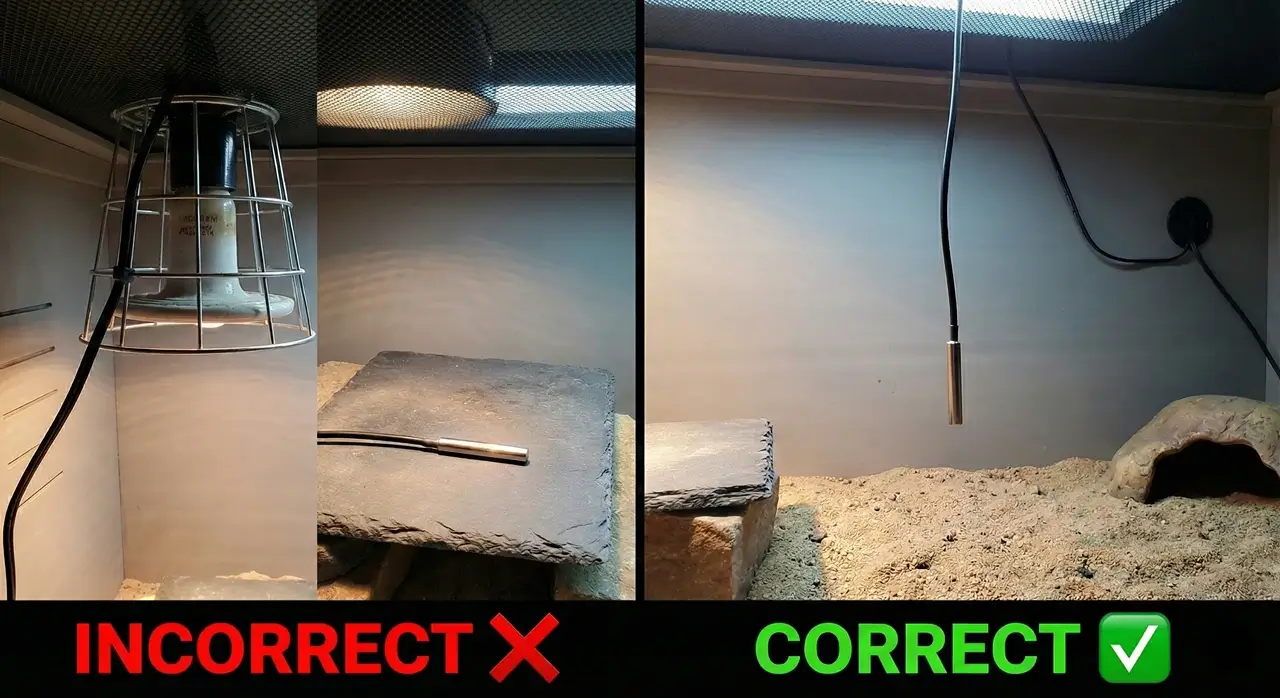
Do not zip-tie the probe directly to the CHE fixture, and do not lay it flat on the basking rock. If the probe is too close to the heater, it will turn off prematurely. If it is sitting on a rock, the dragon might sleep on top of it, insulating the sensor with their cold body and causing the heater to blast all night.
The Fix: Hang the thermostat probe in the ambient air, roughly two inches above the floor on the cool side of the tank, near where your dragon usually sleeps. This guarantees the heater is reading the air temperature, not the surface temperature.
Nighttime Temp Action Plan
Check your digital thermometer right before you go to bed. Find your temperature below and take the corresponding action.
| Nighttime Tank Temp | What It Means | Action Required |
|---|---|---|
| 75°F or Higher | Too Warm | Turn off all heat. Increase room ventilation so they can sleep. |
| 65°F to 74°F | Perfect | Do nothing. Leave the tank pitch black. |
| 60°F to 64°F | Getting Chilly | Monitor closely. Babies need heat added; healthy adults will be fine. |
| Under 60°F | Dangerous | Install a CHE on a thermostat set to 65°F immediately. |
Winter Emergencies: The Power Outage Protocol
A Ceramic Heat Emitter won’t do you any good if a winter storm knocks out your power grid. When the house drops into the 40s, you need an off-grid backup plan ready to go. Do not wait for a blizzard to figure this out.
Never use HotHands or pocket hand warmers. Those chemical packets are designed for human ski boots. They require oxygen to activate, burn rapidly, and can spike over 135°F. If your dragon falls asleep on one, it will severely burn their belly scales.
Your Emergency Kit Needs:
- Uniheat Reptile Shipping Warmers: Buy the 40-hour or 72-hour packs. Breeders use these to ship reptiles in the mail. They heat up slowly, max out at a safe 100°F, and last for days. Wrap one in a thin towel and place it next to (not under) your sleeping dragon.
- Insulation: Glass is a terrible insulator. If the power dies, immediately wrap the back, sides, and top of the glass tank in heavy moving blankets or sleeping bags to trap whatever heat is left inside.
- Body Heat: If you have no supplies and the house is freezing, put your dragon inside a pillowcase and stick them inside your shirt. Your core body temperature is 98.6°F. You are a walking heat rock.
Frequently Asked Questions (FAQ)
How do I measure the temperature at night?
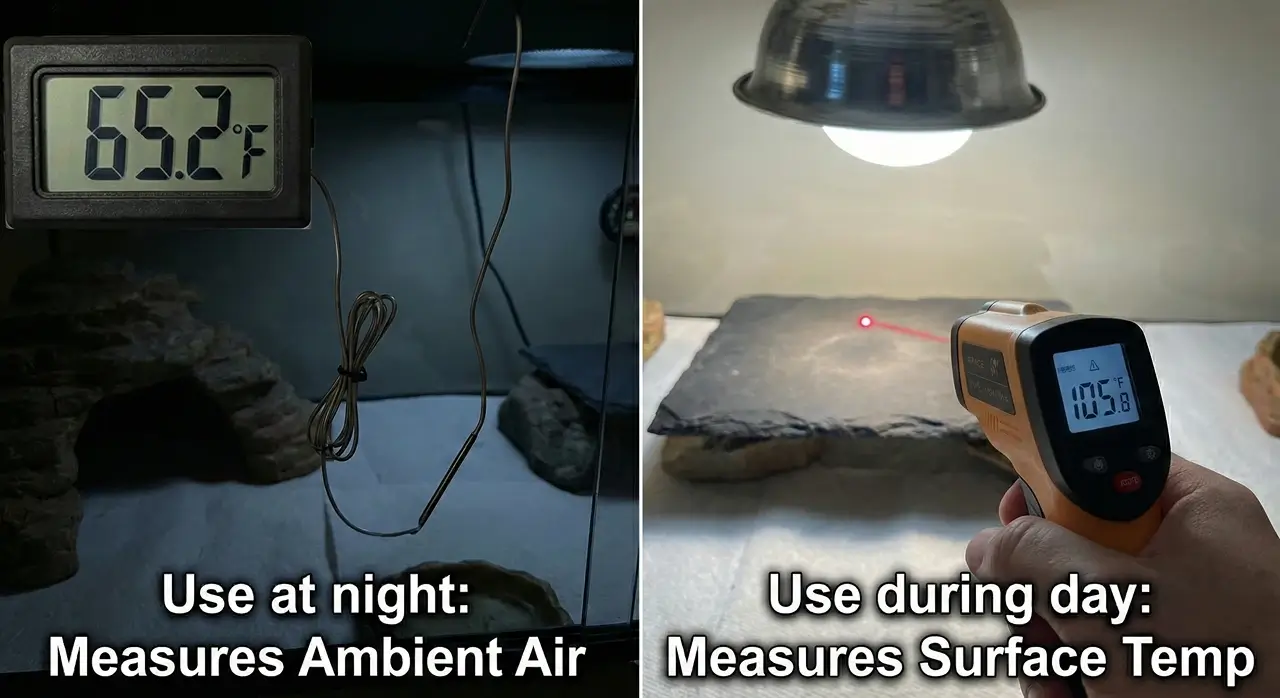
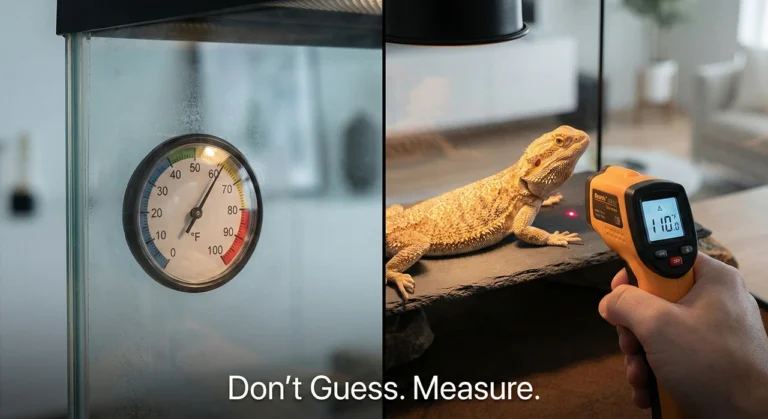
At night, you need to measure the ambient air temperature using a digital thermometer with a probe. Do not use a temperature gun at night. Temp guns only measure surface temperatures. The surface of a rock will always be colder than the air in the room, which often causes owners to panic and buy heaters they do not need.
Can I put a blanket inside the tank for my dragon to sleep on?
No. Reptiles are cold-blooded. A blanket works for a human because our bodies generate heat, and the blanket traps it. A blanket on a reptile does nothing because they have no body heat to trap. Worse, blankets snag their nails, hold onto bacteria from feces, and can be accidentally ingested. Keep fabrics out of the enclosure.
What about blue “moonlight” bulbs?
Just like red bulbs, blue moonlight bulbs are a gimmick. They emit a constant, unnatural light that disrupts your dragon’s sleep cycle. In the wild, moonlight is incredibly dim. A bright blue bulb shining directly into a glass box is blinding to them. Keep the tank completely dark.
My dragon buried itself in the dirt to sleep. Are they dying?
No, they are just acting like a wild animal. In their natural habitat, ambient air temperatures drop rapidly, but the earth holds onto residual heat. If a dragon feels a bit too chilly, their instinct is to dig a shallow trench and bury themselves in the substrate to insulate their body. As long as your substrate is safe (like a proper topsoil/sand mix) and your daytime temps are correct, leave them alone. They will dig themselves out when the lights turn on.
My dragon feels cold to the touch in the morning. Is that normal?
Yes. Reptiles cannot generate their own body heat. When they wake up, their skin will feel exactly like the ambient temperature of the room. This is why they immediately move to their basking spot when the lights turn on. As long as they warm up and become active within an hour of the lights turning on, they are perfectly healthy.
Should I cover my bearded dragon’s tank at night?
If your tank is in a busy living room with the TV on late at night, or if you work the night shift and have the room lights on, yes. Covering the outside of the tank with a dark blanket blocks out visual stress and room lights so they can sleep. Just check that you aren’t covering the top ventilation screens, as they still need fresh air.
Before You Buy More Gear: Check Your Daytime Temps
Nighttime heating is usually an unnecessary waste of money. Instead of buying extra bulbs, put your effort into making sure their daytime setup is flawless. A dragon that gets proper heat and UVB during the day will have no problem handling a cold night.
- ✅ Audit Your Basking Spot: Do not guess. Use a digital infrared temp gun. The surface of the basking rock must read between 100°F and 105°F for an adult.
- ✅ Check Your Cool Side: The opposite side of the tank should sit between 75°F and 80°F. If the whole tank is 100 degrees, your dragon will overheat and die.
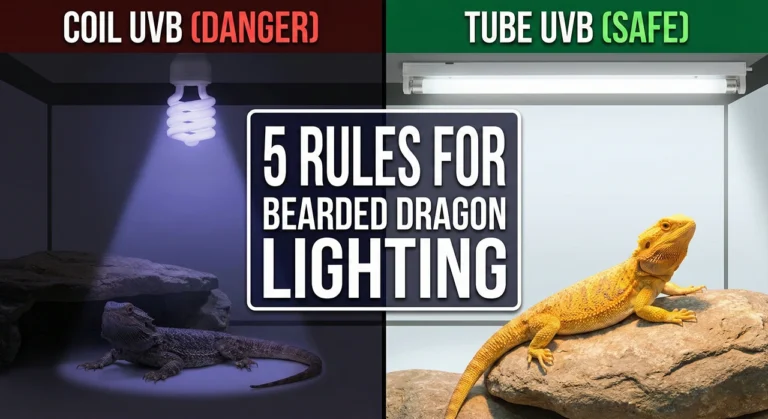
- ✅ Verify Your UVB: Coil bulbs do not work. You need a linear T5 HO tube spanning at least half the length of your enclosure.
If your daytime temperatures are off, your dragon physically cannot digest their food, regardless of how they sleep. Head over to our complete Lighting & Temp Guide right now to make sure your primary heat and UVB setup is actually up to modern veterinary standards.
Written by
Sarah ArdleySarah has kept bearded dragons for over ten years. She founded Beardie Husbandry after discovering that most mainstream care advice — including what she followed with her first dragon — was doing more harm than good. Every article on this site is grounded in veterinary research and real keeper experience.