Bearded Dragon Swollen Belly – Is It Serious
A swollen belly sends most owners straight to the worst-case scenario. I understand why. But in my experience the most dangerous moment is not the panic. It is the wait-and-see period that follows once the panic passes and the dragon still seems okay. That is where things go wrong.
A gravid female that looks alert and is still eating can be egg-bound. An impacted dragon can eat right up until the blockage becomes critical. Knowing the difference between those situations and the ones that genuinely resolve on their own is what this article is for.
When a Swollen Belly Is Completely Normal
Rule these out before investigating anything medical. Each one looks alarming to a new owner and is not.
Belly Flattening During Basking
A dragon absorbing heat spreads and flattens its body against the basking surface to maximise contact with the warmth. From the side this makes the belly appear to push outward. The dragon is alert, moving normally, and the profile returns to normal once it moves off the rock. This is not swelling.
Post-Meal Fullness
A large feeding produces visible belly bulge for several hours afterward. In a fast-growing juvenile eating heavily this can look dramatic. The belly is soft, the dragon is alert and basking normally, and the fullness reduces on its own within four to six hours. If it is still the same or worse by the following morning, it is no longer post-meal fullness.
GI Gas From Overfeeding
Gas distension looks similar to post-meal fullness but feels different. It tends to be uniformly tighter across the mid-belly rather than soft, and it does not reduce as quickly. If the swelling appeared after a heavy insect feeding and feels tight rather than soft, a warm soak and a 24-hour fast usually resolves it. Gas that does not reduce within a day is not gas.
The distinction matters because owners sometimes fast a dragon unnecessarily after normal post-meal fullness, or treat persistent gas distension as normal digestion. Soft and reduces in under six hours is post-meal. Tight and persists past 24 hours despite soaking is worth investigating further.
Defensive Puffing and Soak Puffing
A threatened dragon inflates its body briefly and deflates once the stressor is removed. Many dragons puff slightly during a warm soak, particularly during a shed cycle. Both are temporary and resolve without intervention.
How to Check the Belly at Home
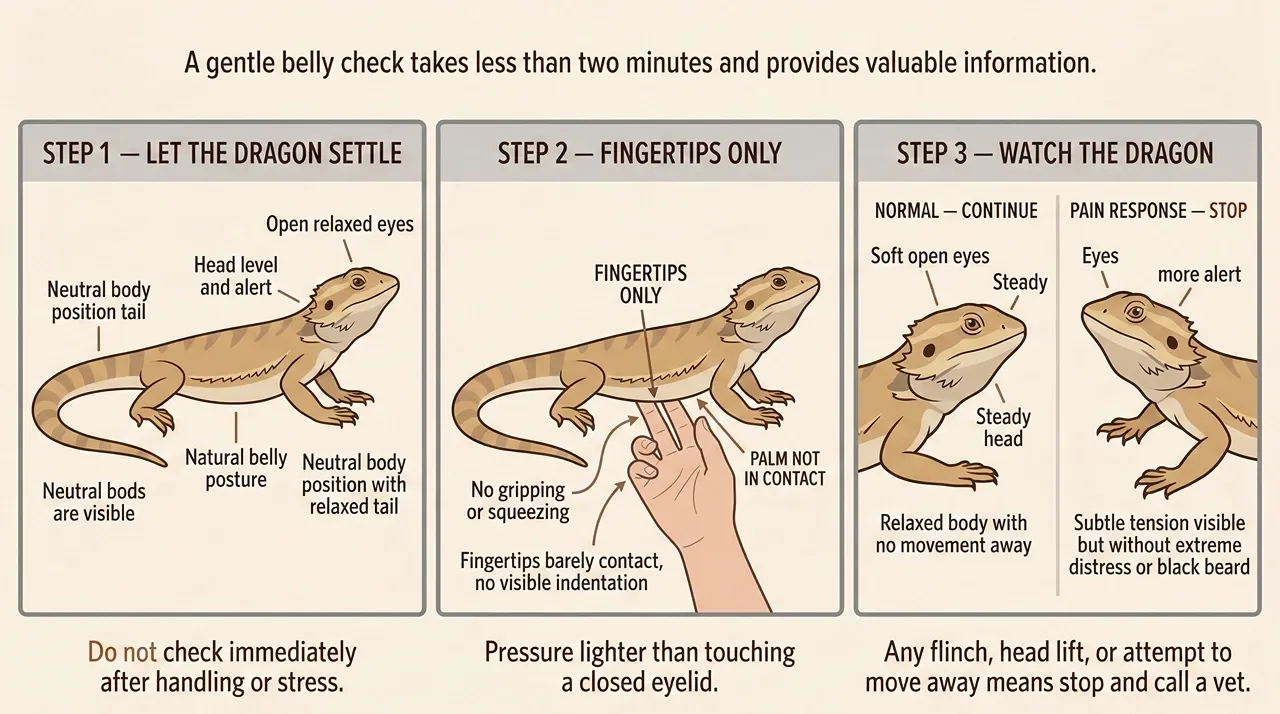
If none of the normal patterns above fit what you are seeing, a hands-on check gives you the most useful information available before any vet visit. It takes two minutes.
Step 1. Let the dragon settle on a flat surface. Do not check immediately after handling or after the dragon has been stressed.
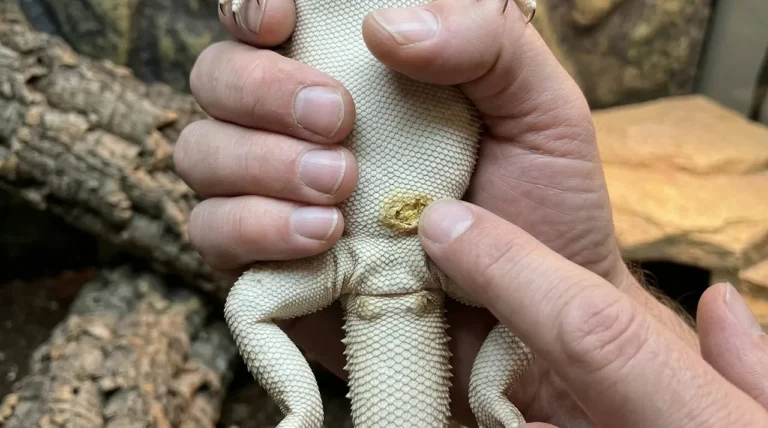
Step 2. Place your fingertips lightly along the underside of the belly. No pressure, fingertips only. You are feeling for texture.
Step 3. Watch the dragon’s face and body while you do this. Any flinching, head lifting, or attempt to move away means stop.
What Each Finding Means
| What It Feels Like | What It Points Toward | Urgency |
|---|---|---|
| Soft, uniform, yields easily | Normal or post-meal | Monitor |
| Hard and firm throughout | Impaction or gravid female | Assess further today |
| Distinct round shapes, marble-to-grape-sized | Eggs, almost certainly in a female | Provide laying box immediately |
| Uniformly tight, does not yield or shift | GI gas | Soak and fast 24 hours |
| Soft but pressure shifts when dragon is tilted | Fluid accumulation, ascites | Vet same day |
| Dragon flinches or moves away from light touch | Pain, cause unknown | Vet same day |
The Causes Worth Knowing in Detail
Gravid Female
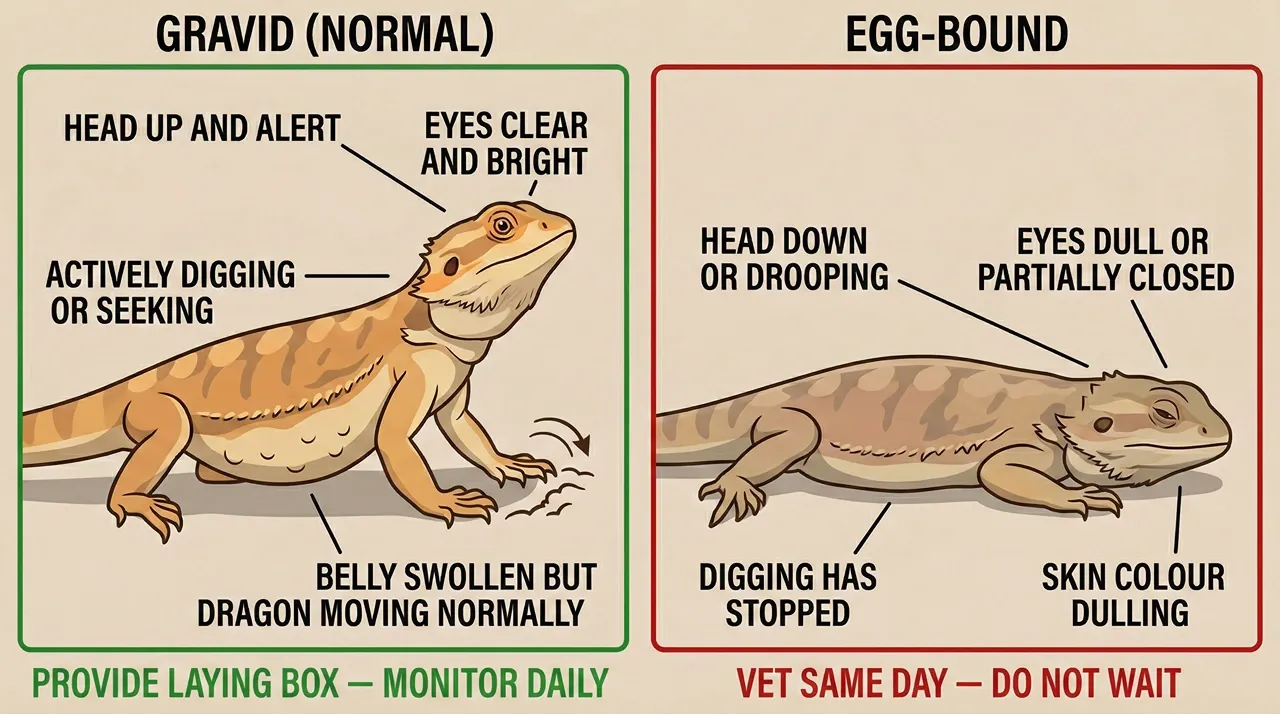
An unmated female develops a swollen belly from infertile eggs the same way a mated female does. The belly becomes lumpy with round firm shapes over one to three weeks, and she will typically begin digging. Scratching at the enclosure floor and walls, sometimes relentlessly. A female that is alert, eating, and actively seeking a place to dig is doing exactly what she should be.
Provide a laying box immediately. A container deep enough for her to fully submerge while digging, filled with moistened topsoil or play sand. Most females lay within a few days once given a suitable site, and getting the laying box right makes a real difference to whether she accepts it and lays cleanly.
The shift from normal to concerning is a behavioural one. Digging slows or stops. She goes quiet. Appetite drops. Skin colour dulls slightly. Owners often hesitate at this point because the dragon is not dramatically ill. Calling the vet at this stage is not overreacting. It is catching dystocia before it becomes a surgical emergency rather than a hormonal intervention.
Separating a normal gravid female from an egg-bound one comes down to reading the behavioural shift early. The belly itself looks similar in both cases. What changes is the activity level, the drive to dig, and the brightness of the eye.
Impaction
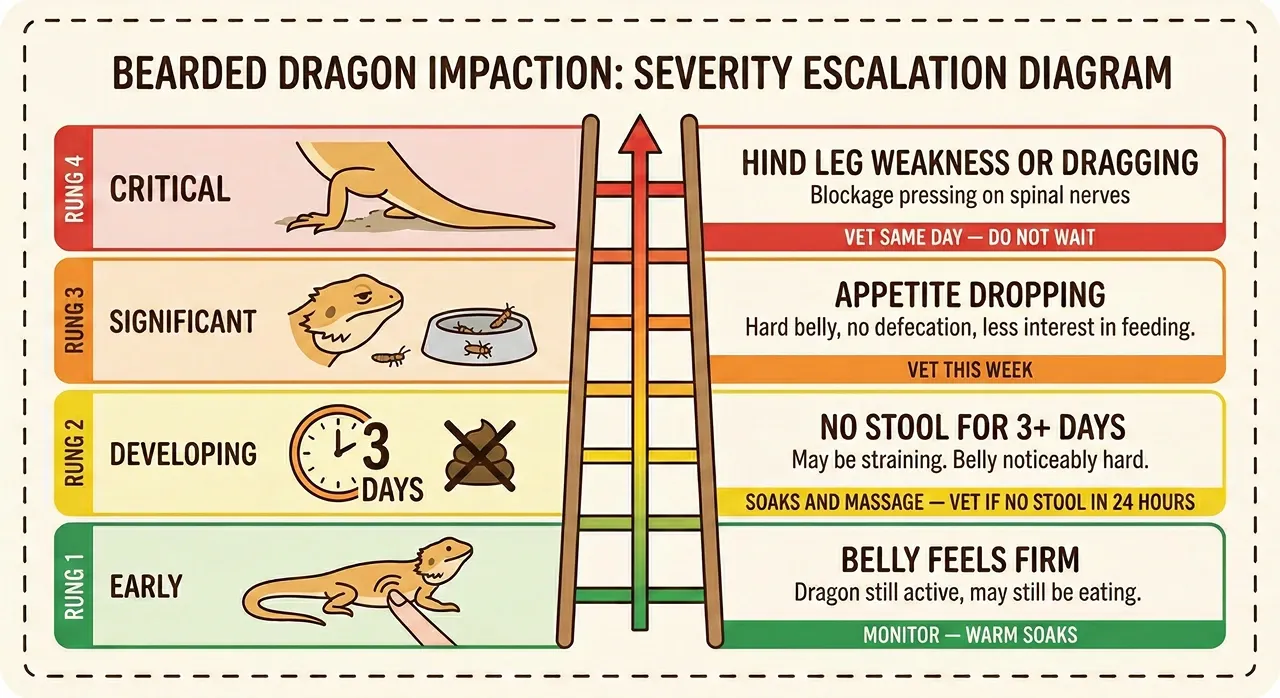
Impaction is a blockage in the digestive tract from ingested substrate, oversized feeder insects, or accumulated exoskeleton that cannot pass through the gut. The part most attentive owners miss is that the belly hardens before defecation stops. By the time a dragon has gone three days without a stool, the impaction is already well established. This is not a failure of observation. It is simply not a symptom that announces itself early.
Signs that point toward impaction, in order of escalating severity:
- Belly feels hard and resistant rather than soft
- No defecation in three or more days, or visible straining without result
- Reduced appetite alongside a firm belly
- Hind leg weakness or dragging, because the blockage is pressing on spinal nerves. This is a same-day vet situation, not something to soak through overnight
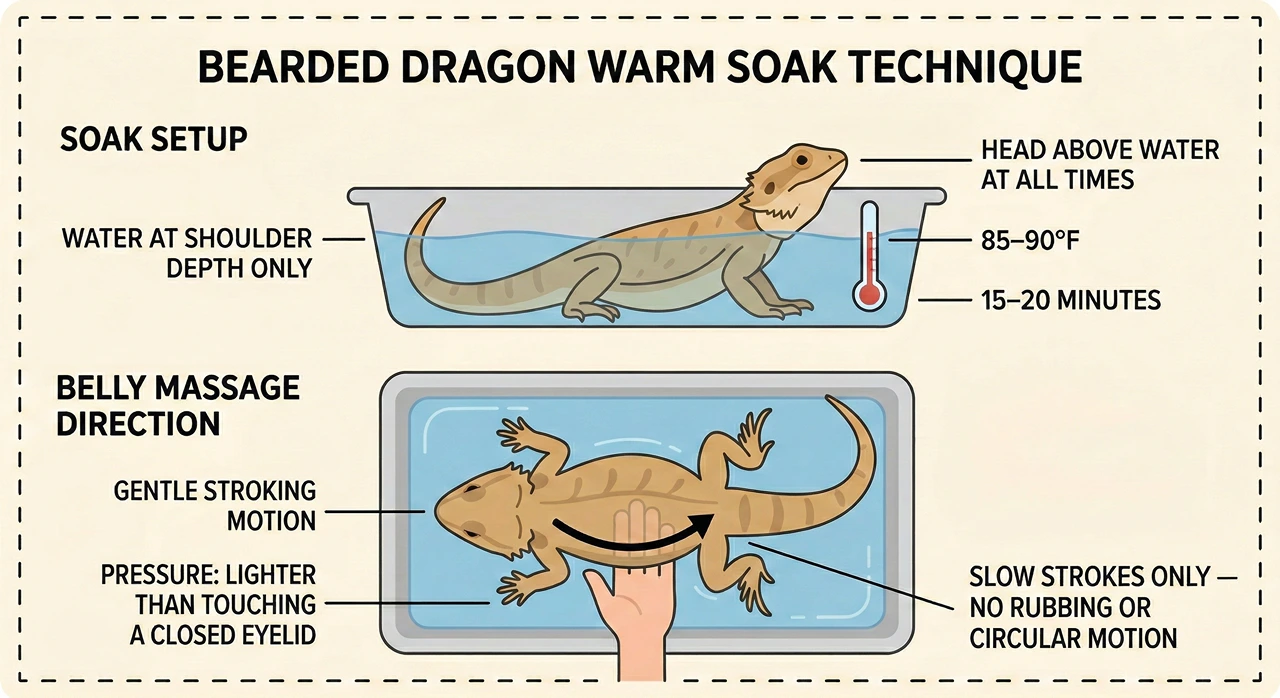
Loose particle substrates are the most common cause. Switching to safe substrate alternatives eliminates this risk before impaction becomes a recurring problem. For mild cases without hind leg involvement, warm soaks at 85 to 90°F with gentle belly massage during the soak can encourage gut movement.
The pressure should be lighter than touching a closed eyelid. Barely contact while stroking slowly from front to back toward the vent. If no stool passes after two soak sessions over 24 hours, the full impaction assessment covers when to escalate to a vet.
Parasites
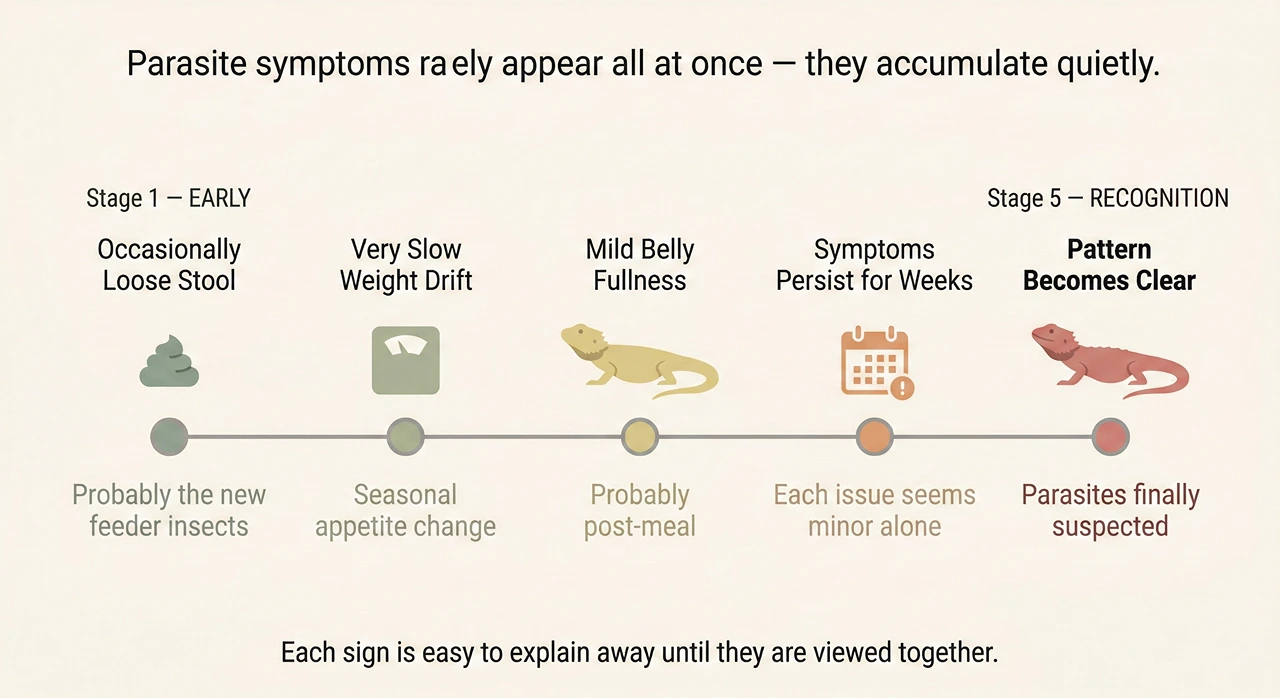
The reason parasites go undetected for so long is that the signs appear one at a time, weeks apart, and each one has a simpler explanation nearby. Stools are loose, must be the new feeder batch. Weight is drifting down, dragon is just going off food for the season. Belly looks slightly full, probably post-meal. None of those explanations are wrong in isolation. Together, over two or three months, they describe a dragon being quietly drained.
Coccidia and other protozoa irritate the gut lining and produce persistent low-level distension that does not resolve the way post-meal fullness does. It reappears consistently and the stools are foul-smelling in a way that does not match the current diet. A faecal float test specifically covering protozoa, not a standard worm-only test, will identify it.
Ascites
Ascites is fluid accumulating in the body cavity from organ dysfunction. Liver disease, kidney failure, or cardiac problems. Most owners who encounter it describe realising something had been gradually off for weeks before the belly became obviously distended. The dragon had been slightly less active, eating a little less, looking not quite right without any single symptom being dramatic enough to act on. Then the belly becomes visible.
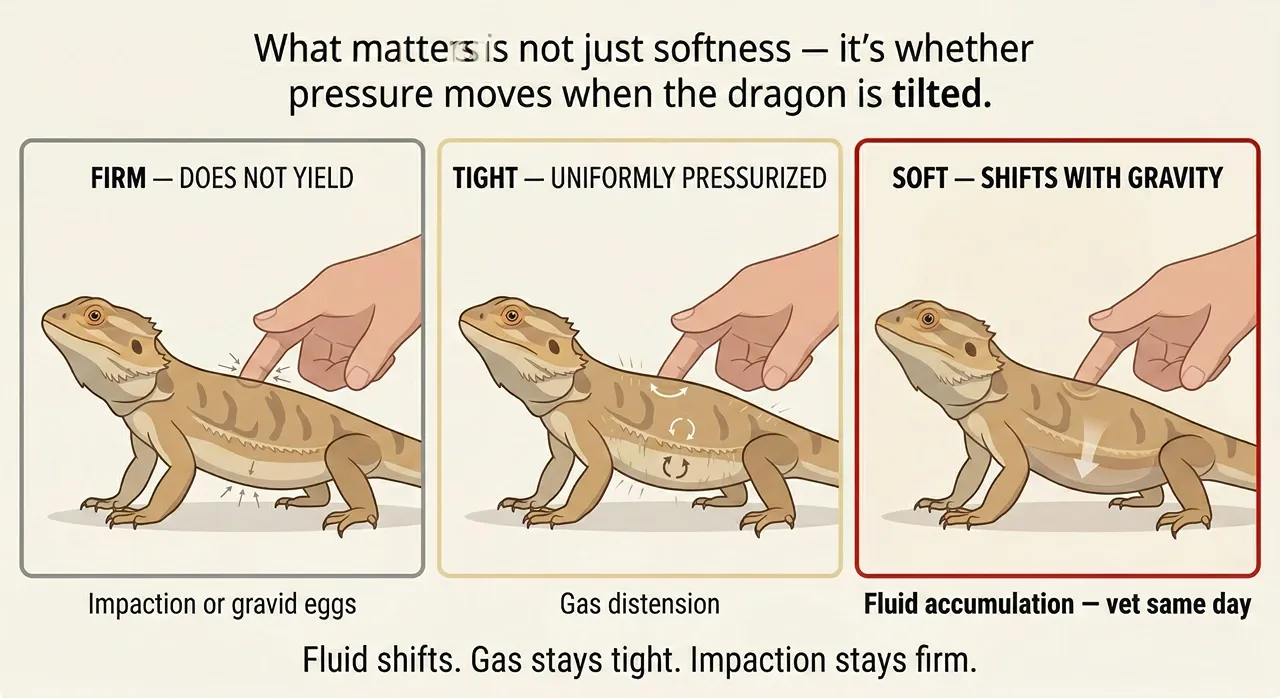
The tactile distinction from every other cause is that fluid moves with gravity. If you tilt the dragon gently and can feel the pressure shift toward the lower side, that is fluid. Gas stays uniformly tight regardless of position. Eggs feel firm and round. Impaction feels solid throughout. Fluid moves. That specific observation, pressure shifting when you change the dragon’s angle, is the clearest home indicator that this is not something a soak will address.
Respiratory Infection
Owners report this one more often than you might expect. A dragon with significant mucus pooling in the lower respiratory tract can look, from the side, like the upper belly is distended. The visual confusion happens because the ribcage-to-belly boundary is not obvious from outside the enclosure, and a chest that is fuller than normal reads as belly swelling to an owner who has not seen it before.
What separates this from an abdominal cause is location and accompaniment. The apparent swelling sits higher, toward the ribcage rather than the mid or lower belly, and the dragon will have other signs. Audible breathing, mucus at the mouth or nostrils, or a slight upward head tilt. A respiratory infection producing this level of mucus accumulation needs a vet regardless of whether belly involvement appears to be present.
Swollen Belly Quick Reference
| What You Are Seeing | Most Likely Cause | Action |
|---|---|---|
| After large meal, alert, basking normally | Post-meal fullness | Monitor. Resolves in a few hours. |
| Tight uniform swelling after heavy insect feeding | GI gas | Warm soak. Fast 24 hours. Reassess. |
| Female, lumpy belly, actively digging, alert | Gravid | Provide laying box. Monitor daily. |
| Female, digging stopped, going quiet, 48+ hours | Egg binding | Vet same day. |
| Hard belly, no stool 3+ days | Impaction | Warm soaks. Vet if no improvement in 24 hours. |
| Hard belly, hind legs weak or dragging | Severe impaction | Vet same day. |
| Persistent swelling, foul stools, slow weight loss | Parasites | Faecal float test. Vet this week. |
| Soft belly, pressure shifts when dragon tilted | Ascites | Vet same day. |
| Any swelling with pain response to light touch | Unknown, pain present | Vet same day. |
What to Do Right Now
If you have ruled out the normal causes and are still unsure, a warm soak at 85 to 90°F for 15 to 20 minutes is the right first step for almost every non-urgent scenario. It encourages defecation, supports hydration, and allows for the gentle belly massage described in the impaction section above. The full soak technique matters more than most owners realise the first time they try it.
Check the next stool carefully. Colour, consistency, and urate colour all add diagnostic detail. A dragon that passes a normal stool after a soak and whose belly then reduces was almost certainly dealing with mild impaction or gas. Understanding what each stool variation means before you interpret the result makes that assessment more reliable.
Verify basking surface temperature with an infrared gun before assuming the dragon needs medication. A surface running below 100°F slows gut motility significantly. This is one of the most consistently overlooked contributors to impaction and gas in otherwise well-managed dragons.
Frequently Asked Questions
Is a Swollen Belly Always an Emergency
Sometimes yes, sometimes no. The belly texture and the dragon’s behaviour tell you which. A pain response to light touch, pressure that shifts with gravity when you tilt the dragon, hind leg weakness, or a lethargic gravid female are all same-day vet situations. A hard belly with no stool and no pain response gives you a 24-hour window for warm soaks before escalating.
How Long Can I Wait Before Seeing a Vet
Wait 24 hours only if the dragon is alert, has no pain response to touch, and the cause appears to be impaction or gas that has not resolved after soaking. Go same day if there is any pain response, the belly feels fluid-like, the dragon is lethargic, hind legs are weak, or a gravid female has been digging for more than 48 hours without laying.
How Do I Tell If My Female Is Egg-Bound Rather Than Gravid
Watch the behaviour, not just the belly. A normal gravid female is alert, moving, and actively digging. An egg-bound female goes quiet, digging slows or stops, she becomes lethargic, and skin colour dulls slightly. If a female with a lumpy belly has been showing nesting behaviour for more than 48 hours without producing a clutch, that is the point to call a vet rather than wait another day.
My Male Dragon Has a Swollen Belly, What Is Causing It
Males cannot be gravid, so egg-related causes are off the list entirely. In a confirmed male, a swollen belly points toward impaction, parasites, GI gas, or in more serious cases, organ-related fluid accumulation. The same palpation check applies. Feel for firmness, check stool history, watch for a pain response. A hard belly with no stool in three or more days is impaction until a vet confirms otherwise.
Could the Swelling Be a Tumour
Internal masses are possible but uncommon as a first explanation, and worth keeping in proportion. The causes above account for the vast majority of belly swelling in captive dragons. A mass becomes worth considering when you have worked through all the common causes and nothing fits. The swelling is irregular and asymmetric, it does not change after soaking or defecation, and the dragon has been gradually declining over weeks. An X-ray or ultrasound is the appropriate next step at that point rather than continued home monitoring.
Disclaimer: This article is for general husbandry guidance only and does not constitute veterinary advice. A swollen belly with a pain response, hind leg weakness, fluid-feeling distension that shifts with gravity, or lethargy in a gravid female all warrant same-day contact with a qualified reptile veterinarian.
Written by
Sarah ArdleySarah has kept bearded dragons for over ten years. She founded Beardie Husbandry after discovering that most mainstream care advice — including what she followed with her first dragon — was doing more harm than good. Every article on this site is grounded in veterinary research and real keeper experience.