Bearded Dragon Escaped: What to Do Right Now
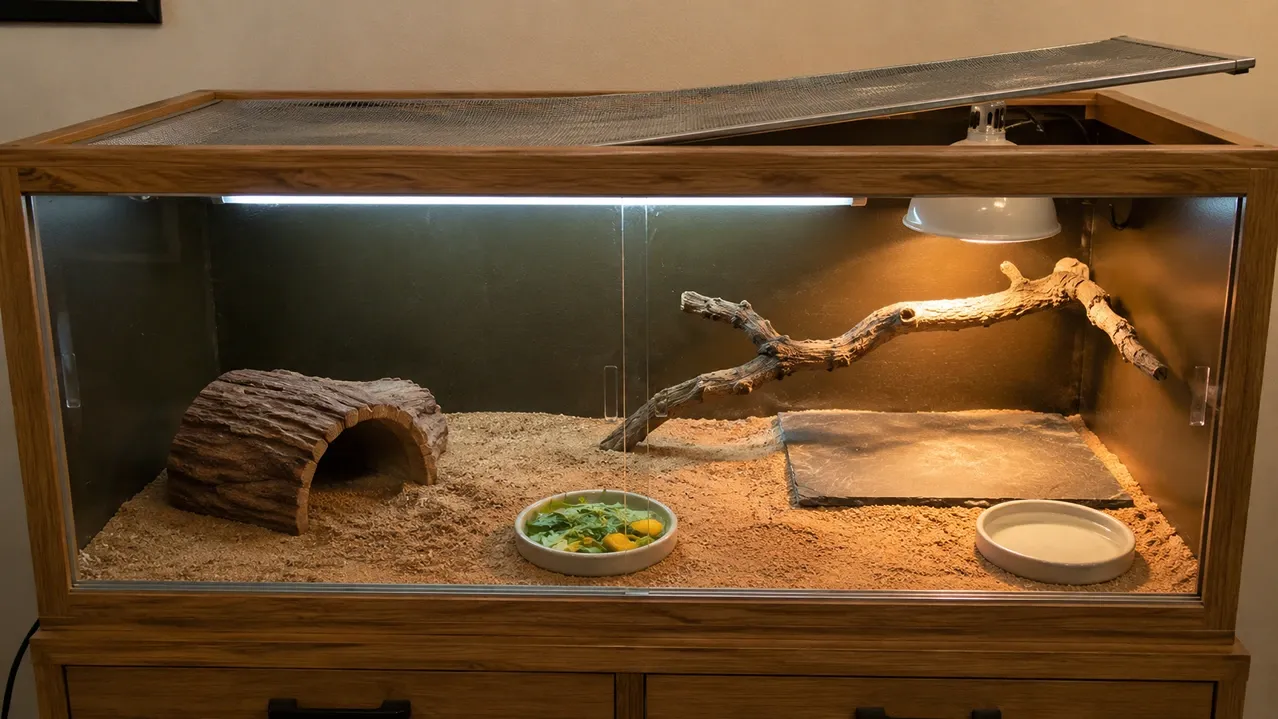
The empty tank is the worst part. You walk past, glance over, and the basking spot is empty. No movement on the cool side. No tail sticking out from under the hide. That sinking feeling when you realise your bearded dragon escaped is universal among keepers, and the good news is most escapees turn up safe within a few hours, usually within ten feet of the tank.
The first ninety minutes matter more than the next ninety days of prevention talk. Heat loss, household hazards, and other pets are the three real threats, and addressing them in the right order is the difference between a quick recovery and a genuine emergency.
This is the playbook keepers actually use when a dragon goes missing indoors, plus what changes if they made it outside.
First Things to Do in the First Ten Minutes
Before you start lifting cushions, you need to make the house safer than it was two minutes ago. A panicked search can scare a hiding dragon deeper into a spot you will never find.
Shut Down the Immediate Hazards
Close every external door and window. Block the gap under doors with a rolled towel if there is one. A bearded dragon can fit through a surprisingly narrow gap when motivated.
Lock cats and dogs in a separate room immediately. Other pets are the single biggest indoor risk to an escaped beardie, and a curious cat does not need to be aggressive to cause serious injury.
Turn off any ceiling fans. Unplug heaters and stovetops if they are within reach of floor level. Check that the toilet lid is down in every bathroom on the same floor.
Stop and Listen for Thirty Seconds
Stand in the room where the tank is. Turn off the TV, music, washing machine. Listen. Bearded dragons make scratching sounds against hardwood, tile, and cardboard that carry surprisingly well in a quiet room.
You may also hear claws on carpet under furniture. This thirty seconds of silence has located more dragons than any search routine.
Where Beardies Actually Hide Inside
Bearded dragons are ground-dwellers with a strong instinct to find tight, dark, warm spaces. They are not climbing the curtains. They are wedged somewhere you have to get on your hands and knees to see.
Start in the room with the tank and work outward. Roughly 80% of indoor escapees are found in the same room they escaped from, often within six feet of the enclosure.
The Top Ten Hiding Spots
- Under and behind the tank stand itself
- Under the bed, pressed against the wall or a leg
- Behind or under the sofa, especially against the back cushions
- Inside open closets, behind shoes or low-hanging clothes
- Behind books on the lowest shelf of a bookcase
- Inside or behind laundry baskets and piles of clothes
- Under or behind the fridge, washing machine, or dryer
- Inside boots, slippers, or any footwear left on the floor
- Behind or inside cardboard boxes and storage bins
- Pressed flat against a wall in a narrow gap between furniture
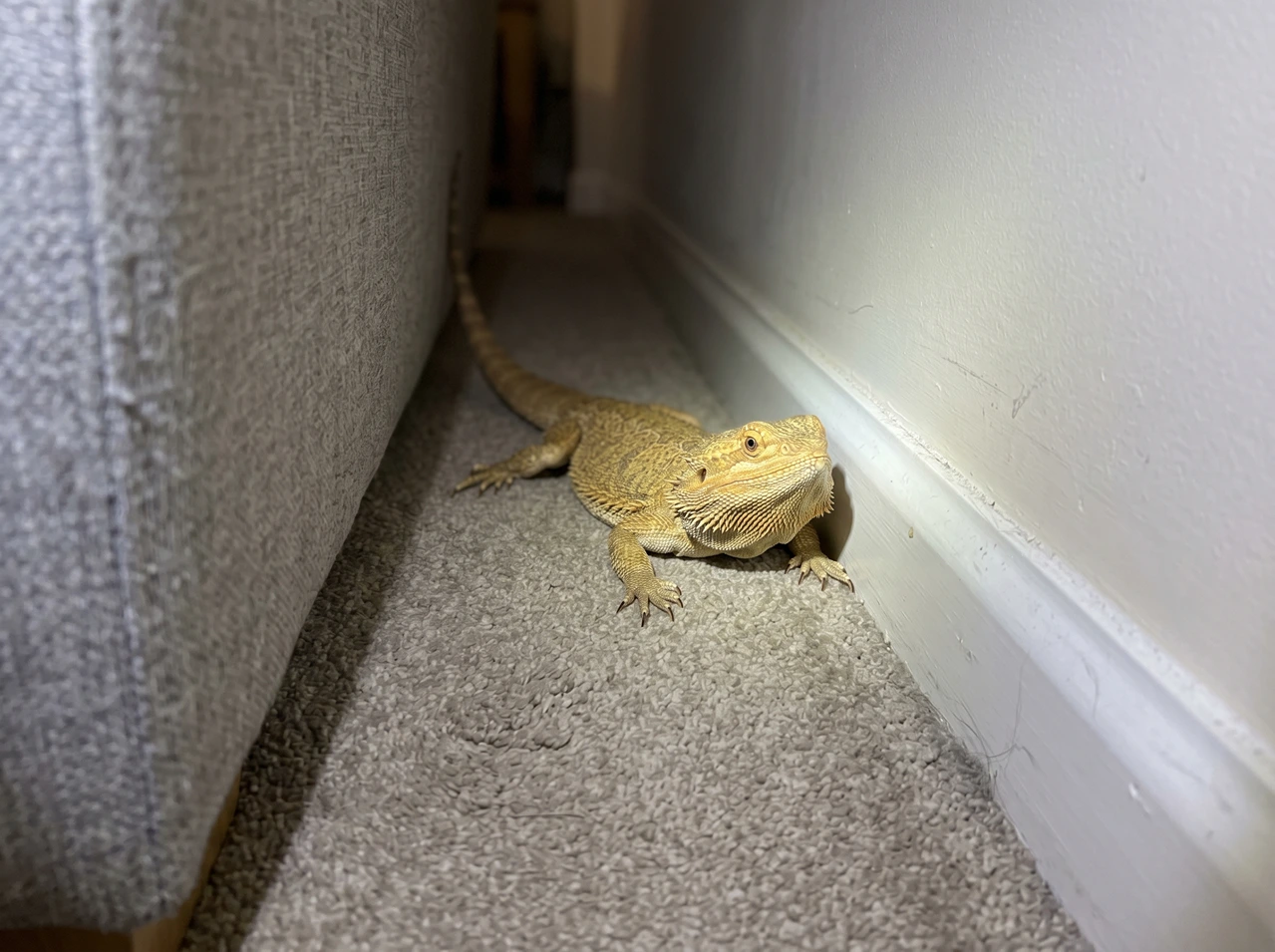
Use a flashlight even in a well-lit room. Their eyes reflect a faint pink-orange in torchlight, which is often the first thing you spot before you see the dragon itself.
The Warm-Spot Rule
An escaped dragon is losing body heat by the minute. They gravitate toward the warmest spots they can find, which means checking near radiators, behind the fridge motor, on top of running electronics, and along sun-warmed floors near windows.
In a cool house, this instinct is your biggest advantage. They will move toward heat, not away from it.
How Long Can a Bearded Dragon Survive Outside the Tank
This is the question every panicked owner asks, and the honest answer depends entirely on your room temperature.
| Ambient temperature | Safe time window | What to expect |
|---|---|---|
| Above 75°F (24°C) | 24–48 hours | Slowed but functional; will hide and conserve heat |
| 65–75°F (18–24°C) | 12–24 hours | Sluggish; metabolism dropping; will not move much |
| 55–65°F (13–18°C) | 6–12 hours | Near torpid; respiratory infection risk climbs sharply |
| Below 55°F (13°C) | Under 6 hours | Hypothermia risk; emergency warming needed on recovery |
These windows assume a healthy adult. Babies and juveniles lose heat faster because of surface-area-to-volume ratio, and a sick or freshly fed dragon has less reserve.
If your house is sitting at around 70°F overnight, a dragon missing for ten hours is uncomfortable but almost certainly fine. The same dragon missing for ten hours in a 55°F basement is a different situation.
The Bait Method That Actually Works
If a methodical search has not turned anything up within an hour, switch tactics. A hungry beardie will come to you if you create the right conditions.
Pick the room you suspect they are in. Close the door. Place a shallow dish of warm water and a few live crickets or hornworms on a plate in the middle of the floor.
Then leave the room. Bearded dragons will not approach food with a person standing over them, but a quiet room with movement on the floor is irresistible to a hungry one.
Check back every twenty minutes. Many keepers find their dragon either on the plate or within a foot of it within the first hour of trying this method.
What to Do If You Find Them
Resist the urge to grab. A cold, scared dragon that has been hiding for hours is not the same dragon you handled yesterday, and a fast grab is the fastest way to get bitten or to startle them into bolting again.
Approach slowly. Slide one hand under the chest and the other under the belly. Lift them in one smooth motion. The same technique used in calm handling sessions applies here, just slower.
Do not put them straight back under the basking lamp. A dragon that has dropped to room temperature for hours needs gradual rewarming, not a 100°F blast.
The Rewarming Sequence
- Place them on a warm towel in a quiet room for fifteen minutes
- Move them into the cool end of the enclosure for another thirty minutes
- Allow them to walk to the basking spot on their own
- Offer warm water from a shallow dish or by dropper
- Skip food for the rest of the day; offer normally tomorrow
Watch their breathing closely for the next 48 hours. Clicking, mucus around the nose, or open-mouth breathing at rest are early warning signs of a cold-triggered respiratory infection, which is the most common health fallout from a prolonged escape.
If Your Bearded Dragon Got Outside
Outdoor escapes change the entire calculation. The risks shift from hiding spots to predators, traffic, temperature extremes, and the simple fact that an animal coloured like dry grass is very hard to see in a garden.
Search the Last Known Direction
Beardies do not wander randomly outdoors. They move toward warmth and cover, usually along a wall or fence line. Start the search hugging the edge of the building they escaped from.
Check sun-warmed concrete, paving stones, the base of south-facing walls, and the inside of any potted plants. They will flatten themselves against warm surfaces and become almost invisible.
The Time of Day Matters
Search at dawn and mid-morning, not midday. A dragon that spent the night outside will move into early sunlight to warm up before becoming active. Mid-morning, between roughly 9am and 11am, is when they are most exposed and easiest to spot.
If they have been out overnight in temperatures below 60°F, expand the search to sheltered spots. Look under porches, inside garages with cracked doors, beneath outdoor furniture cushions, and inside coiled hose pipes.
When to Bring Neighbours In
If a thorough search of your immediate property turns up nothing after a few hours, knock on the doors of the houses directly adjacent. Most outdoor escapees are found within two gardens of their starting point.
Post on local community groups with a clear photo and the time they went missing. A surprising number of bearded dragons are recovered because a neighbour spotted what they assumed was a child’s toy on a patio.
Why Bearded Dragons Escape in the First Place
Most escapes trace back to one of three causes, and recognising the pattern tells you how to prevent the next one.
The first is an unsecured lid. Glass tanks with mesh tops that just rest in place are easy to push up from inside, especially by a determined adult. Lid clips solve this for under ten dollars.
The second is climbing furniture. Tall hides, stacked rocks, or branches that reach within a few inches of the lid give the dragon enough leverage to push and slip out. The fix is rearranging decor, not adding more locks.
The third is hormonal restlessness, which is most common in spring. A male in peak breeding behaviour will glass-surf, dig at substrate, and push at every weak point in the enclosure for weeks at a time. Females driven by egg-laying instinct behave the same way.
This is not bad behaviour. It is biology, and it is your cue to upgrade containment before it becomes a problem.
Preventing the Next Escape
Once you have your dragon back, the prevention work is straightforward and worth doing the same day.
- Install lid clips or weights on every removable panel of the enclosure
- Move climbing decor at least four inches below the lid line
- Inspect the back of the tank for gaps where cables enter
- Check screen tops for any tears, especially in older mesh
- Never leave the tank open while you walk into another room, even for a minute
- If you free-roam your dragon, do it in one room with the door shut and floor-level gaps blocked
Free-roaming is where most escapes happen, not from the tank itself. A dragon under furniture during free-roam can stay there for the rest of the day if you turn your back at the wrong moment.
FAQ
How long can a bearded dragon survive outside its tank?
A healthy adult can manage 24–48 hours indoors at normal room temperature without lasting harm. The window shrinks sharply below 65°F, and outdoor survival in cold conditions can be as short as a few hours.
Do bearded dragons come back on their own?
Sometimes, especially if they are hungry and the tank lamp is on as a familiar warm cue. Many keepers report finding their dragon back near the open enclosure within a day, drawn to the heat source they remember.
Will my bearded dragon find food on its own?
Indoors, no. There is nothing safe for them to eat in a typical house, and pesticide-treated plants are a real risk. Outdoors they may catch insects, but this is not reliable nutrition and dehydration sets in faster than hunger.
Should I leave the tank open in case my dragon comes back?
Yes. Leave the basking lamp on, the door of the enclosure open, and a shallow water dish on the floor in front of it. The combination of warmth, light, and water is the strongest draw for a returning dragon.
Can a bearded dragon survive outside overnight?
It depends entirely on the overnight low. Above 65°F most healthy adults will be fine for one night. Below 55°F the risk of hypothermia and respiratory infection becomes serious, and a vet check is warranted on recovery.
Your First-Hour Action Checklist
- Close all external doors, windows, and gaps under doors immediately
- Confine cats, dogs, and any other pets to a separate room
- Turn off ceiling fans; check that toilet lids are down
- Stand silent for thirty seconds and listen for scratching
- Search the tank room first, working floor-level with a flashlight
- Check the top ten hiding spots in order, starting under the tank stand
- Set up a bait station with crickets, warm water, and a heat pad if no luck within an hour
- Leave the tank open with the basking lamp on as a returning beacon
- If outdoor escape is possible, search building edges and sun-warmed surfaces between 9am and 11am
- On recovery, rewarm gradually and monitor breathing for 48 hours
Written by
Sarah ArdleySarah has kept bearded dragons for over ten years. She founded Beardie Husbandry after discovering that most mainstream care advice — including what she followed with her first dragon — was doing more harm than good. Every article on this site is grounded in veterinary research and real keeper experience.