How to Tell How Old Your Bearded Dragon Is
A rescue with no paperwork. A pet-shop dragon sold vaguely as “a few months old.” A hand-me-down from a friend who never wrote anything down. These are the dragons whose age nobody actually knows.
If you are asking how old is my bearded dragon, the honest answer is that you can estimate it, not confirm it. Only the breeder who watched it hatch holds the real date.
What you can do is read the signals. Size, sexual maturity, the wear on its body, and its daily behaviour each tell you part of the story.
Read together, they usually place a healthy dragon within a year or two. That is accurate enough to feed, light, and house it correctly.
How Old Is My Bearded Dragon, Really
Growth is the only signal that behaves like a clock, and that clock stops early. A bearded dragon does almost all of its growing in the first twelve months, then fills out slowly until somewhere around eighteen months to two years.
After that the clock effectively stops. A four-year-old and an eight-year-old can look almost identical on a tape measure. This is exactly where every size chart online quietly gives up.
So the question how old is my bearded dragon gets harder, not easier, as the animal ages. While it is still clearly growing you have a usable window, and comparing it against the expected length for each age narrows things down fast.
Once growth plateaus, that window closes. From there you switch to reading wear and behaviour instead of reaching for a tape measure.
What Size Tells You Before 12 Months
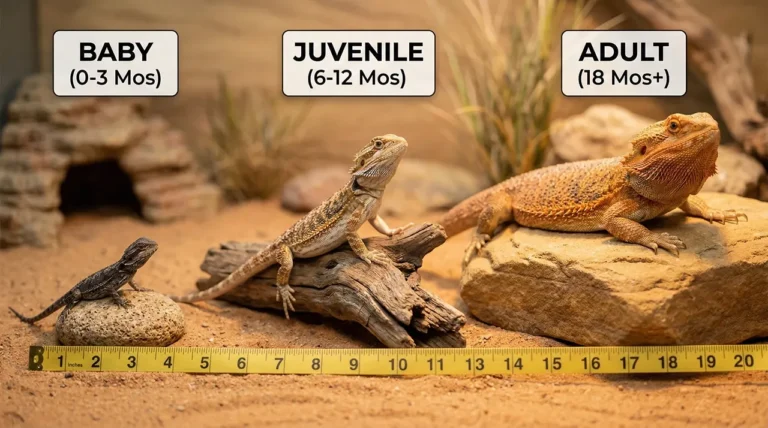
Under a year, length is your most reliable single clue. A hatchling measures roughly three to four inches nose to tail, and that figure climbs quickly through the first few months. The table below gives the bands keepers actually see, rather than perfect lab numbers.
| Age | Typical length (nose to tail) | What it tells you |
|---|---|---|
| 0 to 1 month | 3 to 4 in (8 to 10 cm) | Fresh hatchling, delicate with an oversized head |
| 2 to 3 months | 5 to 11 in (13 to 28 cm) | Fast growth, often doubling month to month |
| 4 to 6 months | 11 to 18 in (28 to 46 cm) | Juvenile, still gaining length most weeks |
| 8 to 12 months | 16 to 22 in (41 to 56 cm) | Near adult size, growth clearly slowing |
| 18 months plus | 16 to 24 in (41 to 61 cm) | Fully grown, length no longer ages the dragon |
How to Measure Your Dragon Properly
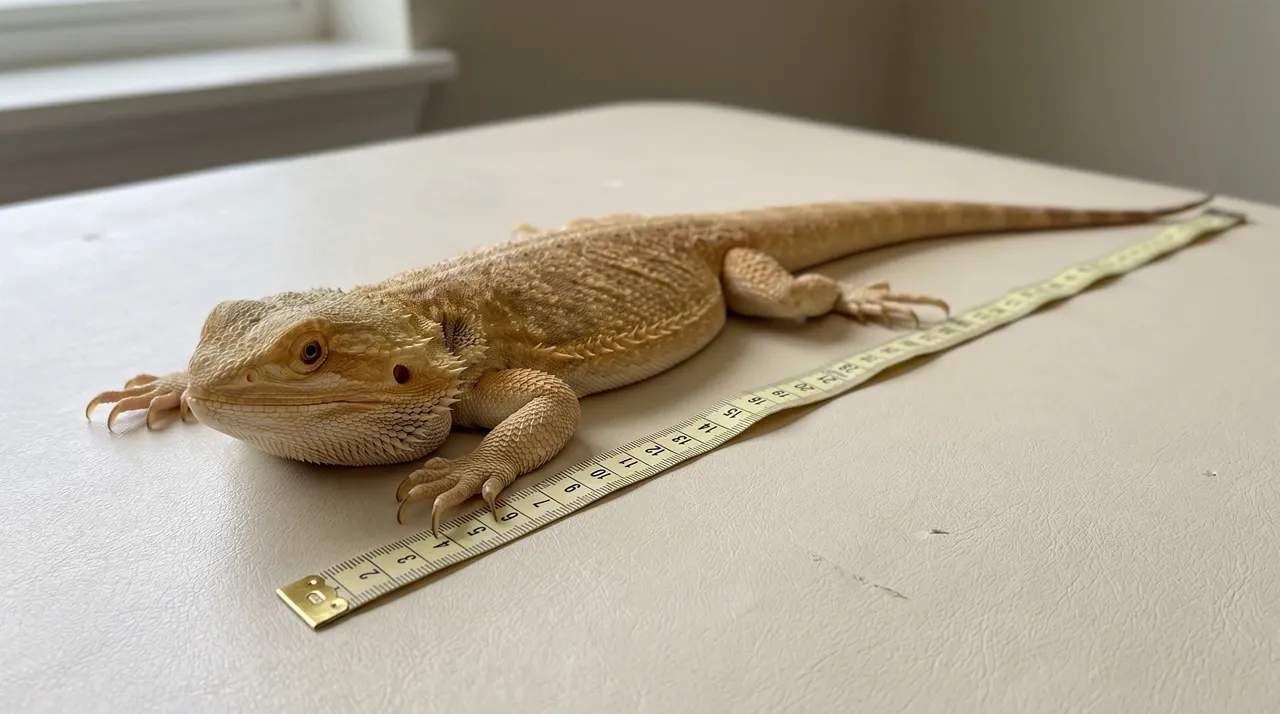
Measure nose to the tip of the tail, not nose to vent, with the dragon stretched out flat. A soft tape laid alongside a relaxed dragon works far better than trying to pin a wriggling one against a hard ruler.
One thing throws this off more than people expect. A tail that was bitten, dropped, or healed badly will read short, and bearded dragons do not regrow tails cleanly the way some lizards do.
A damaged tail can make a grown adult measure like a juvenile. When the tail looks wrong, trust the size of the body and head over the total length.
When the Chart Will Lie to You
Length only tracks age when a dragon has been kept properly. Poor lighting, a cold enclosure, or a thin diet stunts growth, and a stunted dragon stays small for the rest of its life.
That breaks the chart in one direction only. A dragon raised on bad husbandry can be two years old and still measure like a six-month-old, so size makes it look far younger than it is.
Sexual Maturity Sets a Hard Floor
Maturity gives you a floor, not a ceiling. It tells you the dragon is at least a certain age, without capping how old it might be.
Captive dragons often show the first signs from around eight to twelve months, while full maturity usually settles between one and two years. A clearly mature dragon is therefore past its first birthday for practical purposes.
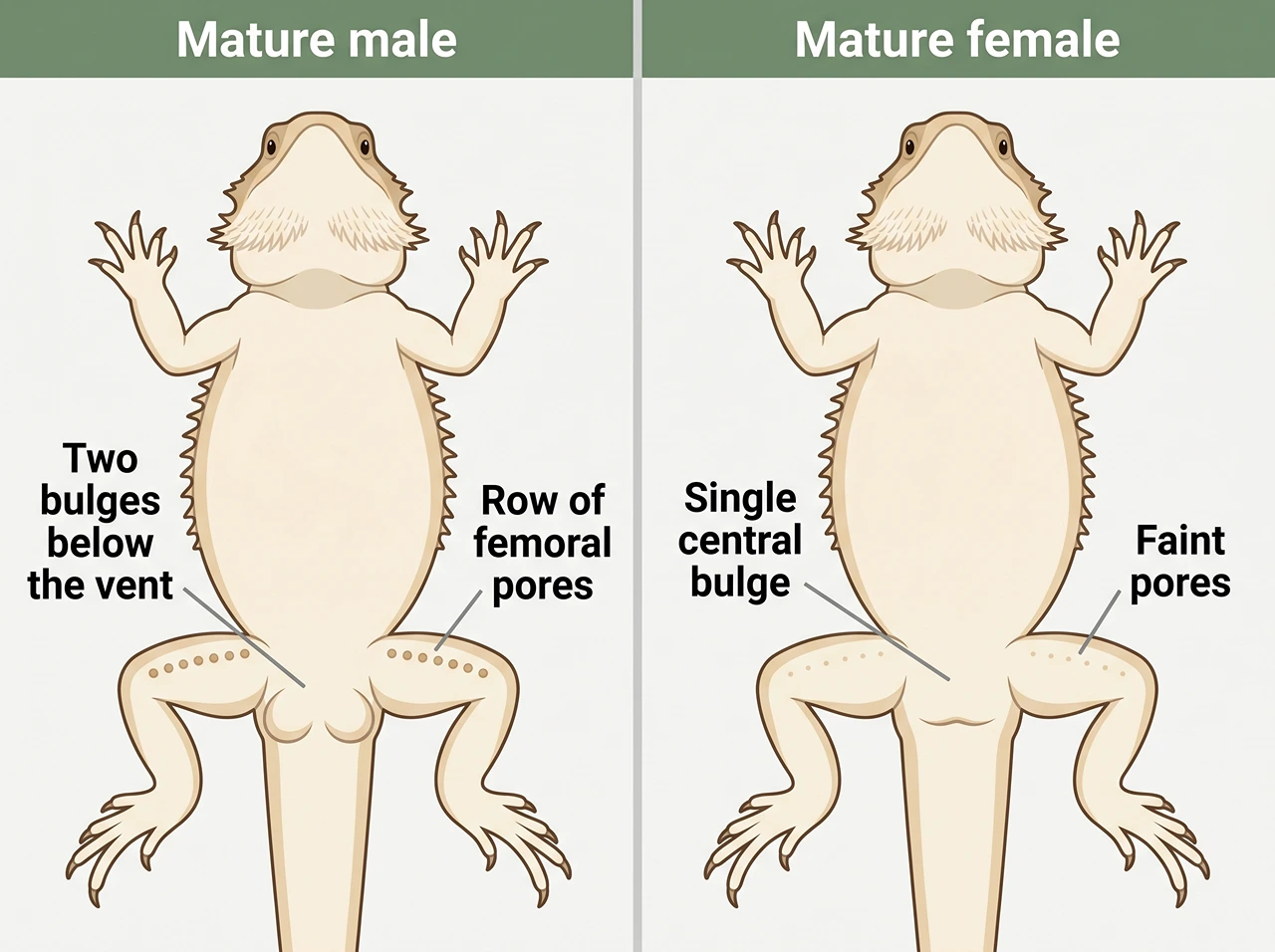
You read maturity the same way you sex a dragon. Males show two bulges below the vent with prominent femoral pores, while females show a single central bulge, the same anatomy used for telling males from females.
No bulges at all usually points to a young animal still under six to eight months.
How to Age a Grown Bearded Dragon
This is the part every competing article skips. Once a dragon is fully grown, asking how old is my bearded dragon stops being a measuring problem, because size has nothing left to tell you.
So you read the body for wear instead. No single sign is exact, which is why you stack several and settle on a band rather than a birthday.
An Old Dragon Wears Its Age
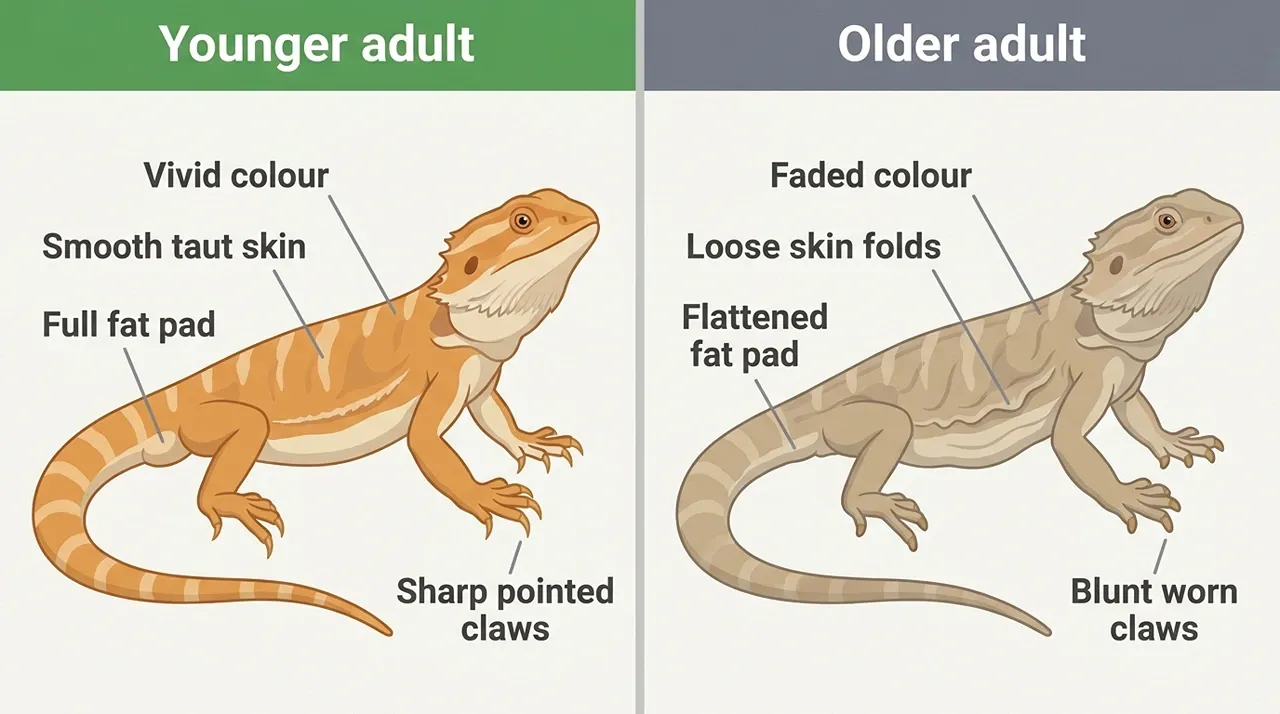
Claws are the quickest tell. On an older dragon they blunt and thicken from years of walking, unless someone has been trimming them, while a young adult keeps finer, sharper points.
Skin and fat tell the rest. A young adult looks smooth and plump, with a full pad at the base of the tail and over the head. An older dragon carries looser skin, flatter fat pads, and a slightly sunken look even at a healthy weight.
Why Older Dragons Look Washed Out
Colour fades with age. The sharp oranges and reds of a young adult dull over the years into something flatter and more muted, even in a well-kept dragon.
Behaviour shifts alongside the colour. Older dragons tend to bask more, roam less, and settle into longer naps, which is when looking after a senior starts to matter more than pinning down its exact age.
Brumation Turns Into a Yearly Clock
Hatchlings rarely brumate, and they should not be encouraged to. A dragon that reliably settles into brumation each winter is almost certainly past its first year, and the longer that pattern has been running, the older it tends to be.
Can a Vet Tell You the Age
A reptile vet helps most with young dragons. An X-ray can show the open growth plates that confirm an animal is still developing. For a fully grown adult, even a good vet is estimating from the same wear signs you can see at home.
That does not make the visit pointless. Booking time with a reptile-experienced vet gives you a baseline weight and overall health read.
That baseline shapes care far more than an exact number ever will, especially measured against how long they live.
Aim for a Range Not a Number
No single signal is enough on its own. You combine them, let them agree or disagree, and land on the tightest band the evidence supports.
| What you observe | What it points to |
|---|---|
| Still visibly growing | Under about 12 months |
| Sexual maturity present | At least 8 to 12 months |
| Length near 20 inches, growth stopped | Adult, but no precise age |
| Sharp colour, smooth skin, plump base | Younger adult, roughly 1 to 3 years |
| Faded colour, loose skin, worn claws | Older adult, likely 4 years or more |
| Reliable yearly brumation | Mature, at least a year and often older |
Ask how old is my bearded dragon and you want a single number. The realistic deliverable is a season and a year, give or take twelve months, and for everyday care that is all you actually need.
Frequently Asked Questions
How old is my bearded dragon if it has stopped growing?
It is almost certainly an adult, which means at least eighteen months. Past that point length cannot separate a two-year-old from an eight-year-old, so you read claw wear, skin condition, and colour to narrow it down.
Can you tell a bearded dragon’s age by size alone?
Only under twelve months, and only if it was raised properly. A stunted dragon stays small for life, so size can make a poorly kept adult look like a baby.
At what age is a bearded dragon fully grown?
Most reach near-full length by twelve months and finish filling out by eighteen months to two years. After that, weight may change but length holds steady.
Do bearded dragons keep growing their whole life?
No. Unlike some reptiles, they stop growing once they mature, usually by two years. A dragon that is still gaining length is young, full stop.
Does a vet know exactly how old a dragon is?
Not for an adult. A vet can confirm a young dragon is still growing through an X-ray, but for a grown adult they estimate from the same physical signs you can read yourself.
What to Do With Your Best Guess
You may never pin how old is my bearded dragon to the exact month, and for everyday care that does not matter. Your dragon does not care what the calendar says.
It cares whether the care it gets matches its life stage, and the signals above tell you that stage without a birth date.
Treat a still-growing dragon as a juvenile with the protein and feeding frequency that suits one. Treat a worn, faded, slowing dragon as a senior and adjust accordingly. A confident range beats a wrong number every time.
Written by
Sarah ArdleySarah has kept bearded dragons for over ten years. She founded Beardie Husbandry after discovering that most mainstream care advice — including what she followed with her first dragon — was doing more harm than good. Every article on this site is grounded in veterinary research and real keeper experience.